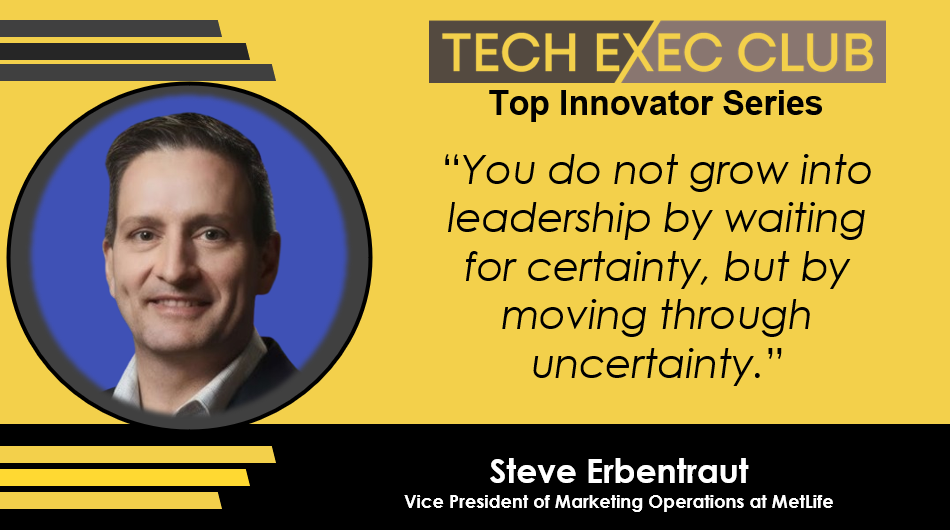
In a business world shaped by digital transformation, artificial intelligence, and constant disruption, leadership growth no longer comes from staying in one lane. It comes from curiosity, courage, and the willingness to understand how technology connects to real business outcomes. That is exactly what makes Steve Erbentraut’s leadership journey so compelling.
Now serving as VP of Marketing Operations at MetLife, Steve Erbentraut brings an unusual and highly relevant perspective to modern leadership. Trained in computer science and shaped by years in software, data, and technology consulting, he built his career by stepping into messy problems, pursuing unconventional opportunities, and learning the business behind the systems. His path from engineering into marketing operations is not only rare, but increasingly important in an era where technology leaders are expected to think like product owners, business partners, and strategic operators.
In this Top Innovators conversation with Josef Martens, Steve shares practical leadership lessons on career growth, risk-taking, AI, mentorship, and the future of technology leadership. His story offers a powerful blueprint for professionals who want to lead with greater impact in today’s fast-changing business environment.
Why the Road Less Traveled Created Steve Erbentraut’s Early Leadership Advantage
One of the clearest themes in Steve Erbentraut’s leadership story is that career growth often begins where others hesitate to go. Early in his career, after earning a computer science degree and entering the software world, he found himself working on difficult data conversions and integrations at BlackBaud. It was not glamorous work. It was messy, undefined, and far from the obvious path that most people on his team preferred. Yet Steve saw something others missed: hidden opportunity.
While much of the team focused on flagship products and established systems, Steve deliberately raised his hand for the harder assignments. He stepped into the ugly conversions, the niche integrations, and the fast-changing work that did not yet have a playbook. That decision gave him something incredibly valuable early on: leadership exposure. Even before becoming a formal manager, he developed expertise, took ownership, and began guiding others.
This part of Steve Erbentraut’s journey offers a powerful lesson for leadership development. The fastest path to growth is not always the safest or most popular one. Sometimes it is the path with the least structure and the most uncertainty. By choosing the road less traveled, Steve did not just build technical skills. He built trust, visibility, and leadership momentum that would shape the rest of his career.
How Curiosity and Comfort with Messy Problems Shaped a Modern Leader
If there is one personal trait that runs through Steve Erbentraut’s career, it is curiosity. He describes himself as someone with an insatiable appetite for learning, someone who genuinely enjoys figuring out how things work. That mindset did more than make him intellectually engaged. It gave him an edge in leadership. Curiosity pushed him toward challenges that other people avoided, especially in environments that were messy, ambiguous, and still taking shape.
For Steve, uncharted territory was never just a risk. It was also an invitation. He found excitement in building systems and processes in spaces that lacked structure. That entrepreneurial energy became a defining part of his professional identity, even while working inside large corporate environments. Rather than waiting for perfect clarity, he leaned into uncertainty and treated it as a chance to create order, shape outcomes, and learn faster than those around him.
This is what makes Steve Erbentraut’s leadership perspective so relevant for today’s business environment. Modern organizations need leaders who are not paralyzed by ambiguity. They need people who can step into complexity, ask better questions, and move forward without having every answer upfront. Steve’s example shows that curiosity is not a soft trait. It is a strategic advantage. In a world of constant disruption, the leaders who keep learning are often the leaders who keep growing.
Why Technology Leaders Must Understand the Business, Not Just the Tools
A major turning point in Steve Erbentraut’s career came when he recognized a gap that many technologists never fully bridge. He saw that great engineering alone was not enough. As software became more widespread and technology matured, the real differentiator was no longer just technical skill. It was the ability to understand the business behind the systems.
Steve noticed a recurring pattern in the technology world. Many engineers were highly capable builders, but too often they operated as order takers. They gathered requirements, completed the assignment, and moved on without developing a deeper understanding of what the business was actually trying to achieve. Steve took a different path. He became increasingly interested in the end user, the business domain, and the goals driving the work. That shift is what eventually pulled him deeper into marketing and, ultimately, into a major leadership role at MetLife.
His message for today’s technology leaders is both timely and practical. In a world where software development is accelerating and AI is making execution faster, technical expertise alone is becoming less rare. The real value now comes from product thinking, business fluency, and the ability to connect technology decisions to commercial outcomes. Steve Erbentraut’s career proves that when technology leaders understand the business, they stop being support functions and start becoming strategic partners.
How Mentorship Taught Steve Erbentraut to Lead Through Uncertainty and Risk
Steve Erbentraut’s leadership style was not shaped by experience alone. It was also shaped by mentorship. One of the most influential figures in his career was a former CTO who challenged Steve’s engineering instincts in ways that initially made him uncomfortable. Coming from a rigorous technical mindset, Steve naturally wanted more planning, more control, and more certainty before moving forward. His mentor operated differently.
This leader was highly customer-facing, entrepreneurial, and comfortable selling ideas before every detail had been fully engineered. To Steve, that felt risky. It created tension between the impulse to perfect the solution and the need to move quickly, create momentum, and win business. Over time, however, Steve came to see the deeper value in that approach. He realized that executive leadership often requires the confidence to move without complete certainty and the ability to shape opportunity before everything is fully formed.
That lesson became increasingly important as Steve’s own responsibilities expanded. As he moved into more senior leadership roles, he had to think beyond technical execution and embrace growth, business development, and strategic risk-taking. This mentorship experience taught him that uncertainty is not always a problem to eliminate. Sometimes it is the environment leaders must learn to navigate. In today’s volatile market, that ability is not optional. It is one of the defining traits of effective leadership.
What AI Means for the Future of Technology Leadership and Human Expertise
Steve Erbentraut offers a balanced and highly practical view of artificial intelligence, and that makes his perspective especially valuable in today’s leadership conversation. He does not buy into the extreme idea that AI will simply replace all human expertise. At the same time, he also rejects the complacent belief that nothing meaningful is changing. Instead, he sees AI as a powerful magnifier that is reshaping how technology work gets done and how leaders need to think.
According to Steve, the role of the software engineer is already evolving. As coding and development become faster and more accessible, the value of technical professionals will increasingly depend on their ability to act as orchestrators, architects, and business-minded problem solvers. In other words, the future belongs less to the order taker and more to the strategic builder who understands where human judgment still matters most.
He also believes technology leaders have a responsibility to communicate clearly about AI across the organization. The market is full of hype, fear, and confusion. Business partners need leaders who can explain what AI can do now, where human expertise remains essential, and how teams should realistically adapt. Steve Erbentraut’s point is not just about technology. It is about leadership communication. In an age of noise, the best leaders bring nuance, clarity, and direction.
What Leaders and Technology Professionals Can Learn from Steve Erbentraut
- Choose one difficult problem that others avoid: Career growth often starts where comfort ends. Look for the messy assignment, the undefined process, or the challenge that lacks clear ownership. These are the places where leadership visibility is often created.
- Build curiosity into your professional identity: Do not just learn what your role requires. Learn how the business works, how customers think, and how value is created. Curiosity makes you more adaptable, more strategic, and more valuable in times of change.
- Move beyond order-taking and become a business partner: If you work in technology, data, or operations, do not stop at requirements. Understand the outcome the business is trying to achieve. Ask better questions. Interpret the problem. Help shape the solution.
- Get comfortable with uncertainty: Leadership does not always come with perfect information. Sometimes the next level requires action before every detail is fully planned. Learn to operate with thoughtful confidence, not total certainty.
- Develop a product-owner mindset: Technical skill matters, but business context matters more than ever. Focus on customer needs, strategic goals, and real-world outcomes. This is where future leadership value is being created.
- Use AI as leverage, not as a substitute for judgment: Adopt AI tools to move faster, learn faster, and create faster. But do not confuse speed with wisdom. Human judgment, communication, and contextual understanding still matter deeply.
- Translate technology for the rest of the business: Strong leaders do not just understand innovation. They explain it. Help your teams and business partners understand what AI and modern technology can realistically do today and where caution is still needed.
- Invest in cross-functional growth: Steve’s career shows that leadership expands when expertise crosses boundaries. Go deeper into the functions your work supports. The more you understand the larger system, the more influence you can have.
Steve Erbentraut’s story is a powerful reminder that leadership growth rarely follows a straight line. His career did not advance because he stayed narrowly defined by a technical title. It advanced because he kept learning, kept stretching, and kept stepping into spaces where technology met business reality.
What makes his journey especially relevant today is that it reflects the future of leadership itself. The modern leader is not just a specialist. The modern leader is a translator, a builder, a strategist, and a learner. Steve’s move from software engineering into marketing operations is not simply a career pivot. It is a case study in how to remain valuable in a world transformed by SaaS, AI, and constant organizational change.
As VP of Marketing Operations at MetLife, Steve Erbentraut represents a new kind of executive leader, one who understands both the machinery and the mission. His perspective is thoughtful, grounded, and highly actionable for anyone trying to grow as a leader in technology, data, marketing, or operations.
Want to hear Steve’s insights firsthand? Watch the full, live podcast interview [click here]