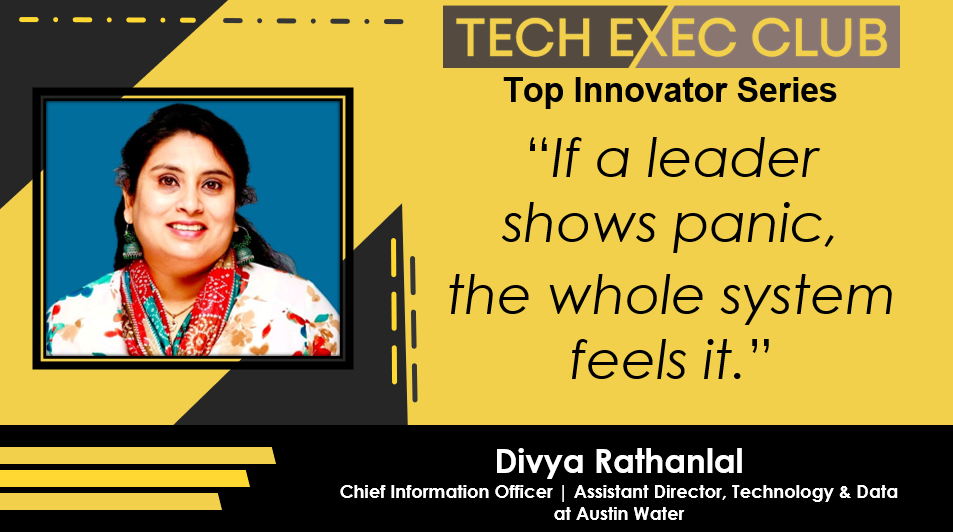
What makes a great leader in technology today? According to Divya Rathanlal, Chief Information Officer at Austin Water, leadership today is not built in moments of comfort or certainty. It is forged in ambiguity, strengthened by trust, and revealed through the courage to step forward when the path is unclear.
In a conversation with Josef Martens on the Top Innovators series, Divya shares the leadership lessons that shaped her journey, from volunteering for the toughest challenges to guiding teams through the uncertainty of the pandemic. Her perspective is both practical and deeply human. She makes a compelling case that leadership goes beyond technical expertise and strategic vision. It is also about emotional steadiness, relationship building, and the kind of trust that helps teams do their best work.
For leaders navigating change, complexity, and constant disruption, Divya’s insights offer a timely and practical roadmap. Her story shows that the most effective leaders are often the ones who listen closely, stay calm under pressure, and empower others to rise.
Curiosity and Courage Create Leadership Opportunities
For Divya Rathanlal, leadership did not begin with a title. It began with curiosity.
When she reflects on her career, she doesn’t measure it by a predefined path or a perfect sequence of promotions. Instead, she points to the moments of uncertainty – not as detours, but as deliberate opportunities to lead, learn, and create impact. When others paused, she stepped forward. When direction was unclear, she helped define it. Those were the moments that shaped her most. Her approach was simple but powerful: raise your hand, lean in, and figure it out.
That mindset opened doors over time. Divya volunteered for projects that others did not want to take on. She stepped into challenges that had no obvious answers. Over time, something important happened. Senior leaders began engaging her in difficult conversations, not because she had the answers, but because they trusted her ability to navigate complexity and move things forward.
Leadership often appears in behavior before it appears in a job title. People notice who shows up when things get hard. They notice who stays grounded when uncertainty rises. They remember who is willing to move forward without waiting for perfect clarity.
Divya’s story is a reminder that career growth in technology leadership is often driven less by certainty and more by courage. In fast-changing environments, curiosity becomes a competitive advantage. Leaders are not always the people with the clearest answers. Often, they are the ones most willing to explore the hardest questions.
Great Mentors Push You from Victim to Hero
Every strong leader can usually point to one piece of advice that stayed with them. For Divya Rathanlal, that advice came from a mentor who challenged her to see adversity differently.
In difficult moments, when confusion and frustration threatened to take over, this mentor offered a message that was both tough and transformative: do not see yourself as a victim, emerge as a hero.
It was not advice meant to make things easier in the moment. It was meant to push toward ownership, resilience, and action.
That lesson changed how Divya interpreted challenge. Instead of waiting for circumstances to improve on their own, she learned to focus on the response that would move her forward.
True mentorship, in her view, is not just reassurance. It is perspective combined with accountability. It is someone helping you rise when you would rather retreat.
This philosophy continues to shape how she leads others. Great leaders do more than encourage. They help people find the strength they may not yet see in themselves, while also challenging them to step into responsibility and confidence.
In leadership development, this matters deeply. Support is important, but growth usually happens when support is paired with expectation. Divya’s mentor understood that. And that lesson continues to influence how she faces pressure, uncertainty, and transformation today.
Momentum Matters More Than Perfection in Crisis
One of the most powerful insights in Divya Rathanlal’s interview is her belief that leadership in crisis is not about perfection. It is about momentum.
Before the pandemic, leadership often followed structure – a defined mission, a roadmap, and a clear path forward. Then came a period that broke the usual rules. Leading through the pandemic meant operating without a blueprint. Decisions had immediate consequences for communities, frontline workers, and exhausted teams. In that environment, waiting for perfect answers was not an option.
What became essential was the ability to stay steady and keep teams moving forward.
Divya highlights a truth many leaders overlook. Technology leadership is not only about vision and technical depth. There is a third dimension that matters just as much: the ability to provide clarity under pressure, preserve team focus, and protect people from chaos.
When leaders absorb the noise and create calm, teams can continue doing meaningful work.
She also discovered something deeply human during that period. The most extraordinary outcomes did not come from ideal structures or big teams. They came from small groups of people who felt trusted and believed their work mattered.
Trust became a force multiplier.
In times of uncertainty, teams do not need leaders who pretend to have everything under control. They need leaders who can remain steady, make thoughtful decisions, and keep the mission moving forward.
Technology Leaders Must Become Translators and Relationship Builders
Divya Rathanlal is clear about one major shift happening in technology leadership: the role is expanding beyond technology itself.
As her career moved from centralized technology teams into the utility sector, she gained a broader view of what effective leadership really requires. In her current role at Austin Water, success depends not only on technical expertise but also on understanding the water business, the operational environment, and the people who keep the system running. That change sharpened her perspective. Today, she sees the modern technology leader as a relationship builder, an integrator, and a translator.
This is a significant insight for CIOs and technology leaders. Technology teams and business teams often speak different languages. One side focuses on systems, architecture, and implementation. The other focuses on outcomes, operations, and strategic priorities. The leader in the middle must connect those worlds. That means translating high-level vision into practical execution while also making technical possibilities understandable to the business.
Divya’s description of leadership here is especially relevant in complex organizations. The value of a technology leader is no longer limited to delivering systems. It includes aligning people, building trust across functions, and ensuring that technology serves real operational needs.
She also brings this mindset into team collaboration. Her go-to leadership tools are not flashy digital platforms, but simple, effective design thinking methods – bringing people into a room and creating space for open thinking and psychological safety. Her focus is clear: when people feel safe enough to question, contribute, and think together, better solutions emerge.
Leadership, as Divya Rathanlal describes it, is not defined by certainty or control. It is defined by presence – the ability to stay grounded, create clarity, and help others move forward when the path is still unfolding.
The Future of Leadership Is Trust, Transparency, and Empowerment
Looking ahead, Divya believes leadership is moving toward something more open, more human, and more collaborative.
In her view, people no longer expect leaders to have all the answers. Instead, they want leaders who are honest, transparent, and willing to create space for others to think and contribute. This shift matters because when leaders dominate conversations too early, they narrow the possibilities. When they listen first and speak later, they widen the field of ideas.
That belief reflects a major evolution in leadership culture. Authority alone is no longer enough to lead effectively. Teams want trust. They want clarity. They want to know their voices matter. Divya sees the leader’s role as building a community where people feel safe enough to participate and confident enough to solve hard problems.
She also frames leadership in long-term terms. A successful leader is not someone an organization depends on forever. A successful leader is someone who helps the organization thrive beyond their presence. That is why she keeps returning to people and process. Invest there first, and the rest follows.
Her final leadership insight may be the most memorable of all. Leaders set the emotional tone whether they intend to or not.
If a leader shows panic, the system reflects it.
If a leader shows steadiness, people can breathe and keep going.
It is a powerful reminder that leadership is contagious. The mood at the top often shapes the performance below.
In the years ahead, leaders who can combine transparency with calm and empowerment with trust will be the ones teams choose to follow.
What Leaders Can Learn From Divya Rathanlal Right Now
- Raise your hand for the challenges others avoid: Growth often begins in uncertainty. Leaders who step into difficult situations develop trust, resilience, and visibility.
- Choose curiosity over comfort: Divya’s career shows that curiosity is not just a personality trait. It is a leadership advantage that opens new paths and creates momentum.
- Build emotional steadiness, not just technical expertise: Vision and strategy matter, but teams also need calm, clarity, and focus when conditions become unpredictable.
- Protect your team from noise and confusion: One of the leader’s most important jobs is to absorb pressure without passing chaos down the line.
- Invest in people before process and technology: Strong teams build strong outcomes. When people feel trusted and supported, performance improves.
- Become a translator between technology and the business: Great technology leaders connect vision to execution and help different teams understand one another.
- Create a safe space for honest input and better ideas: Innovation improves when people feel confident enough to question, contribute, and collaborate openly.
- Listen first and speak last: Leaders who create room for others to think often unlock stronger solutions and better team ownership.
- Lead so the organization can thrive without you: Sustainable leadership is about building capability in others, not making yourself indispensable.
- Set the tone with calm and confidence: Your team reflects your emotional signals. Steadiness is not soft leadership. It is strategic leadership.
Divya Rathanlal offers a compelling vision of leadership in a complex and fast-changing world. Her journey shows that the strongest leaders are not always the loudest or the most certain – they are the ones who stay curious, remain steady under pressure, and create the trust that allows others to do extraordinary work.
As Chief Information Officer at Austin Water, Divya brings a leadership philosophy grounded in resilience, service, and human connection. Her story is not just about success in technology – it is about the kind of leadership that helps people and organizations grow stronger together.
Want to hear Divya’s insights firsthand? Watch the full, live podcast interview [click here]