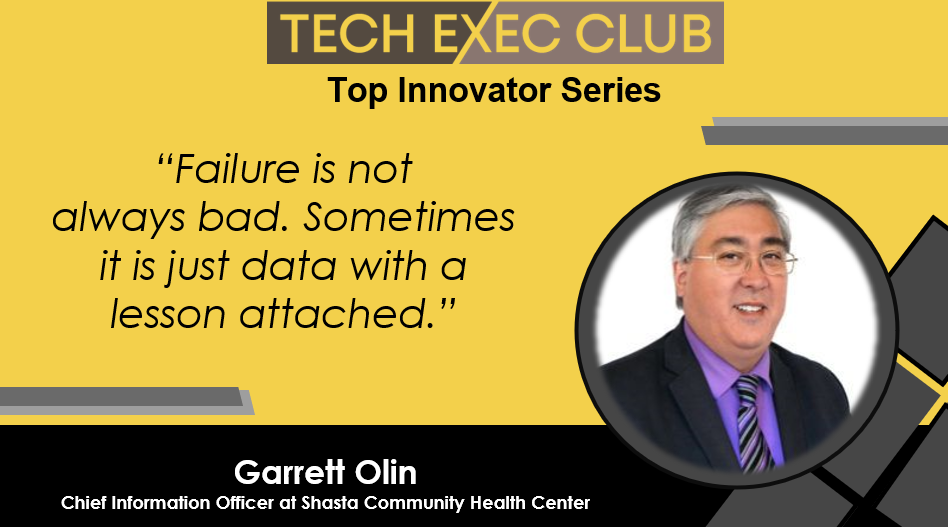
Technology moves too fast for leaders who want certainty before they act. The organizations that stay resilient are led by people who keep learning, who show up when it matters, and who build teams that don’t freeze when something breaks. Garrett Olin, CIO at Shasta Community Health Center and a seasoned technology executive across federal and private-sector environments, leads with that exact mindset.
In the Top Innovator series, Garrett lays out the habits that shaped his career: an “undying need” to improve, a leadership presence that becomes “infectious” inside teams, and a pragmatic relationship with failure, less fear, more learning. He also offers a grounded perspective on artificial intelligence, calling out the hype while pointing to real use cases that can improve processes. But the most powerful theme running through his answers isn’t a tool or a title. It’s trust.
Garrett’s leadership message lands because it’s simple and usable: you can always grow without a title, but you can’t build a high-performing team without curiosity, clarity, and the trust to talk honestly when life and work collide.
Continuous Improvement Powered by Curiosity
Garrett attributes his success less to a single career move and more to a mindset that never goes idle: an “undying need” to continually learn and improve. He describes it as a habit of questioning the default. Why is this happening the way it is? If this is how it’s done today, how can we do it better tomorrow?
What makes Garrett’s curiosity leadership-relevant is that it is not limited to his own lane. He wants to understand how departments interact, how processes connect, and where friction hides between teams. That cross-functional awareness matters because the biggest inefficiencies are often not in the technology itself, but in handoffs, assumptions, and workarounds people build when systems do not match reality.
He also warns about a common trap: comfort. Teams can be proud of what they have built and still be vulnerable if they stop learning. Technology evolves too quickly to “sit on your hands” and assume current success will extend into the future. Garrett’s message is that curiosity is not a personality trait reserved for a few. It is a culture you can grow, and it becomes the engine for sustainable improvement.
Visible Leadership That Becomes Infectious
When Josef asks how to reignite a team that has gotten comfortable, Garrett’s answer is practical: build relationships and lead visibly. He talks about walking into departments, checking in on people, and getting a real pulse of how work is going. He listens, stays open and honest, and communicates what he sees, including what is working well and where the team can do better.
Garrett also emphasizes that leadership is most believable in moments where it would be easy to disappear. In technology, the work often happens when “the business isn’t,” including weekends. He shows up alongside the team, not to perform, but to demonstrate commitment and to protect work-life balance. That combination changes the department’s tone. People feel supported, and they also feel the standard.
Over time, Garrett says, it becomes “infectious.” The team begins to emulate what they observe, including how he handles frustrated end users, communicates under pressure, and shows respect when things are tense. His point is that culture spreads through behavior, and the quickest way to change a team is to consistently model what you want repeated.
Smart Risk, Failure, and the Discipline of Learning Fast
Garrett shares two lessons that shaped him and continue to guide his leadership. First, you cannot be successful if you are not willing to risk some failures. Progress requires reach, and reach sometimes fails. Second, when failure happens, the leader’s job is to turn it into learning and growth, not fear and blame.
Garrett is clear that nobody likes failure, including him. The difference is what happens next. He uses the Edison story to reframe the emotional weight of setbacks: the failures are data, proof of what does not work, and a step toward what will. But he also adds the real-world constraint that matters in organizations: risk has to be managed. That is where relationships come in. With strong trust and credibility, you can tell leadership there is risk involved, explain why it is worth it, and still maintain confidence even if something does not go perfectly.
He describes the leadership response as pivoting. If it does not work, adjust and make the best of it. The goal is not to chase failure. The goal is to remove the fear that blocks improvement, while keeping the discipline that protects the organization.
AI Without the Hype, Innovation With Real Value
Garrett points to artificial intelligence as an area he wants to keep developing. Still, he does not treat it as a shortcut to credibility. He notes that many vendors claim their products now have AI, even though they have added the term to their marketing materials. That comment is not just a tech critique; it is a leadership filter: Do not confuse labeling with value.
In Garrett’s view, AI will continue to grow, and there are plenty of use cases that can improve businesses and processes. The key is being honest about what is real and what is noise. Leaders who chase hype tend to buy confusion. Leaders who demand practical outcomes tend to buy progress.
He pairs that perspective with another leadership point that is easy to miss: growth is not tied to titles. Garrett mentions that being a CEO in a large organization might be a bucket-list goal, but it is not required for him to keep growing. That same mindset applies to technology. The goal is not the badge, it is the impact. Garrett’s AI stance is a reminder that modern leadership means choosing substance over performance, even when the market is loud.
Trust as the Foundation for High Performance
If Garrett could change one thing about how leaders lead, it would come back to trust, not as a vague ideal, but as the practical foundation that keeps teams functioning well. Garrett connects trust to the reality that leaders and teams often avoid discussing: life affects work, and work affects life.
He explains that people do not need to share personal details, but they do need to feel safe enough to say something is happening so adjustments can be made. Without trust, a leader may only see performance dropping and assume the worst. With trust, the leader can respond like a partner: “Let’s see how we can adjust things.” That protects the person, the team, and the organization.
Garrett also makes a strategic point. Trust reduces preventable turnover and protects institutional knowledge. He would rather work with someone through a difficult season than lose their expertise and then spend time hiring, training, and rebuilding what was already working. In his view, trust is not soft leadership. It is durable leadership, and it is one of the clearest separators between teams that merely function and teams that perform at a high level.
Garrett’s interview points to a simple truth: high performance is not a single initiative. It is the result of daily leadership behaviors that build trust, fuel learning, and keep teams improving even when technology and pressure move fast.
- Build continuous improvement into the week: Ask “Why is this happening this way?” and “How can we do it better?” Choose one friction point, one workaround, or one broken handoff and improve it with the team.
- Lead visibly and consistently: Do walkabouts, check in across departments, and get a real pulse of the day. Share what is working and what needs to improve so people feel seen and guided.
- Make leadership contagious through example: Show calm under pressure, treat end users with respect, and demonstrate commitment when the work happens off-hours. Model work-life balance so the team protects it too.
- Reframe failure as learning with guardrails: Take smart risks, define what could go wrong, and plan how to recover. When something misses, capture the lesson, pivot quickly, and move forward without blame.
- Use Garrett’s rule about asking: If you do not ask, the answer is already no. Build a clear business case for what is truly needed, ask for it directly, and let evidence lead the conversation.
- Keep AI practical, not performative: Challenge “AI” claims that are just marketing. Focus on real use cases that improve processes, test small, and scale only what proves measurable value.
- Practice situational leadership with clear decision rights: Hear the team and end users who know the real workarounds. Use their input to make a well-informed decision, then be clear that leadership chooses the direction.
- Invest in trust on purpose: Make it safe for people to say something is affecting work without sharing personal details. Act early when performance dips, with support and clarity. Protect institutional knowledge by keeping good people and working through challenges together.
Garrett Olin does not frame leadership as a title, a speech, or a personality. In this conversation with Josef Martens, he frames it as a set of choices that show up every day: staying curious when it would be easy to coast, showing up when it would be convenient to delegate, and building the kind of trust that lets people speak early instead of struggling quietly.
What stands out most is how practical his leadership is. Garrett wants teams that improve continuously because technology will not wait. He wants smart risk, not reckless change, and he wants failure to produce learning instead of fear. He is interested in AI, but only where it creates real value, not where it merely creates noise. And underneath all of it is his clearest priority: trust, because trust keeps people engaged, teams stable, and organizations strong.
If there is a single takeaway from Garrett’s approach, it is this: high performance is not something you demand. It is something you build through presence, honesty, and the discipline to keep getting better. And when a leader makes those behaviors consistent, the results become exactly what Garrett described: contagious.
Want to hear Garrett’s insights firsthand? Watch the full, live podcast interview [click here]