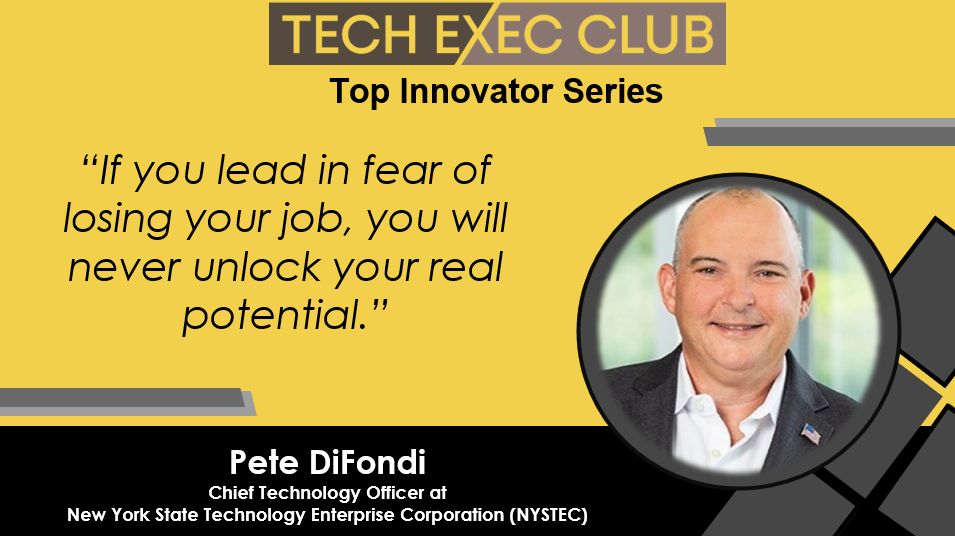
Inside the mindset, financial discipline and bold optimism are shaping the future of innovation.
Artificial intelligence is changing how companies operate, but Pete believes leadership itself does not need a reinvention. It needs a return to what works: caring deeply, finishing what you start, and leading with courage.
In our Top Innovator conversation, Pete DiFondi, CTO of the New York State Technology Enterprise Corporation (NYSTEC), shares the principles that shaped his career across multiple industries and executive roles. He explains why “caring more” became his advantage, why leaders must understand the business’s financial engine, and why the future belongs to those who ride the AI wave with confidence rather than fear.
This is not a story about titles. It is a leadership blueprint for the AI era.
Caring More: Pete’s Leadership Edge
When Pete reflects on the drivers of his success in technology leadership, he does not immediately point to strategy, certifications, or technical brilliance. He points to something more fundamental. He cared more.
For Pete, caring is not emotional language. It is operational language. It means ownership of outcomes, responsibility for the mission, and commitment to the people involved. Early in his career, he observed how projects could technically succeed while still leaving customers or colleagues dissatisfied. Those subtle disappointments stayed with him. They became lessons.
Instead of accepting “good enough,” Pete chose to raise his personal standard. He leaned into responsibility rather than avoiding it. He stayed present when others disengaged. He treated every initiative as if the final impression truly mattered.
In today’s AI-driven environment, where automation accelerates delivery, Pete’s principle becomes even more powerful. Technology can optimize speed and scale. It cannot replace genuine accountability and human care. Leaders who consistently demonstrate that level of commitment build trust over time. And trust, more than any tool, becomes a long-term competitive advantage.
For Pete, caring more is not a soft skill. It is a strategic differentiator.
“Put a Bow on It”: The Discipline of Complete Delivery
Pete often summarizes his philosophy with a simple expression: “Put a bow on it.”
At first glance, it sounds almost lighthearted. In practice, it represents disciplined execution. To Pete, leadership is not about reaching near completion. It is about finishing so thoroughly that no one needs to revisit the issue. Stakeholders feel aligned. Customers feel heard. Teams feel confident that the outcome is solid.
He learned that many initiatives stall at 85 or 90 percent completion. They technically work, but they leave unanswered questions or unresolved concerns. Over time, these gaps accumulate. They erode confidence and create hidden friction inside organizations.
Pete’s approach is different. Close the loop. Clarify expectations. Ensure both emotional and operational closure. That extra layer of completion strengthens reputation and builds credibility.
In complex technology environments, where implementations and transformations can span months or years, this mindset becomes critical. “Putting a bow on it” is not about perfectionism. It is about responsibility. It is about respecting the people who depend on your leadership.
Know Your Numbers: Financial Literacy as a Leadership Multiplier
One of the most influential lessons Pete received from mentors was simple and direct. Know your numbers.
Throughout his career, Pete noticed that many technologists focus intently on systems and solutions but neglect the organization’s financial structure. He believes this limits their influence. Leaders who understand how the business makes money, manages costs, and measures performance speak a language that executives respect.
Pete emphasizes that financial information is often readily available. Public companies publish detailed filings. Nonprofits disclose financials through public records. Internally, finance leaders are typically willing to explain the mechanics of budgets. The barrier is not access. It is an initiative.
When Pete led organizations, he made financial transparency part of the culture. He encouraged his leadership team to understand budgets and industry economics. He modeled that behavior himself by investing in education specific to the industries he served.
Financial literacy, in Pete’s view, is not about becoming an accountant. It is about empowerment. When leaders tie innovation directly to business value, they gain credibility and accelerate change.
Riding the AI Wave: Pete’s Optimistic Vision for Humanity
Few leaders speak about artificial intelligence with the enthusiasm Pete brings to the conversation. He sees this moment not as a disruption alone, but as a turning point in human progress.
Pete believes the technological advancements of the past decades have led to this inflection point. From the rise of the internet to the spread of personal computing, each wave prepared the foundation for what is happening now. AI is the next major evolution.
Importantly, Pete is not driven by fear of displacement. He draws parallels to earlier innovations that initially caused anxiety but ultimately expanded opportunity. He believes AI will unlock breakthroughs in healthcare, extend human longevity, and enable creative individuals to bring ideas to life in ways previously impossible.
At the same time, he is clear that leadership principles remain constant. Investing in people, building shared vision, and unlocking talent do not change. Technology enhances capability. It does not replace human connection.
Pete wants to be on the front edge of this transformation, helping organizations and individuals ride the wave rather than resist it.
Lead Without Fear: Independence as a Leadership Catalyst
If Pete could influence one shift in modern leadership, it would be this. Lead without fear.
He believes that leaders who operate out of fear of losing their jobs limit their effectiveness. They hesitate to make bold decisions. They avoid necessary conflict. They protect the position instead of advancing the mission.
Pete’s solution is proactive. Build your personal brand. Develop your network. Understand your industry deeply. Become marketable not because you want to leave, but because independence removes fear.
When leaders know they have options, they act differently. They align decisions with values and long-term vision rather than short-term security. This independence unlocks creativity, courage, and clarity.
For Pete, true leadership requires the confidence to stand behind your decisions and the competence to back them up. Freedom from fear is not reckless. It is empowering.
If Pete DiFondi’s leadership philosophy resonates with you, the next step is not reflection. It is an action. Here is how you can apply his principles starting today.
- Care More Than Your Job Description Requires: Audit your current responsibilities. Ask yourself where expectations are merely met rather than exceeded. Identify one initiative where you can go beyond mere completion and deliver true satisfaction to stakeholders.
- Put a Bow on One Critical Project: Choose one active project and finish it completely. Close communication gaps. Clarify open questions. Ensure every stakeholder feels heard and aligned. Build your reputation through thorough execution.
- Learn the Financial Engine of Your Organization: Schedule a conversation with your CFO or finance partner. Review your company’s annual report, public filings, or budget summaries. Understand how revenue is generated, where costs concentrate, and how profitability is measured. Tie your next proposal directly to financial impact.
- Invest in Industry Knowledge Beyond Technology: Study the business model of your industry, not just the tools you use. Encourage your team to do the same. Model the behavior by participating in certification or executive education programs.
- Ride the AI Wave Instead of Resisting It: Experiment with AI tools. Encourage responsible innovation within your team. Focus on how these technologies can unlock creativity, productivity, and human potential.
- Build Your Leadership Independence: Strengthen your professional network. Develop your personal brand. Stay informed about industry trends. Position yourself to be marketable anywhere so you can lead without fear.
Pete DiFondi does not lead with noise. He leads with conviction.
In a time when technology executives are racing to define the future of artificial intelligence, Pete stands out for a different reason. His confidence does not come from hype. It comes from clarity. He understands the mechanics of business. He invests in people. He finishes what he starts. And he approaches the AI revolution not with fear, but with disciplined optimism.
What makes Pete compelling is not just his role as CTO of the NYSTEC. It is his mindset. He believes leadership is timeless. He believes financial literacy is empowering. He believes care is strategic. And he believes the next wave of innovation will unlock human potential in ways we are only beginning to understand.
Pete is not waiting for the future to arrive. He is preparing for it, shaping it, and inviting others to ride the wave with him.
In an era defined by rapid change, leaders like Pete DiFondi remind us that courage, competence, and care will always be the foundation of meaningful progress.
Want to hear Pete’s insights firsthand? Watch the full, live podcast interview [click here]