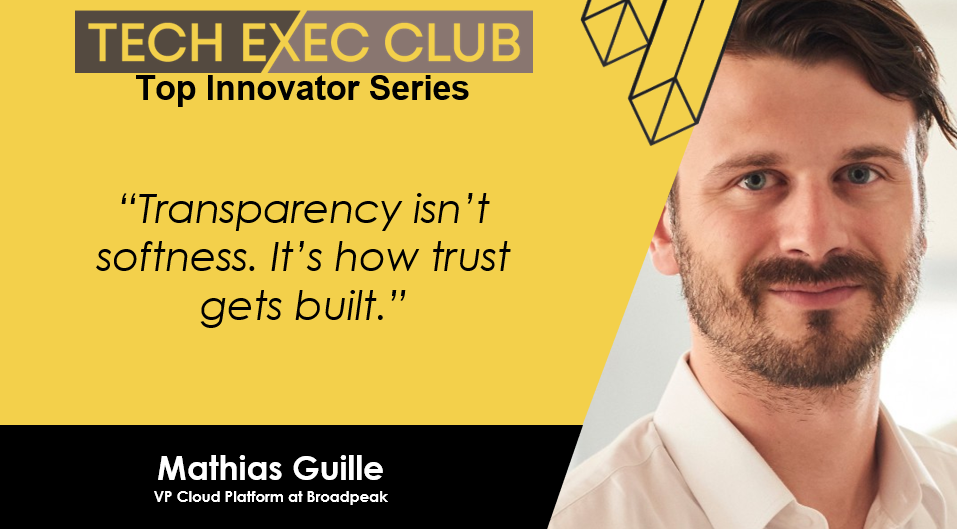
Mathias Guille, VP Cloud Platform at Broadpeak, has built his leadership career in the streaming and content delivery world, across Asia, Europe, and the United States. When asked what drove his growth, he doesn’t point to a master plan. He points to a mindset.
He calls it being “careless.” Not reckless, not sloppy. Careless in the sense of moving forward even when you do not have every detail, and taking opportunities before they disappear.
In his conversation with Josef Martens on the Top Innovator series, Mathias shares what he learned from scaling roles, leading through ambiguity, working across cultures, and watching leaders who earn trust by telling the truth. He also explains why AI is pushing leadership back toward doing rather than just directing.
“Careless” leadership that creates growth
Mathias Guille credits much of his leadership growth to a mindset he calls “careless.” He does not mean reckless or sloppy. He means the ability to move when conditions are not perfect, and to take opportunities before you feel completely ready. In his early career, he was fortunate to work for a growing company that gave him room to grow. But the key, he says, was recognizing the openings in front of him and deliberately reaching for them. He talked to his boss, expressed interest, and asked to expand his role. That habit of stepping forward, even without full certainty, became a major driver of his trajectory.
Mathias also connects this to the reality of the streaming industry. Streaming is serious work, but it is not emergency medicine. The product is entertainment and media that people love. That context matters because it leaves space for playfulness and boldness, not just rigor. For him, the best leaders carry both. They execute with discipline but also maintain enough lightness to experiment, take smart risks, and stay calm when things get messy.
Today, Mathias even looks for this trait when hiring. He may not use the word “careless” in a job post. Still, he actively seeks people who can move decisively and grow in motion, especially when the path is unclear.
Leading through ambiguity without freezing
A central theme in Mathias Guille’s leadership philosophy is the ability to operate in the face of ambiguity. He describes today’s tech organizations as complex environments with too many projects, competing priorities, and multiple teams that must coordinate. In that kind of system, you rarely get perfect clarity. Waiting for full alignment can become a trap. You spend energy gathering information that never fully materializes, and momentum fades as the market keeps moving.
Mathias argues that leaders have to act anyway. The job is not to remove uncertainty entirely. The job is to help teams make progress in the face of uncertainty. That means being comfortable making decisions with imperfect inputs, then adjusting quickly as reality delivers new data. He sees this as a practical discipline, not a personality quirk. It is the habit of deciding, testing, learning, and iterating.
When he translates his “careless” idea into more professional language, he calls it “the ability to deal with ambiguity.” He wants people who can do useful work even when the situation is not fully mapped out and who do not need a complete instruction manual to get started. In his view, this is one of the most valuable leadership skills in streaming and in modern tech overall, because ambiguity is not a temporary phase. It is the operating condition.
Transparency as the fastest path to trust
Mathias points to Broadpeak CEO Jacques Le Mancq as a major influence on his leadership. The lesson he highlights most is transparency. For Mathias, transparency is not simply a communication style. It is the foundation of trust, and trust is what makes teams work well under pressure.
He explains that leaders often face decisions that are not easy for everyone to understand, especially when tradeoffs are involved. At that moment, a leader has two options. One is to announce the decision and move on. The other is to explain the decision, share the reasoning, and be honest about constraints, risks, and intent. Mathias believes the second option is the one that holds a team together, especially in difficult moments. Transparency matters in both good times and bad times. In good times, it keeps success grounded and shared. In bad times, it prevents rumor, fear, and misinterpretation from filling the silence.
Mathias also repeats a principle he learned from Jacques: telling the truth is often the best way out of situations. This does not mean oversharing everything. It means sharing what matters, when it matters, in a way people can understand.
In fast-moving industries like streaming, trust is not abstract. It affects speed, coordination, and resilience. Mathias sees transparency as one of the simplest leadership behaviors that produces the biggest long-term return.
Cross-cultural leadership and the humility to adapt
Mathias Guille’s career includes leadership experience across Singapore, Europe, and the United States, including responsibility for the Americas region. One of his biggest realizations is how deeply culture shapes professional life. It is not just language or etiquette. It is the mechanics of how people work, how they give feedback, how direct they are, and how decisions are interpreted.
When asked for advice on expanding internationally, Mathias recommends reading The Culture Map. He describes it as a practical guide that explains cultural differences with concrete examples. Some cultures give very detailed feedback, others almost none. Some cultures are highly direct, others are more indirect. He offers a specific comparison: French communication can be very direct, and Americans may experience that as blunt. Meanwhile, detailed American-style feedback can be perceived in France as patronizing. Those mismatches can damage relationships if leaders do not prepare for them.
Mathias also warns against exporting “the US way” as if it is universally correct. The United States drives massive technological innovation, but international markets have legacy systems, local standards, and long histories. In streaming, even standards differ by region, so pushing a US approach without adapting is unlikely to work.
His approach is humility and open-mindedness. Come with ideas, but respect what already exists. Lead like a guide, not like a conqueror.
AI and the return of the builder leader
Mathias believes AI is reshaping leadership, not just technology. He argues that leaders need to stay informed about developments in AI and strike the right balance. They do not need to become researchers, but they do need sufficient understanding to make AI intelligible to their teams and to use it in ways that genuinely improve performance. He also warns that it is easy to treat AI as hype or as a magic solution. Both are mistakes.
For Mathias, AI is valuable because it lowers the cost of building. It makes prototyping and experimentation more accessible, faster, and more affordable. That changes what leaders can do. Instead of only describing a vision, a leader can demonstrate it. They can build a prototype, create an MVP, or produce a demo that makes the future tangible. Mathias believes that kind of “show it” leadership will become more important in the coming years.
He also suggests that the era of leaders who only manage and give direction is coming to an end. Leadership will still include team motivation and organizational alignment, but it will expand to include more individual contribution. AI gives leaders a practical way to step back into doing, not as a micromanager, but as a catalyst who creates momentum and clarity.
In his view, the leaders who thrive will be the ones who learn AI firsthand, test it themselves, and use it to help teams build better and faster, with more excitement and less empty talk.
Mathias’s ideas are simple to apply in real life, not just admire on paper:
- Practice “productive carelessness” this week: Pick one stalled decision and move it forward with the best available information. Ship a draft, start the experiment, schedule the hard conversation.
- Rewrite your hiring lens for modern reality: Add “ability to deal with ambiguity” to your evaluation criteria and test for it with real scenarios (unclear priorities, shifting requirements, partial data).
- Build a transparency ritual for your team: After major decisions, share what you decided, why you decided it, what tradeoffs you accepted, and what you will watch next. Do this in both good and bad moments.
- Audit your cross-cultural assumptions before expanding globally: List your default communication habits (directness, feedback style, decision speed). Compare them with your target culture and adjust intentionally.
- Read The Culture Map and turn it into action: Create a one-page “culture playbook” for your team covering feedback norms, meeting dynamics, escalation habits, and common misinterpretations.
- Adopt humility as your market-entry strategy: enter new countries with a partner-first mindset. Learn the legacy, respect existing standards, and bring ideas as options, not mandates.
- Make AI personal before you make it organizational: Test AI yourself for drafting, analysis, prototyping, and clarity. Learn its limits firsthand so you can guide responsibly.
- Use AI to become a “show, don’t tell” leader: Build a simple prototype or MVP that embodies your vision. Let the demo do what slide decks can’t and create belief.
- Refocus your mission on a “good reason”: Ask, are we spending our best minds on meaningful problems, or just optimizing negligible gains? Then prioritize work that matters.
Mathias Guille isn’t selling a leadership formula. He’s offering a posture shaped by opportunity, cultural complexity, and deep respect for trust. His “carelessness” is really courage with a smile: the willingness to act without perfect certainty, to stay playful in an industry built on human enjoyment, and to keep moving when ambiguity tries to freeze the room.
In an age where AI tempts leaders to chase hype or ignore it, Mathias argues for something harder and more useful: engage, learn, and build. Because the leaders people follow in the next decade won’t be the ones who merely describe the future. They’ll be the ones who can make it visible.
Want to hear Mathias Guille’s insights firsthand? Watch the full, live podcast interview [click here]