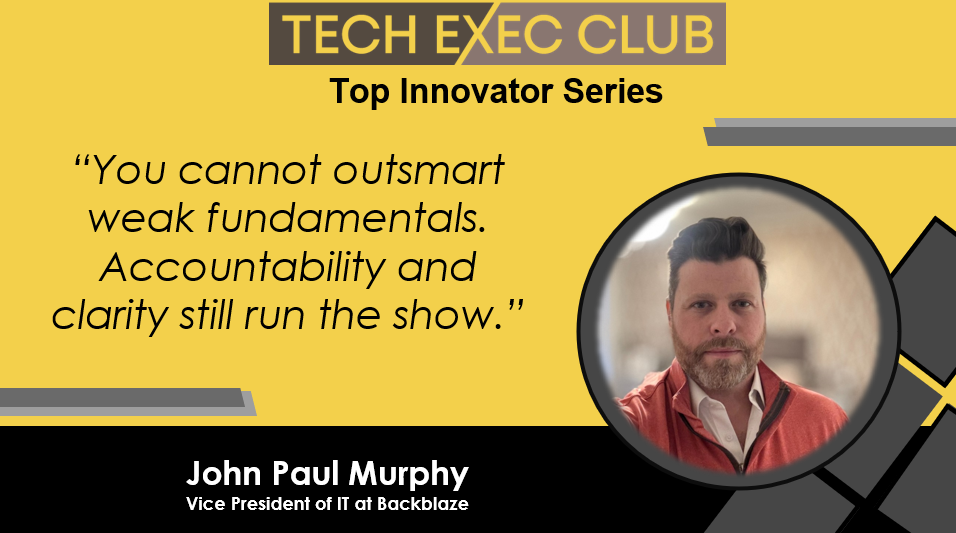
Technology leadership is often portrayed as a relentless pursuit of speed, scale, and sophistication. But for John Paul Murphy, VP of IT at Backblaze, the real differentiator isn’t chasing complexity—it’s knowing when to strip leadership back to its fundamentals.
In this episode of the Top Innovator Series, host Josef Martens sits down with Murphy to explore what modern leadership really looks like inside high-growth, tech-driven organizations. From startups racing toward IPOs to global enterprises navigating data maturity, Murphy has lived through moments when leadership theories collide with operational reality. His journey is not defined by a single leadership style, but by an ability many leaders struggle to master: adaptability with accountability.
Murphy speaks candidly about the leadership mistakes that forced him to evolve, the moments when collaboration slowed progress, and the hard-earned lesson that sometimes clarity matters more than consensus. He shares how pattern recognition, rapid prototyping, and cross-functional fluency became essential tools—not just for scaling systems, but for scaling trust.
As AI reshapes how organizations operate, Murphy offers a grounded counterpoint to the hype. He argues that the future of leadership won’t belong to those who adopt the most tools, but to those who can simplify complexity, communicate crisply, and remain deeply human in how they lead.
This conversation isn’t about leadership trends. It’s about what actually works when the stakes are high, the organization is growing fast, and people are counting on you to get it right.
Leadership Is Not a Style — It’s an Ongoing Act of Adaptation
For John Paul Murphy, leadership has never been about perfecting a single philosophy or clinging to a fixed playbook. Instead, his success has come from a willingness to adapt—sometimes in uncomfortable ways—to the reality in front of him.
Over the course of his career, Murphy has led startups, scale-ups, and complex global organizations. Each environment demanded something different. Early-stage teams needed speed and clarity. Growing organizations require structure without suffocation. External pressures—funding rounds, market shifts, financial constraints—forced constant recalibration. What worked once didn’t always work again.
Rather than seeing this as an inconsistency, Murphy views adaptability as intellectual honesty. Leadership, in his view, requires acknowledging when a previous approach no longer fits—and being accountable enough to change it. “I don’t believe in one-size-fits-all,” he explains, pointing out that maturity curves, team dynamics, and organizational needs evolve continuously.
That mindset also requires humility. Murphy openly reflects on moments where his leadership instincts were wrong or misaligned with the situation. Those moments didn’t derail his growth; they sharpened it. Each experience became a data point he could draw from later.
This adaptive posture is rooted partly in Murphy’s competitive background. Sports taught him that conditions change mid-game—and leaders who fail to adjust lose. The lesson carried into his professional life: leadership isn’t about consistency of style, but consistency of intent—helping the organization and its people win under changing conditions.
When Consensus Becomes a Bottleneck — Choosing Clarity Over Comfort
Few leadership moments define growth as clearly as those in which collaboration stops working.
Murphy recalls a pivotal inflection point while helping an organization become truly data-driven. The mandate was ambitious: build a full business intelligence capability from scratch—technology, people, processes, and governance—while serving finance, product, and go-to-market teams across a global organization.
His instinct was collaboration. He sought consensus among stakeholders and incorporated feedback from all directions. The intent was right—but progress stalled. Meetings multiplied. Alignment remained theoretical. Momentum evaporated.
That’s when Murphy made a decisive shift.
Instead of seeking agreement on every step, he focused on defining a clear end state that everyone could support. Then he took ownership of the path to get there. He laid out the phases, the execution model, and how each function’s needs would be met—without reopening the plan at every turn.
The result was velocity.
By moving from abstract prioritization to a rapid prototyping mindset, Murphy transformed feedback from opinion-based to evidence-based. Stakeholders could respond to real issues rather than debate hypotheticals. Conversations shifted from theory to execution.
The lesson was profound: collaboration is powerful—but only when paired with decisive leadership. In complex environments, clarity can be more inclusive than endless consensus. By leading from the front when needed, Murphy unlocked progress that collaboration alone couldn’t deliver.
Pattern Recognition and Cross-Functional Fluency: The Quiet Advantage of Great Leaders
Murphy believes leadership maturity shows up in what you notice.
As an IT leader, he occupies a rare vantage point—one that touches finance, HR, engineering, product, and executive leadership. Rather than treating this as operational overhead, he sees it as a strategic advantage. Over time, exposure across domains builds pattern recognition: the ability to see how today’s problem echoes yesterday’s challenge in a different function.
That recognition doesn’t mean solving everything alone. In fact, Murphy is explicit about knowing where his expertise ends. The real skill lies in understanding when to engage specialists, how to frame the problem, and how to connect the dots between teams that rarely speak the same language.
This cross-functional fluency allows Murphy to anticipate risks before they surface, spot misalignments early, and guide conversations toward productive outcomes. It’s also what enables him to move between the CFO discussing financial systems one hour and the CEO debating execution strategy the next—without losing credibility in either room.
Leadership, in this sense, becomes less about authority and more about translation. Murphy acts as a bridge, helping teams understand not just what needs to be done, but why it matters to the broader organization.
That ability—to see patterns, engage the right voices, and frame problems holistically—is what turns experience into wisdom. And it’s what allows leaders like Murphy to scale impact beyond their own function.
Simplifying Leadership and Technology in an Age Obsessed With Complexity
In a world captivated by AI hype and ever-expanding tech stacks, Murphy argues for a contrarian focus: simplicity.
He is openly enthusiastic about AI—fully “on the bandwagon,” as he puts it—but he’s equally wary of complexity for its own sake. The real value of technology, in his view, lies in making work easier, clearer, and more accessible—not in layering systems until only experts can navigate them.
Murphy challenges himself and his teams to ask harder questions: Does this solution actually increase productivity? Does it reduce friction? Does it make onboarding easier? Or are we solving everything at once and creating a fragile system that’s hard to understand and harder to change?
This philosophy shapes how he approaches AI, automation, and system design. Rather than chasing sweeping transformations, Murphy favors incremental progress—small, practical improvements that can be measured, understood, and iterated.
He even reframes his role entirely. Instead of seeing himself solely as an IT leader, Murphy describes his work as “business-to-employee product leadership.” The goal isn’t technology—it’s experience. And simplicity is the multiplier that allows technology to serve people, not overwhelm them.
In leadership, as in systems, simplicity isn’t about being simplistic. It’s about creating clarity that empowers others to move faster and with confidence.
Back to Fundamentals: Accountability, Communication, and Trust Still Win
When asked what he would change about how leaders lead today, Murphy doesn’t reach for a new framework. He goes back to basics.
For him, great leadership starts with accountability—personal, team, and cross-functional. Leaders must be clear about expectations, honest about trade-offs, and consistent in how they communicate both wins and pressures.
Murphy acknowledges the human complexity of leadership. People are different. Motivations vary. Circumstances shift. But fundamentals cut through that complexity. Crisp communication creates alignment. Clear ownership enables execution. Trust allows teams to navigate both high-pressure moments and periods of growth.
He’s wary of leadership becoming over-engineered. Assessments, frameworks, and models have their place—but only if the basics are solid. Without strong fundamentals, even the most sophisticated tools fall flat.
Murphy frames every challenge through three lenses: people, process, and technology. It’s a simple model—but one that forces clarity. What’s broken? Who’s impacted? What dependencies exist? How do we move forward together?
In the end, Murphy’s philosophy circles back to a timeless truth: leadership doesn’t need to be flashy to be effective. It needs to be grounded, disciplined, and human.
This conversation with John Paul Murphy is not meant to be admired—it’s meant to be applied. Below is a clear, practical call to action, directly grounded in what JP shared, designed for leaders who want to turn insight into impact.
- Audit Your Leadership Style for Adaptability: Ask whether your current leadership approach fits the organization you lead today—or the one you led in the past. Identify one behavior that once worked but may now be limiting progress, and intentionally adapt it.
- Know When Consensus Slows You Down: Identify initiatives where collaboration has turned into stagnation. Define a clear end state, take ownership of the execution path, and lead decisively when momentum matters more than alignment.
- Build Cross-Functional Fluency: Deepen your understanding of finance, HR, product, and engineering. Learn to translate between functions, recognize patterns, and engage the right experts at the right time.
- Use Technology and AI to Simplify: Evaluate tools by how much clarity and productivity they create—not by their complexity. Apply AI and automation incrementally to reduce friction, improve usability, and enable faster iteration.
- Recommit to Leadership Fundamentals: Strengthen accountability, communicate expectations clearly, and balance individual needs with organizational priorities—especially during difficult periods.
- Lead Through Trust and Communication: Learn how each person best receives information and adapt your communication style accordingly. Build trust through transparency, enabling teams to focus on solving the real problem.
What stands out most about John Paul Murphy is not just the breadth of his experience, but the clarity with which he approaches leadership in an increasingly complex world. In an era defined by speed, scale, and technological disruption, Murphy consistently returns to what matters most: adaptability, simplicity, accountability, and trust.
As VP of IT at Backblaze, Murphy operates at the intersection of business, technology, and people—yet he never loses sight of the human element of leadership. His perspective is shaped by real-world challenges, not abstract theory. He has led through growth, ambiguity, and pressure, learning when to collaborate, when to decide, and when to simplify rather than add complexity.
Murphy’s leadership philosophy is both modern and timeless. He embraces AI and emerging technology while insisting they serve clarity, not confusion. He values innovation, but only when it is built on strong fundamentals. And above all, he leads with a deep respect for people—understanding that trust, communication, and accountability are what ultimately move organizations forward.
This conversation is a reminder that great leaders aren’t defined by having all the answers. They’re defined by how they adapt, how they listen, and how consistently they return to the fundamentals when it matters most.
Want to hear John Paul Murphy’s insights firsthand? Watch the full, live podcast interview [click here]