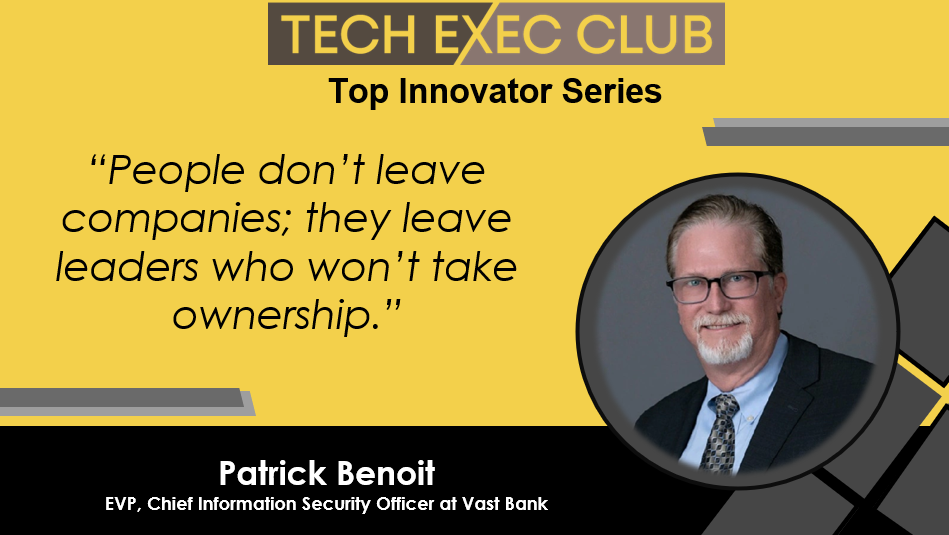
Leadership is often portrayed as a straight line with clear goals, decisive moves, and steady success. But according to Patrick Benoit, real leadership looks far messier, more human, and far more meaningful than that.
As the EVP, Chief Information Security Officer at Vast Bank, Patrick Benoit has spent decades navigating high-stakes environments where trust, accountability, and judgment matter just as much as technical expertise. Yet when asked how he arrived at his position as a respected leader, his answer isn’t about flawless execution or carefully plotted career moves. It’s about making mistakes, owning them, and learning how to stand back up afterward.
In this episode of Top Innovator, hosted by Josef Martens, Patrick pulls back the curtain on a leadership philosophy grounded in empathy, emotional intelligence, and extreme ownership. He speaks candidly about guilt and shame, the dangers of decision-making based on assumptions, and why a leader’s success is inseparable from that of their team. Drawing inspiration from timeless principles like The Four Agreements by Don Miguel Ruiz, Benoit outlines a framework for leadership that prioritizes integrity over ego and service over status.
In a business world obsessed with titles, growth curves, and constant acceleration, Patrick offers a different measure of success, one defined by the impact you leave behind, the people you elevate, and the values you refuse to compromise. This is not a story about climbing the ladder faster. It’s about making sure the ladder is leaning against the right wall.
Leadership Is Forged Through Mistakes, Not Avoidance
For many leaders, mistakes are something to hide, minimize, or explain away. For Patrick, they are unavoidable and essential. Looking back on his leadership journey, he’s clear about one thing: a career without mistakes is either dishonest or unambitious. Real growth only happens when you stretch far enough to fail.
Early on, mistakes came with self-criticism and frustration. Patrick admits that, like most people, he beat himself up when things went wrong. Over time, however, he learned to separate responsibility from guilt. A leader should fully own outcomes, especially failures, but ownership does not require shame. If you did your best with the information you had, the lesson matters more than the regret.
This distinction changes everything. When leaders stop fearing mistakes, they stop making decisions defensively. They become more open, more reflective, and more willing to learn. Just as importantly, they create space for their teams to take smart risks without fear of punishment.
Patrick views leadership as a continuous recovery process, not a quest for perfection. Each mistake becomes a checkpoint, not a dead end. The real test of leadership is not how often you stumble, but how quickly and thoughtfully you get back up, bringing the lesson forward instead of carrying the blame.
“All Ships Rise on the Same Tide”: Why Team Success Comes First
Patrick rejects the idea of the lone, heroic leader driving success through sheer force of will. In his view, leadership is fundamentally collective. “All ships rise on the same tide,” he says, and that belief shapes every decision he makes.
True leadership, Patrick argues, is not about standing out above the team, but lifting the entire group together. If a leader is the only one producing results, something is already broken. Sustainable success comes from enabling others to perform at their best, consistently and confidently.
That mindset demands a shift away from ego. Leaders must stop asking, How do I look successful? and start asking, How do I help my team succeed? When the team thrives, recognition follows naturally. When it doesn’t, no title or authority can compensate.
Patrick is also clear about accountability. Putting the team first doesn’t mean avoiding responsibility; it means taking it on. When things go wrong, the leader owns it. When things go right, the credit flows outward. Over time, this builds trust, loyalty, and momentum.
By prioritizing team success over individual validation, Patrick creates environments where people feel supported rather than used. The result is not just better performance, but stronger leaders emerging throughout the organization, multiplying impact far beyond any single role.
Emotional Intelligence, Empathy, and Extreme Ownership
For Patrick, technical expertise may open doors, but emotional intelligence determines how far a leader can go. Modern leadership, he believes, requires empathy, vulnerability, and a deep understanding of human behavior, especially under pressure.
Empathy doesn’t mean tolerating poor behavior or avoiding hard conversations. Patrick is clear about boundaries. Leaders can and should pause unhealthy interactions while still recognizing that not everything directed at them is personal. Understanding context allows leaders to respond thoughtfully rather than react emotionally.
This emotional awareness pairs directly with what Patrick learned from the book Extreme Ownership. Everything that happens on a team’s success or failure belongs to the leader. Even when mistakes aren’t personally caused, they are still personally owned. That mindset eliminates blame and shifts focus toward solutions.
When leaders model empathy and accountability together, teams feel safe enough to be honest and strong enough to improve. Vulnerability from the top invites openness throughout the organization. Ownership removes ambiguity about responsibility.
Patrick’s approach shows that emotional intelligence isn’t “soft.” It’s precise, disciplined, and deeply practical. Leaders who master it don’t just manage outcomes; they shape cultures where people can do their best work without fear.
The Four Agreements as a Practical Leadership Framework
Patrick doesn’t treat leadership principles as abstract philosophy. He prefers simple, repeatable frameworks, and one of the most influential in his career comes from The Four Agreements by Don Miguel Ruiz.
The first agreement, integrity, is foundational. Leaders don’t need to share everything, but they must always be honest about what they can and cannot say. Transparency builds trust, even when answers are incomplete.
The second agreement-“not taking things personally”-protects leaders from unnecessary emotional drain. Not every conflict is about you, and recognizing that creates clarity instead of resentment. The third, avoiding assumptions, reinforces disciplined decision-making. Observations and data matter; guesses do not.
The final agreement, always do your best, ties everything together. If you consistently act with integrity and effort, guilt and shame lose their power. Mistakes still happen, but they become learning moments rather than emotional burdens.
Patrick teaches these agreements because they remove friction. They simplify leadership decisions, reduce conflict, and create healthier teams. For him, they aren’t rules; they’re operating principles that allow leaders to stay grounded, focused, and human.
Legacy Leadership: Measuring Success by What You Leave Behind
When Patrick reflects on leadership, he doesn’t focus on titles, compensation, or status. Those things, he says, are temporary. What lasts is the impact you leave behind.
His definition of legacy is simple: helping others succeed. Whether through mentoring, modeling ethical behavior, or developing future leaders, Patrick measures success by contribution rather than accumulation. A leader’s true value shows up in how others grow after working with them.
This philosophy also shapes how he views career progression. Promoting strong leaders from his own team doesn’t feel like a loss; it feels like multiplication. When people carry your values into new spaces, your influence expands far beyond your direct reach.
Patrick believes leadership is ultimately an act of service to the business, the people, and the broader community. Everything else fades. What remains is how you made others feel, what you helped them become, and whether you made the path easier for those who followed.
That, in his view, is the only legacy worth pursuing.
Patrick’s leadership philosophy is not theoretical; it’s actionable. Below is a practical, itemized call to action, drawn directly from his insights, for leaders who want to elevate their impact immediately.
- Redefine Your Relationship with Mistakes: Stop treating mistakes as personal failures and start treating them as leadership data. Take full responsibility for outcomes without carrying guilt or shame. After every failure, ask yourself: What did I learn, and how will I do it differently next time?
- Shift the Focus from Personal Success to Team Success: Measure your leadership effectiveness by how well your team performs without you. Invest time in developing people, not just delivering results. Publicly give credit to your team and privately absorb accountability when things go wrong.
- Lead with Emotional Intelligence and Empathy: Practice awareness of your own emotions and those of others. Pause before reacting, especially in moments of conflict. Set healthy boundaries while recognizing that not everything directed at you is personal.
- Apply the Four Agreements to Everyday Leadership: Lead with integrity, even when full transparency isn’t possible. Refuse to take feedback personally. Avoid assumptions by gathering facts and context before making decisions. Always do your best so guilt never becomes a leadership burden.
- Take Extreme Ownership of Your Team’s Outcomes: Assume responsibility for everything that happens on your team’s successes and failures alike. Replace blame with curiosity and problem-solving. Model accountability so others feel safe doing the same.
- Learn the Business, Not Just Your Function: Go beyond your technical role and actively learn how the business operates. Ask daily how your work contributes to business success. Translate complexity into clarity for non-technical stakeholders.
- Lead for Legacy, Not for Title: Develop leaders who can eventually outgrow your team. Measure success by the impact you leave behind, not the position you hold. Commit to serving people, the organization, and the broader community.
Patrick’s leadership journey is not defined by titles, certifications, or technical authority, even though he holds all three. It is defined by how consistently he shows up for people. As a seasoned technology executive and security leader, Patrick brings clarity to complexity, but what truly sets him apart is his commitment to service, empathy, and ethical leadership.
Throughout his career, Patrick has demonstrated that leadership is not about control, prestige, or climbing faster than others. It’s about responsibility. It’s about owning outcomes, developing people, and creating environments where teams can thrive without fear. His approach blends emotional intelligence with discipline, humility with accountability, and vision with practicality.
As the EVP, Chief Information Security Officer of Vast Bank, Patrick continues to influence not only how organizations think about security and technology, but also how leaders think about people. He leaves behind more than results; he leaves behind stronger teams, future leaders, and a culture built on trust.
In a world where leadership is often measured by short-term wins, Patrick reminds us that the only success that truly endures is the impact we have on others. That is the mark of a leader worth following.
Want to hear Patrick’s insights firsthand? Watch the full, live podcast interview [click here]