What if the best leaders weren’t the loudest voices in the room, but the ones who listened the most?
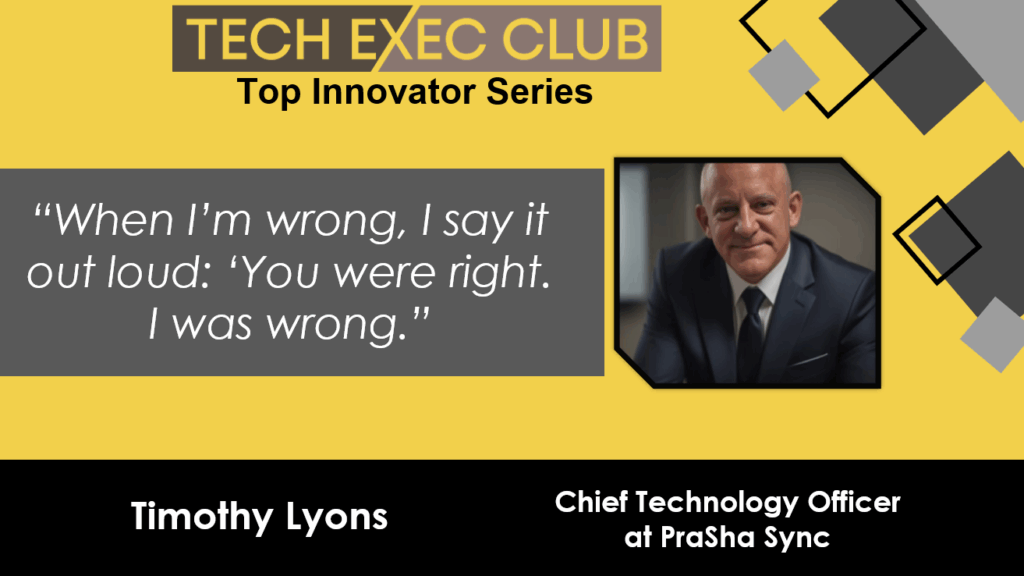
That thought kept circling my mind after sitting down with Timothy Lyons, the CTO of PraSha Sync, for an episode of the Top Innovators Series. Tim isn’t your typical tech executive. Yes, he’s led engineering and innovation teams at companies like Divinia, Eco Science Solutions, Ploom Style, and even Cisco. But what sets him apart isn’t just his technical pedigree—it’s his deeply human approach to leadership.
In our conversation, Tim opened up about his unlikely journey: from military discipline to debugging life with Sesame Street logic, from learning to listen to owning his mistakes. He doesn’t lead through hierarchy—he leads through trust, reflection, and humility.
What follows is not just a glimpse into Tim’s leadership philosophy, but a blueprint for any leader who wants to grow, adapt, and inspire—not by knowing all the answers, but by asking better questions and listening more intently than anyone else.
Leadership Is a Learned Journey, Not an Inborn Trait
Tim Lyons doesn’t believe in the myth of the “natural-born leader.” For him, leadership is something you grow into—a skill shaped by failure, reflection, and a willingness to evolve. “You don’t become a leader at the beginning,” he told me. “It’s about the journey.” That journey, for Tim, started not in a boardroom but in the mess halls and drills of military life.
There, he encountered one of his earliest leadership lessons: the concept of “commander’s intent.” It wasn’t about rigid control; it was about clearly communicating your desired outcome and then trusting your team to figure out the best path to achieve it. It’s a lesson he carried into the corporate world, where he now prefers to lead by establishing direction—not micromanaging the route.
Tim’s upbringing also played a critical role. The seventh of eight children, he grew up in what he jokingly called a “Norman Rockwell childhood.” In a home where humor, humility, and hard work were family currency, leadership wasn’t a title—it was a way of treating people.
Today, as a seasoned CTO, Tim credits his success not to technical mastery alone, but to the accumulated wisdom he has gained across various disciplines and decades. Leadership, in his view, is crafted—not conferred.
The Power of Active Listening and Following Your Team
The most striking insight Tim shared was deceptively simple: listen more. But this isn’t about nodding politely while others talk—it’s about genuinely absorbing what your team says, why they say it, and what’s left unsaid.
“People are willing and able to follow, but the leader has to be able to follow them also,” he explained. That reversal of roles—the leader following the team—is radical in many organizational cultures. Yet Tim lives by it. He seeks out people more intelligent than him in specific areas and empowers them to lead the way.
This approach requires humility. It means letting go of ego and embracing the idea that you don’t have all the answers. Tim’s not pretending here—he openly admits he knows less today than he thought he did when he was starting out. “As a young leader, I had more confidence in myself than I do now,” he said, “because I didn’t yet know what didn’t work.”
Active listening also serves another purpose for Tim: it helps build future leaders. By showing his team how he thinks and why he makes certain decisions, he’s creating frameworks for them to think independently—and take calculated risks when the moment calls for it.
Humor, Humanity, and the Aha Moments That Shape Us
Tim’s leadership journey wasn’t shaped solely by business mentors or war-room decisions. Some of his biggest lessons came from childhood—like when his mother spat in his hair to fix his cowlick before church. “It was a level playing field,” he recalled with a laugh. “She was enough of a leader and a mother to use humor in that moment—and I never forgot it.”
It’s not just a funny story. It’s a principle Tim brings to the workplace: that humor can serve as a pressure valve, a tool for empathy, and a bridge between power dynamics. Leadership, in his view, should never feel like a dictatorship. Even in moments of correction or tension, levity has a role to play.
This profoundly human approach infuses all aspects of Tim’s leadership style. He doesn’t posture, doesn’t claim perfection, and certainly doesn’t pretend to know it all. Instead, he shares moments of personal imperfection—such as being wrong, learning the hard way, or misunderstanding advice as a kid, only to realize its wisdom years later.
By owning these moments and even laughing at them, Tim brings a rare vulnerability to leadership—one that invites connection rather than control. For him, humor is not a distraction from leadership; it is a vital component of leadership. It’s a form of it.
Debugging Life with Sesame Street Logic
You might not expect a senior tech executive to pull leadership insights from a children’s TV show—but that’s exactly what Tim Lyons does. His go-to mental model? A line from Sesame Street: “One of these things doesn’t look like the other.”
At first, it sounds whimsical. But for Tim, it’s a razor-sharp diagnostic tool. Whether he’s reviewing broken code or navigating a complex team dynamic, he looks for what doesn’t fit—not to judge it, but to understand it. “Is it a good thing or a bad thing?” he asks. “Could be either. But you start from facts.”
It’s the engineer’s mindset applied to human systems. By identifying the “delta”—what changed between success and failure—you remove emotion from the equation and achieve clarity more quickly. That approach isn’t just valuable for software; it’s a leadership lens for life.
This kind of mental flexibility—borrowing lessons from unexpected places—is part of what makes Tim’s leadership style so effective. He doesn’t see boundaries between disciplines, industries, or age groups. If a truth holds up, even if it came from a puppet, he’ll use it. And that ability to synthesize wisdom from anywhere gives him an edge that’s hard to replicate.
Integrity, Mistakes, and the Courage to Own Them
If there’s a single thread running through all of Tim Lyons’ leadership insights, it’s this: integrity matters more than authority.
Tim doesn’t shy away from admitting mistakes. In fact, he leans into them. “I was wrong. You were right,” he’ll tell his team, without spin or excuse. Why? Because doing so earns trust faster than pretending to be perfect.
He sees leadership as a constant process of looking inward first. When things go wrong, his first instinct isn’t to blame others—it’s to ask, What was my role in this? That mindset, he says, doesn’t imply guilt or fault, but responsibility. It’s about understanding your impact.
This personal accountability goes beyond performance—it’s how new leaders are born. When team members see a leader own their flaws, admit to misjudgments, and remain transparent, it sends a powerful message: This is a safe space to grow, speak up, and challenge the norm.
In a world where many tech leaders hide behind data, dashboards, and jargon, Tim leads with something rare and raw: truth. It’s not always easy—but it’s always worth it.
Tim Lyons didn’t offer theoretical leadership advice. He shared a lifetime of experience grounded in humility, insight, and human connection. Here’s how you can turn his wisdom into action—starting today:
1. Stop Talking. Start Listening: Don’t just hear—listen. Active listening means understanding the why behind your team’s words. Are you really paying attention, or just waiting for your turn to speak?
2. Let Your Team Lead You: Great leaders don’t always have to lead. Sometimes, the most brilliant move is to follow your team. Trust the experts around you and give them the space to drive solutions.
3. Use Humor to Build Trust: A well-placed laugh can do more than a 10-point plan. Humor, when used with care, dissolves tension, humanizes leaders, and invites honest conversation.
4. Apply “Sesame Street” Thinking: “One of these things doesn’t look like the other.” Use this simple but powerful framework to diagnose issues—whether in code or company culture. Find the delta, remove emotion, and follow the facts.
5. Own Your Mistakes, Out Loud: Say it clearly: “You were right. I was wrong.” Vulnerability builds trust. Admitting mistakes doesn’t make you weak—it makes you real.
6. Model How You Think: Show your people not just what to do, but how you think through problems. It gives them the confidence and clarity to lead when you’re not in the room.
7. Look Inward Before You Point Outward: When something breaks, start by asking: What was my role in this? It’s not about blame—it’s about responsibility. Own your part, and others will own theirs, too.
Tim Lyons isn’t the kind of leader who chases headlines or clings to job titles. He’s the kind who listens first, leads with humility, and makes you think twice about what leadership really means.
From military command structures to Sesame Street metaphors, from childhood wisdom to executive boardrooms, Tim has built a leadership philosophy that is grounded, authentic, and unapologetically human. He doesn’t offer buzzwords—he offers lived experience. He’s the kind of leader who admits mistakes, values humor, and believes that listening is more powerful than telling.
In a world of tech disruption and constant reinvention, Tim Lyons reminds us that the best innovation in leadership isn’t about knowing more—it’s about becoming more. It was an honor to sit down with Tim and explore the principles that have guided his remarkable journey. My hope is that his insights will stay with you long after the screen fades to black—and that they will help you lead with greater clarity, courage, and compassion.
Want to hear Tim’s insights firsthand? Watch the full, live podcast interview [click here]