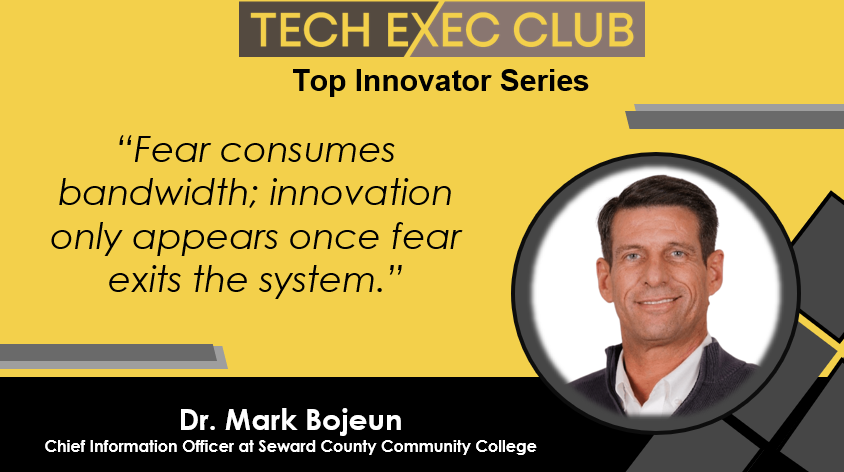
When Dr. Mark Bojeun talks about leadership, he doesn’t start with titles, strategy, or even results—he begins with ownership. In a raw, thoughtful, and refreshingly honest conversation with host Josef Martens on the Top Innovators series, Dr. Bojeun—CIO of Seward County Community College, keynote speaker, and author of Awakening Leadership—unpacks a leadership philosophy forged through years of trial, reflection, and relentless personal growth.
With an impressive track record that includes building a high-performing team with zero percent attrition for eight straight years, Mark doesn’t just talk about building successful teams—he’s lived it. But his journey hasn’t been about chasing perfection. Instead, it’s been about learning to own mistakes, create psychologically safe environments, and shift from being right to being responsible.
In this interview, Mark shares powerful insights on how emotional intelligence evolves over time, why innovation dies in the presence of fear, and how authentic leadership lies not in having all the answers but in empowering others to speak. His approach is personal, sometimes confessional, and deeply rooted in a passion for creating work cultures where trust, reflection, and learning from failure are not just buzzwords—they’re the standard.
If you’re a leader looking to evolve, a team builder seeking longevity, or simply someone curious about how to lead with more awareness and impact, this is an interview you’ll want to dive into fully.
Psychological Safety Is the Foundation of High-Performing Teams
When Dr. Mark Bojeun talks about leadership, his eyes light up at the mention of psychological safety—a concept he believes is the bedrock of any truly high-performing team. Having led a team that grew from three to 65 people with zero attrition over five years—and remained intact for three more years after his departure—Mark knows that peak performance doesn’t come from pressure or control, but from trust and empowerment.
In his experience, the most transformative teams are those where every voice matters—especially the quiet ones. “The one who says the least,” he warns, “is probably the one you need to hear from the most.” But in many IT and male-dominated environments, voices get stifled by dismissiveness, arrogance, or unconscious bias. That’s why leaders, according to Mark, must actively design environments where it’s safe to disagree and to present untested ideas.
Borrowing from agile frameworks like “divergence and convergence,” Mark fosters a space where ideas are debated—not people. “We talk tech, not personality,” he says. Titles and egos are checked at the door. This way, a culture of intellectual humility replaces hierarchy, allowing ideas to evolve into innovations that no one could have conceived alone.
Leadership Is Not About Being Right—It’s About Being Responsible
For Dr. Bojeun, a key turning point in his leadership journey was realizing that being “right” wasn’t the goal—being responsible was. This shift, he admits, came with age, experience, and plenty of mistakes. His mantra now? “Success is the team’s; failure is mine.”
He shares a telling story from his time at an engineering firm, where a mistake under his watch prompted a high-stakes board meeting. Instead of blaming his team, Mark walked in and said plainly: “I screwed up.” The effect? The room deflated its tension instantly. No finger-pointing, no politics. Just problem-solving. “How do we fix it, and how do we make sure it doesn’t happen again?” became the focus. That’s ownership in action.
This philosophy has become central to his current leadership role. “Fear consumes bandwidth,” he says. “Innovation only appears once fear exits the system.” And fear often stems from leaders clinging to being right, to perfection, to power. Instead, Mark embodies a servant-leadership model: shielding his team from blame while helping them rise.
It’s not about controlling the outcome—it’s about creating an environment where success is more likely because trust and responsibility flow top-down.
Emotional Intelligence and Self-Awareness as Evolutionary Practices
Mark’s perspective on leadership isn’t static—it’s evolutionary. Emotional intelligence, he explains, isn’t fixed like IQ. It matures. It deepens. And it must be cultivated through intentional self-awareness and experience.
He’s candid about his past. He once prided himself on always being right—even joking that his only mistake was misreading the weather in 1998. Today, he views that attitude with humility. “I used to be the office jerk,” he says, “but growth isn’t measured by perfection. It’s measured by the speed of repair.”
Mark’s book Awakening Leadership is, as he puts it, an accidental confession—an honest chronicle of lessons learned through failure, self-reflection, and becoming mindful of his impact on others. He believes a true leader must constantly assess how they show up. “I may not be evolved,” he says, “but I’m aware of the path to evolution.”
What drives him today is uncovering blind spots—what he doesn’t know about himself. Because those, he says, are the most dangerous. And they’re also the most potent opportunities for growth.
Mistakes Are Data Points, Not Disasters
In Dr. Bojeun’s worldview, mistakes are not the enemy—they’re essential. He believes strongly that if you’re not making mistakes, you’re not innovating. More importantly, how a leader handles mistakes determines whether a team grows or shuts down.
Failure, he says, should be de-stigmatized. “It’s just a data point,” he explains. Blame, on the other hand, kills creativity. In his team culture, owning mistakes isn’t a weakness—it’s a signal of strength and trust. By taking full ownership of his own errors, Mark removes the team’s fear of retribution. “If I can say, ‘Hey, I messed up,’ then others feel safe to speak up too,” he says.
This creates a cultural feedback loop in which learning is continuous, and innovation thrives. It’s why he emphasizes that psychological safety isn’t about comfort—it’s about capacity. Teams become more capable when they’re not wasting mental energy hiding failures or defending egos.
Mark also quotes Bill Gates: “I never learned anything from success.” That ethos runs through every decision he makes as a leader. It’s not about avoiding mistakes—it’s about learning faster from them than anyone else.
Leadership Begins with Reflection and Continual Self-Discovery
Mark’s evolution as a leader didn’t come from promotions or titles—it came from pausing long enough to reflect. And that, he says, is what most leaders forget to do.
He recalls spending years commuting five hours a day in D.C., never taking time to reflect on who he was or the impact he had. Only later did he realize that making time for reflection was the key to unlocking better leadership.
Now, Mark practices mindfulness, daily emotional check-ins, and encourages leaders to integrate personal growth into their routines. Leadership, he argues, is dynamic. It’s not something you become and stay—it’s something you practice and refine every day.
He encourages exercises from his book that are designed to reveal unconscious programming, challenge knee-jerk reactions, and increase awareness of blind spots. One of his most powerful ideas? Leaders should be handed a mirror showing them how they are perceived by others. Because, as he puts it, “If you could see how you are seen, you’d be shocked.”
To Mark, leadership isn’t about control or charisma. It’s about consciousness—and the willingness to evolve with every interaction.
If you’re a leader, aspiring executive, team builder, or simply someone who wants to create a better work culture, here are the key actions inspired by Dr. Mark Bojeun’s leadership philosophy:
- Prioritize Psychological Safety in Your Teams: Create space for all voices, especially the quiet ones. Don’t just allow input—actively seek it. Replace judgmental responses (“that won’t work”) with curiosity (“let’s explore that”). Use structured frameworks like divergence/convergence to debate ideas, not people.
- Shift from Being Right to Being Responsible: Let go of the ego-driven need to be correct. Own team failures publicly. Take full accountability so your team doesn’t live in fear. Lead by example: If you can say “I screwed up,” you empower your team to do the same.
- Make Reflection a Daily Habit: Block time to reflect—not once a quarter, but daily. Ask yourself: “How did I show up today?” Use journaling, meditation, or structured leadership exercises to explore your blind spots. Growth starts with self-awareness.
- Normalize Mistakes as a Pathway to Innovation: Cultivate a culture where failure is seen as a data point, not a disaster. Encourage experimentation and protect those who take risks. Create team rituals around “lessons learned,” not “who’s to blame.”
- Lead with Emotional Intelligence and Mindfulness: Stay present in every conversation. Don’t plan your next reply—listen to understand. Model emotional regulation, especially during stress or crisis. Understand that leadership is dynamic: regression happens, but the speed of repair is everything.
- Read Awakening Leadership: Dive into Dr. Mark Bojeun’s book (available on Amazon Kindle and in print) for deeper stories, practical exercises, and leadership strategies. Use it as a guide to grow self-awareness and evolve into a conscious, responsible leader.
Dr. Mark Bojeun doesn’t wear leadership like a badge of honor—he wears it like a responsibility. Through vulnerability, clarity, and a deep commitment to personal growth, he invites us to rethink what it really means to lead. His journey—from managing high-performing teams with zero attrition to writing a book that reads like a leadership confession—offers a refreshing model for building organizations that last, innovate, and care.
As CIO of Seward County Community College, Mark continues to put his principles into practice daily, creating environments where ideas—not egos—thrive and leadership is measured not by control but by the capacity to inspire. His story is a reminder that authentic leadership is not about being the smartest in the room—but about making sure every voice in the room is heard, respected, and empowered.
Dr. Bojeun isn’t claiming to be fully evolved. He says it best himself: “I’m not woke—I’m waking up.” And in that spirit, he challenges us all to do the same.
Want to hear Dr. Mark Bojeun’s insights firsthand? Watch the full, live podcast interview [click here]