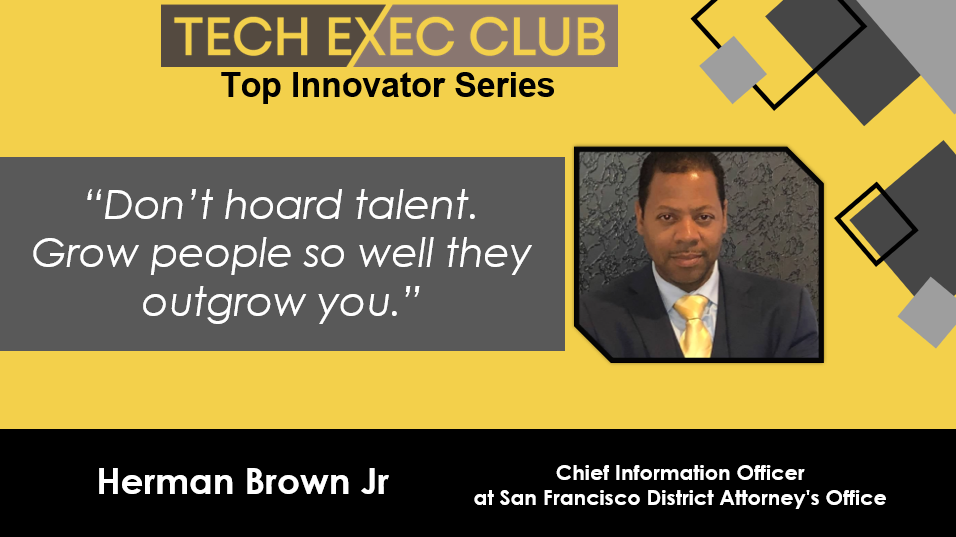
In a world where leadership is often measured by titles and corner offices, Herman Brown Jr offers a radically human perspective. As the Chief Information Officer for the San Francisco District Attorney’s Office, Herman Brown Jr isn’t just leading technology teams—he’s redefining what it means to lead with purpose, empathy, and respect.
In this episode of the Top Innovator Series, host Josef Martens sits down with Herman to uncover the driving forces behind his leadership journey—from his early days running cable as a systems engineer, to learning hard lessons in the military, and rising to the highest levels of public sector IT. What emerges is a portrait of a leader who believes the accurate measure of success lies not in holding onto top talent, but in preparing and encouraging them to grow beyond you.
Brown’s story is more than a career retrospective—it’s a leadership masterclass rooted in humility, mentorship, and a commitment to empowering others. Whether you’re leading a team of five or five hundred, the insights from this candid conversation will challenge your assumptions and inspire a new kind of leadership.
Leading with Respect: A Principle Learned Early and Honed Over Time
For Herman Brown Jr., respect isn’t a leadership strategy—it’s a way of life. He credits his parents with planting the seeds of this principle early on. “Treat others the way you want to be treated,” they told him, a phrase that has guided his professional conduct ever since. But the true power of respect didn’t fully reveal itself until Herman climbed the ladder, from running network cables to becoming CIO of the San Francisco District Attorney’s Office.
As he moved through different levels of IT, he never forgot what it felt like to be at the bottom. That memory shaped how he interacts with his team today: with compassion, empathy, and a deep understanding that everyone has a life beyond their title. “To earn respect,” he says, “you have to give it.” Brown’s leadership style is rooted in building trust by seeing people as individuals, not just employees. He doesn’t view his role as managing talent—he sees it as nurturing potential.
This people-first approach has made him a magnet for loyalty. Team members routinely tell him they’d follow him wherever he goes. But it’s not because he’s demanding or rigid—it’s because he leads by example. In his current role, Herman Brown Jr is credited with leading the most productive technology team in the history of the San Francisco District Attorney’s Office.
From Military Service to Municipal Leadership: Lessons in Discipline, Adaptability, and People Management
Transitioning from the U.S. military into the private sector and later into public service, Herman Brown Jr absorbed a wide range of leadership philosophies. Each chapter of his career added new layers to his identity as a leader—but the one constant was discipline. The military taught him structure, clarity, and how to follow orders. But more importantly, it taught him how to navigate differences and achieve a common goal despite personal disagreements.
“In the military, you don’t have to like the people you work with,” Herman says. “But you have to respect them—and work toward the mission together.” That mindset carried over into civilian leadership, where he found the public and private sectors had vastly different expectations. In the private sector, initiative is prized. In government, political dynamics must be navigated thoughtfully. Leading with empathy, in Herman Brown Jr’s view, does not mean lowering standards or sacrificing results—it means creating the conditions for sustained high performance.
Interestingly, Herman never had a formal mentor. Instead, he became a keen observer. Watching how different leaders conducted themselves—how they treated others in meetings, how they handled conflict—became his real-life MBA. He learned what to emulate and what to avoid.
This self-guided, experience-driven leadership journey makes Herman a rare blend: part soldier, part strategist, and entirely human. His toolkit is diverse, but his goal is singular—build a team culture where people thrive.
The Power (and Pain) of Being Overlooked: A Leadership Awakening
One of the most formative stories Herman shared was a moment of profound disappointment—being passed over for an engineer trainee role after serving in the military and working hard for nearly a year at a small tech firm. The job went to a kid fresh out of high school. Herman was stunned.
When he confronted his supervisor, the answer shocked him even more. “You’re too good,” the supervisor admitted. “We couldn’t afford to lose you.”
It was a backhanded compliment that carried a painful truth. Herman’s competence had become a trap. But instead of growing bitter, he turned that moment into a leadership lesson that would define how he manages others: never hold someone back just because they’re valuable. “My job,” he explains, “is to prepare my team to move on—even if it means losing them.”
This philosophy shows up in countless moments throughout his career. Whether advocating for a colleague’s promotion or refusing to block a transfer that would benefit someone’s career, Herman consistently chooses to invest in people’s growth over protecting his own interests. It’s an approach he compares to parenting—raising team members with care so they can go out into the world, represent the organization well, and make their own mark.
In a field where talent hoarding is often the norm, Herman’s countercultural stance stands tall. His pain became his purpose—and his team is better for it.
Building Connection in the Hybrid Era: Culture, Conversation, and Ninja Assassins
In today’s hybrid workplace, many leaders struggle to maintain cohesion. Not Herman Brown Jr. He’s found innovative—and refreshingly human—ways to keep his team connected beyond the bandwidth.
Every week, his team gathers in person for a casual check-in that starts not with KPIs or performance metrics, but with a real conversation. “We talk about current events, people’s kids, holidays, what folks did for New Year’s,” Herman says. “It’s about creating a sense of belonging.” These relaxed, personal touchpoints help build trust and camaraderie in a world increasingly defined by screens.
But Herman doesn’t stop at small talk. He spices up meetings with quirky icebreaker questions like, What animal would you be? Or if I had a magic wand and you could do any job in the world—no restrictions—what would it be? One team member surprised everyone by saying she’d love to be a ninja assassin. It was a funny, unexpected moment—but also a powerful reminder that people are multifaceted, full of dreams and humor.
Herman believes these informal rituals help people feel seen and safe—a critical foundation for collaboration. In an era where work can feel transactional and detached, his meetings are a breath of fresh air. They’re not just about information-sharing. They’re about relationship-building. And in that, he excels.
Leadership in the Age of AI and Disconnection: Fears, Hopes, and Staying Human
As Herman looks ahead, he sees two competing forces shaping the future of leadership: the rise of AI and the decline of human connection. Post-COVID hybrid work environments have changed the game, and now artificial intelligence is adding another layer of uncertainty. But Herman’s most significant concern isn’t automation—it’s alienation.
He recounts a story from a friend who noticed his teenage children texting their dinner companions instead of speaking to them—despite sitting at the same table. For Herman, that anecdote is a cautionary tale. “I hope we don’t lose the ability to have face-to-face conversations,” he says. “That’s our future.”
While many leaders chase digital transformation, Herman focuses on preserving emotional intelligence. He’s not anti-tech—far from it—but he’s pro-human. He urges tech leaders to stay grounded, to foster honest dialogue, and to never forget that behind every system and screen is a person.
His worry is not that machines will take over—it’s that we might willingly trade human interaction for efficiency. And that, he argues, would be a loss no AI can repair.
The future of leadership, in Herman’s view, will belong to those who balance innovation with intentional human connection. And as always, he plans to lead by example.
Herman’s leadership journey isn’t just a story—it’s a roadmap. Whether you’re a seasoned executive or an emerging leader, his insights offer actionable lessons you can implement right now. Here’s how to take what you’ve learned and put it into practice:
- Lead with Respect—Always: Treat every team member as a whole person, not just a role or function. Remember: respect is earned by first giving it. Create space for people to be heard, seen, and understood.
- Help People Grow, Even If It Means Losing Them: Don’t hoard talent—invest in your team’s career path, even when it leads them away from you. Schedule regular 1-on-1s to ask about personal and professional goals. Celebrate when a team member outgrows their role—it means you did your job as a leader.
- Learn from Every Leader—Good or Bad: Observe the leaders around you; learn what to do and what not to do. Keep a journal of leadership behaviors you admire and want to adopt. Don’t wait for a formal mentor—build your own leadership model from your own experiences.
- Make Space for Human Moments: Open team meetings with informal conversations to build psychological safety. Use icebreaker questions to spark laughter and personal connection. Foster a culture where being yourself is not just allowed—but encouraged.
- Stay Human in a Tech-Driven World: As AI and remote work expand, double down on empathy and face-to-face connection. Prioritize team engagement over productivity dashboards. Remind your people: technology is a tool, not a replacement for humanity.
Herman Brown Jr is not your typical CIO. He’s a veteran, a public servant, a technologist—and above all, a profoundly human leader. His journey from the military to municipal government, from overlooked engineer to executive leader, is marked not by ambition alone but by an unwavering commitment to people.
In an era where leadership is often obsessed with speed, systems, and scale, Herman brings us back to something timeless: integrity, empathy, and the quiet strength of doing what’s right, even when no one’s watching. His story reminds us that leadership isn’t about titles—it’s about impact.
By empowering his team, encouraging growth, and staying grounded in respect, Herman Brown Jr shows us what authentic leadership looks like. He doesn’t just lead systems. He leads hearts and minds—and in doing so, leaves a legacy far greater than any technology he implements.
Want to hear Herman’s insights firsthand? Watch the full, live podcast interview [click here]