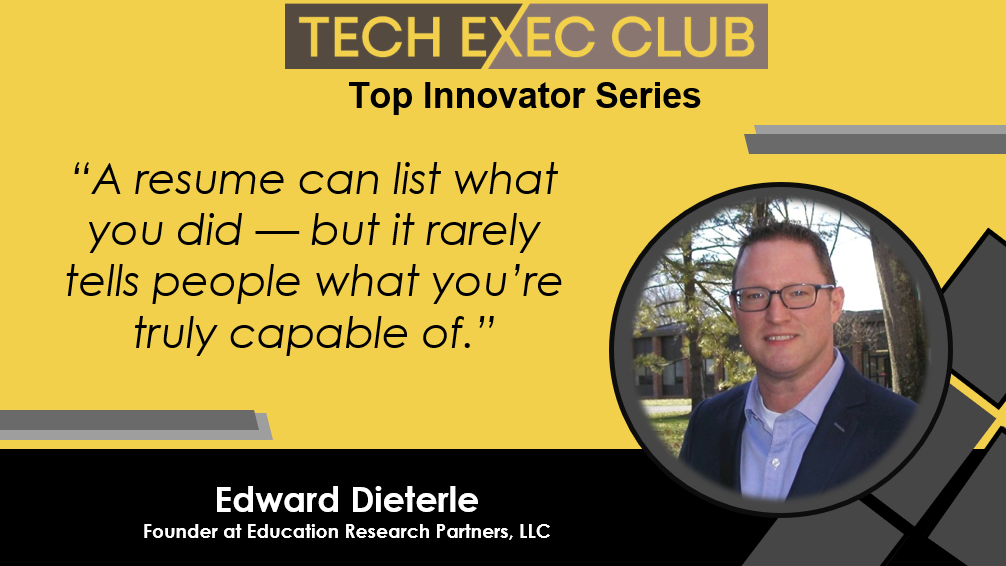
In a world where prestige and power often define success, Ed Dieterle dares to lead differently. As the founder of Education Research Partners and a former senior research officer at the Bill and Melinda Gates Foundation, Dieterle’s career is a testament to bold decisions driven not by status, but by values. In this episode of the Top Innovator Series, host Josef sits down with Ed to explore the leadership principles that have guided his path — from data-driven education reform to redefining career narratives with powerful visual tools.
What emerges is a rich conversation about the invisible compass behind transformative leadership. Ed shares the pivotal moment his son’s heartbreaking words prompted him to leave one of the most coveted roles in education philanthropy, the design of a career visualization tool that reframes the way we think about professional growth, and why enduring values — not titles — should shape your leadership legacy.
Whether you’re a young leader navigating your path or a seasoned executive looking to align purpose with impact, Ed’s story will challenge and inspire you to rethink how success is measured.
Leading with a Values-Based Compass
At the heart of Ed Dieterle’s leadership philosophy lies a simple yet profound idea: success only feels like success when it aligns with your core values. In our interview, Ed shared that his professional “compass” is grounded in three enduring values — being healthy, being a good family member, and doing good in the world. These, he believes, don’t change. But the goals we set — those should constantly evolve, guided by those foundational principles.
Nowhere is this more evident than in one of the most defining moments of his career: resigning from a high-powered role at the Bill and Melinda Gates Foundation. On paper, Ed was thriving — working with top researchers, visiting schools across the country, and making a meaningful impact in education. But a moment of clarity came from his young son’s voice: “I’m forgetting what you look like.” That sentence hit Ed like a lightning bolt.
Within days, he made the unconventional and challenging decision to step away from his prestigious position. It wasn’t because he lacked success — but because he was measuring success by a deeper, more personal standard. That moment crystallized what the compass truly meant: when your goals diverge from your values, it’s time to pivot — even if it means walking away from power.
The Power of Career Visualization & Durable Skills
After a non-linear career path that spanned teaching, research, data analytics, and leadership, Ed found himself at a professional crossroads. His resume — while rich in experience — appeared disjointed to others. That’s when his wife suggested a brilliant idea: don’t just tell your career story, show it.
Ed created a visual resume—a graphic that mapped not just what he had done but the skills he had built along the way. He separated his experience into two categories: activities and durable skills. The former captured what he did in each role; the latter distilled the lasting capabilities he developed — such as applying mixed-methods research, leading interdisciplinary teams, and translating data into policy-relevant insights.
The durable skills were compelling. Unlike job titles or tasks, they were transferable, cross-sectoral, and future-proof. This reframing allowed Ed not only to reconnect with his past but also to project into his future, identifying roles and missions that will enable him to build on his strengths.
Now, Ed uses this tool with teams, helping others see their own work through the lens of growth and potential. “It’s a continuum,” he says. “When you know what skills you’ve built — and what you want to expand — your next step becomes much clearer.”
Embracing Cross-Disciplinary Learning
One of Ed’s most powerful leadership tools isn’t a framework or a spreadsheet — it’s curiosity. Throughout his journey, he’s made a habit of stepping outside his comfort zone to collaborate with people who see the world differently.
Whether it was econometricians at a data firm or computer scientists at the Gates Foundation, Ed gravitated toward interdisciplinary partnerships. “You can learn a lot when you find people who have a common interest but see the world through different disciplinary eyes,” he says. The key? Sustain the conversation long enough to uncover blind spots — both yours and theirs.
He tells the story of being tasked with leading research on student engagement. This deceptively simple topic became complex once psychologists, engineers, data scientists, and educators were brought to the table. The breakthrough came not from a single discipline, but from the bridges they built between disciplines.
This openness to diverse perspectives isn’t just about learning; it’s about innovation. When disciplines collide, new insights emerge — ones that may never arise within silos. It’s a reminder to leaders everywhere: if your team all thinks the same way, you’re not maximizing your potential.
Mentorship, Growth & Continuous Learning
“You don’t have to be sick to get better.” That phrase, offered by a mentor, has stuck with Ed throughout his career. It’s a leadership philosophy rooted in humility — and the recognition that growth isn’t reserved for crises. It’s a daily discipline.
Ed credits much of his growth to a trusted network of mentors, advisors, and, yes, his wife. He shares how her insight helped him reframe his resume, but her influence goes deeper. “She’s much smarter and wiser than I am,” he says, only half-joking. Her clarity, combined with feedback from professional peers, helped Ed not only navigate transitions but also embrace them as opportunities for reinvention.
He also believes growth is reciprocal. These days, much of his energy is spent mentoring younger researchers, helping them think critically about their work and their goals. He encourages them to ask not just what they’re studying, but why it matters, and who it will help.
This mentoring isn’t a one-way street. “When they share what they’ve learned,” Ed says, “it keeps my knowledge base fresh.” For him, leadership isn’t about arriving at a final form — it’s about remaining forever curious, open, and teachable.
The Future of Education, AI & Measurement
Ed’s eyes are firmly on the horizon. Two major themes dominate his current thinking: chronic absenteeism in schools and the ethical application of AI in education. Both, he believes, are urgent—and both require measurement tools that don’t just inform but empower.
Chronic absenteeism isn’t just a logistical issue; it’s a long-term equity problem. Students missing large chunks of the school year face reduced academic outcomes and limited life opportunities. Ed is working with partners to understand the causes — and, more importantly, the consequences — of this growing crisis.
Simultaneously, as AI transforms every sector, education is no exception. Ed warns that while the tools are powerful, they’re not infallible. Ethics must keep pace with innovation. “We need to ensure others are aware of the limits of what these tools mean,” he cautions.
Finally, Ed is focused on something most researchers overlook: what happens after the findings are released. He wants to make sure data doesn’t just sit in reports, but drives real change. “It’s not enough to do valid research,” he says. “You need to help people use it — to understand it, to act on it.”
Whether you’re a seasoned executive or an emerging leader, Ed Dieterle’s journey offers practical tools and mindsets you can apply today. Here’s how to take action based on his insights:
1. Build Your Values-Based Compass: Write down your core values. Align your professional goals with those values. If you’re feeling unfulfilled despite hitting milestones, this misalignment may be the cause. Revisit your compass regularly. Use it to evaluate big decisions, just as Ed did when choosing family over prestige at the Gates Foundation.
2. Map Your Career Using Activities & Durable Skills: Create a visual resume that separates your roles into “activities” (what you did) and “durable skills” (what you carry forward). Identify transferable skills, such as leadership, data interpretation, and team building. Use this map to plan your next steps and reveal new opportunities aligned with your growth.
3. Collaborate Across Disciplines: Seek out conversations beyond your field. Find professionals who share common interests but bring different perspectives. Sustain those dialogues — innovation happens when ideas collide. Ask others to point out blind spots that your own field might overlook.
4. Commit to Continuous Growth: Embrace the mindset: “You don’t have to be sick to get better.” Strive for improvement even when things are going well. Build a network of mentors who can challenge and guide you through transitions. And remember, mentoring others sharpens your own thinking and leadership.
5. Bring Data to Life with Purpose: Focus on the practical impact of your work. Ask yourself: Who will use this? How will they use it? Ensure emerging technologies, like AI, are applied ethically and transparently. Use your measurement skills to tackle pressing issues — from chronic absenteeism to educational equity — and turn insight into meaningful action.
Ed Dieterle is not just a leader — he’s a blueprint for purpose-driven success in an increasingly noisy world. From the classrooms where he began, to the corridors of power at the Gates Foundation, to founding his own research firm, Ed has remained unwavering in one thing: his values. He reminds us that success isn’t about climbing ladders — it’s about knowing which wall the ladder is leaning on.
With his innovative career-mapping tool, his commitment to interdisciplinary collaboration, and his passion for turning research into real-world change, Ed is a rare kind of leader — one who blends humility, insight, and action. His story isn’t just inspiring; it’s a challenge to all of us: to pause, reflect, and ask — are we leading in alignment with what truly matters? In a time when leadership is too often confused with title or speed, Ed Dieterle shows us what it means to lead with integrity, to grow through learning, and to make decisions that resonate for a lifetime—not just a LinkedIn update.
Want to hear Ed’s insights firsthand? Watch the full, live podcast interview [click here]