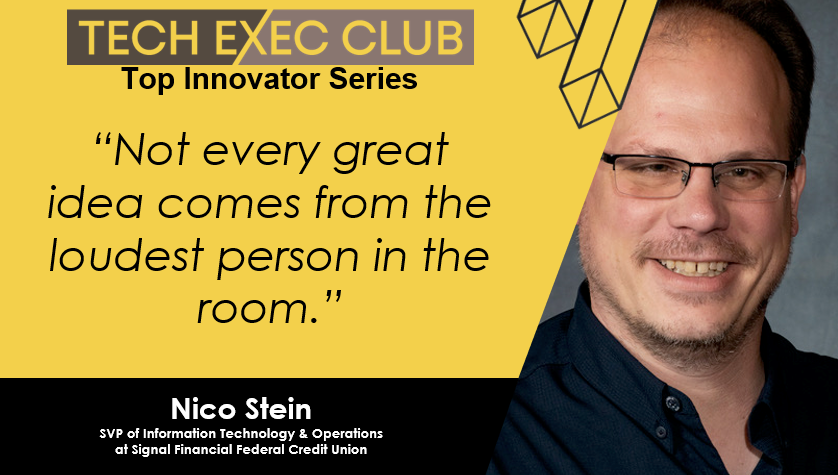
Inside the leadership mind of Nico Stein, SVP of IT at Signal Financial, and why screwing up might be your greatest strength.
In today’s episode of the Top Innovator series, we meet a leader who doesn’t just tolerate mistakes—he celebrates them. Meet Nico Stein, SVP of IT at Signal Financial Federal Credit Union, a technologist-turned-trailblazer whose unfiltered leadership approach is refreshing and practical.
With experience at giants like IBM and at academic institutions like the Catholic University of America, Nico brings more than technical know-how-he brings humanity, grit, and humility. In his candid conversation with host Josef Martens, Nico dives deep into the uncomfortable truths of leadership: Why failure is essential, how to lead from the trenches, and why hype is the enemy of real progress.
Whether you’re a seasoned executive or a rising star in tech, Nico’s story is a masterclass in how authentic leadership can shape high-performance teams and resilient cultures—without ever losing sight of what really matters.
Leading by Example: In the Trenches with the Team
In a world where many tech leaders are quick to delegate and slow to empathize, Nico Stein breaks the mold. As SVP of IT at Signal Financial, he doesn’t just set expectations—he lives them. “Lead by example” isn’t a buzzword for Nico; it’s how he builds his team’s trust and cohesion.
Whether it’s staying overnight during critical system upgrades or understanding the pressure of a network outage from his own early days in help desk roles, Nico’s frontline experience creates credibility. “I know what it feels like to be under fire,” he says, “so when I ask people to go above and beyond, they know I’ve been there too.”
This philosophy creates a foundation of mutual respect. When the leader is shoulder-to-shoulder with the team, working through outages or complex deployments, the message is clear: we succeed—or fail—together. It’s no wonder Nico’s teams are known for their loyalty and performance.
His presence isn’t just symbolic. It instills a culture where leadership is earned, not assumed. And in an industry where burnout and high turnover are common, Nico’s commitment to “being in the trenches” may be the secret weapon that keeps his people engaged, motivated, and willing to push the limits.
Failure Is Mandatory: Why Screwing Up Matters
“If you don’t screw up, you’re not doing anything important.” That’s not a motivational slogan—it’s Nico Stein’s leadership mantra. In a high-stakes field like IT, where outages and missteps can bring business to a halt, Nico’s counterintuitive take on failure is both refreshing and revolutionary.
Early in his tenure at Signal Financial, Nico accidentally knocked all the branches offline during a network change. “The moment I hit Enter, I knew I messed up,” he recalls. Instead of denial or panic, he owned it. His boss responded not with punishment, but with trust—a lesson Nico has carried forward into his own leadership style.
Today, he tells his team that making mistakes is not just acceptable—it’s inevitable. What matters is how you respond: own it, fix it, learn from it. “Don’t screw up resetting a password,” he jokes, “but if you mess up while trying something bold? That’s where growth happens.”
This mindset does more than protect morale; it fuels innovation. In a culture where failure is decriminalized, people take risks. They experiment. They stretch. And that’s where breakthrough ideas come from.
Nico’s approach is a leadership masterclass: build a culture where the fear of failure doesn’t stifle creativity—and watch your team soar.
Culture of Safety: Making Room for Innovation and Surprise
For Nico, innovation doesn’t start with technology—it begins with trust. “If your team is spending all their energy covering their own ass,” he says bluntly, “they’re not going to try anything bold.” In his view, psychological safety is the foundation on which creativity, experimentation, and authentic leadership are built.
In environments where minor mistakes trigger significant consequences, employees retreat. They stick to the script, avoid risks, and clock in mentally checked out. Nico’s leadership flips that script entirely. He creates space for people to voice doubts, test new ideas, and, yes, make mistakes without fear of being thrown under the bus.
That freedom has produced some of his proudest moments—not from projects, but from people. He lights up when talking about teammates who quietly surprised him. “Someone would say, ‘Hey, I thought of this last night,’ and it turns out to be brilliant. I didn’t see it coming, and that’s the best part.”
This culture doesn’t emerge by accident. It’s carefully nurtured through humility, transparency, and empathy. Nico knows not every team member is gunning for promotion or glory. Some want to do good work and be seen for it. He meets them where they are, and in doing so, unlocks potential that other leaders might overlook.
The Evolving Leader: From Engineer to Visionary
Despite his title, Nico admits that stepping away from hands-on IT work has been a personal challenge. “I’m an engineer at heart,” he says. “I love the details, the problem-solving, the day-to-day.” But as his leadership journey matures, Nico is learning to zoom out—and think bigger.
Part of that growth involves letting go of the “small stuff,” a lesson passed down by trusted mentors. Whether it’s a minor bug or a workflow debate that derails a meeting, Nico is learning to ask: Does this really matter in the grand scheme of things?
He’s also turning his focus to the horizon. Not just the next quarter—but the next wave. Trends like AI, once niche topics within IT, have gone mainstream. Nico wants to be the kind of leader who identifies game-changers before they hit the news cycle.
It’s not about chasing buzzwords—it’s about having the vision to prepare his organization for what’s next. That means stepping back from operations, even when it’s uncomfortable, and adopting the “bird’s eye view” required of transformative leadership.
For Nico, this next chapter is as much about mindset as it is about skill. It’s the shift from solving tickets to shaping strategy—and it’s a leap he’s ready to take.
Beware the Hype: A Technologist’s Plea for Skepticism
In the fast-moving world of tech, shiny new trends come and go like clockwork. For Nico Stein, experience has bred skepticism. “I’ve seen it all,” he says. “Blockchain was supposed to change everything. Now it’s AI. In five years, it’ll be something else.”
That doesn’t mean he dismisses innovation, far from it. Nico is deeply engaged with emerging technologies. But he warns against treating new tools as silver bullets. “Technology won’t fix broken workflows or toxic cultures. It’s a tool—not a miracle.”
Nico’s frustration is especially pointed when organizations throw themselves headfirst into the hype, slashing budgets or firing support staff under the illusion that automation will do it all. The result? Disillusionment, dysfunction, and a whole lot of regret.
Instead, Nico champions a pragmatic, strategic approach. Evaluate technologies, yes—but through the lens of real organizational needs. Don’t fire your help desk team just because ChatGPT hit the news. Don’t invest in blockchain if you don’t have a process problem to solve.
His advice to fellow leaders is simple but profound: “Be curious, but be cautious. Hype fades. Fundamentals last.”
Nico Stein’s leadership is a rare mix of realism, trust, and courage. If you’re looking to grow as a leader—or build a stronger, more resilient tech team—here are seven concrete actions you can take based on his insights:
1. Lead from the Front Lines: Don’t lead from behind a desk. Show up when it matters—during outages, upgrades, late-night rollouts. Your presence creates credibility and solidarity with your team.
2. Make Failure Safe and Expected: Encourage your team to take risks, even if it means screwing up. Normalize mistakes by sharing your own failures. Make it clear: it’s worse to do nothing than to fail at something bold.
3. Build a Culture of Psychological Safety: Eliminate blame culture—don’t let mistakes trigger HR escalations. Create an environment where people feel safe to experiment. Reward creative thinking—even if it doesn’t always succeed.
4. Step Back and See the Bigger Picture: Don’t get lost in the technical weeds. Look for upcoming trends, shifts, and opportunities beyond the daily grind. Evolve from a technical doer to a strategic thinker.
5. Balance Tech Trends with Real Needs: Evaluate technologies like AI or blockchain through a business-first lens. Don’t chase hype—solve real, structural problems. Train your team to think critically about trends before diving in.
6. Tap into Outside Perspectives: Seek insight from people outside your industry. Use their experiences to shape how you lead and solve problems. Stay grounded by talking to those who don’t speak tech fluently.
7. Adapt Leadership to Generational Differences: Recognize that Gen Z and Gen X operate differently—and that’s okay. Flex your leadership style to match their work approach. Focus on results, not methods. Adaptability beats rigidity.
Nico Stein isn’t your typical tech executive. He’s not hiding behind dashboards or chasing the next shiny trend. He’s down in the trenches with his team, embracing failure, building trust, and evolving from a hands-on engineer to a forward-looking leader.
What makes Nico stand out is not just his technical expertise—it’s his emotional intelligence, his skepticism in the face of hype, and his unwavering belief in people. He knows leadership isn’t about being flawless; it’s about creating space where others can thrive, mess up, recover, and grow.
In a time when AI, automation, and rapid digital change dominate the narrative, Nico reminds us that true innovation starts with culture—not code. His leadership philosophy proves that human connection and humility are still the most powerful tools in any tech leader’s toolkit.
As we look to the future of IT and leadership, Nico’s journey is a reminder: you don’t have to be perfect, you have to be honest, present, and willing to grow.
Want to hear Nico Stein’s insights firsthand? Watch the full, live podcast interview [click here]