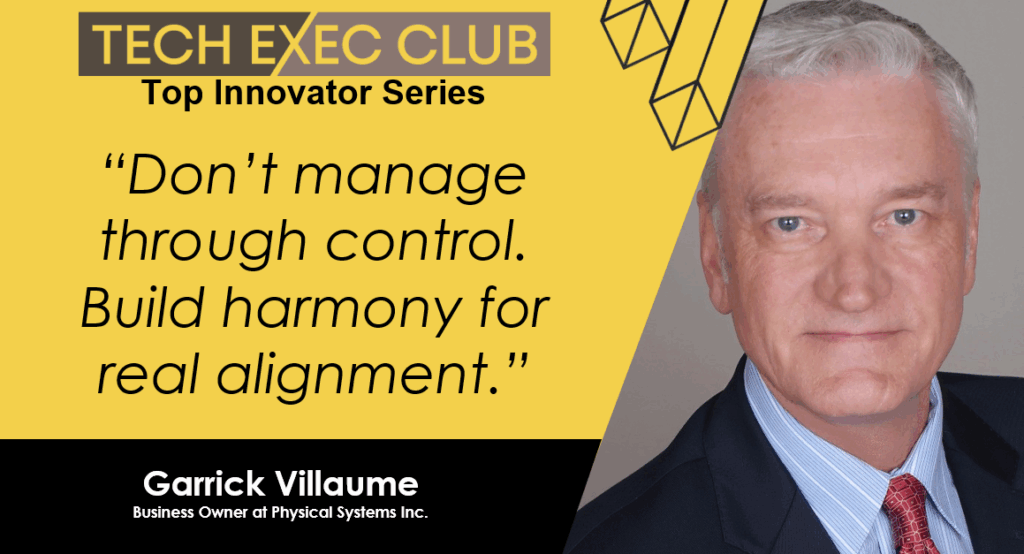
In a world obsessed with rapid results and disruptive innovation, Garrick Villaume stands out as a quiet revolutionary — one who doesn’t just do leadership but understands it at its core, like a physicist studying the universe.
As the owner of Physical Systems Inc. and with a career spanning executive roles at tech companies like Global RAIS and Nuxsen, Garrick has navigated the complexities of both human and technical systems. But what truly sets him apart is his relentless pursuit of root causes — and his belief that leadership is less about control and more about harmony.
In this episode of the Top Innovator Series, Garrick sat down with host Josef to explore the layers beneath his success: the physics-inspired mindset that drives his decisions, the elegant framework he’s developed for organizational transformation, and the hard-earned lessons from decades in the trenches of tech leadership.
What follows is a compelling journey into the mind of a leader who’s part scientist, part philosopher — and entirely grounded in purpose.
Root Cause Thinking & Physics-Inspired Leadership
At the heart of Garrick Villaume’s leadership philosophy is an instinct that began long before he entered the corporate world — a desire to understand systems at their core. Trained in physics and inspired by the likes of Einstein and Oppenheimer, Garrick carries into business a scientist’s obsession: he doesn’t just want to fix symptoms, he wants to uncover why problems happen in the first place.
His approach is rooted in inquisitiveness and relentlessness. As he puts it, “I have a fairly relentless tendency to pursue a root cause. Why is something happening? What are the dynamics of a situation?” This mindset led him into physics as a profession and later into executive leadership, where it proved equally valuable.
But Garrick doesn’t stop at technical causality. He applies the same intellectual rigor to human dynamics, seeking out the deeper structures behind behavior, communication, and resistance to change. His leadership is a blend of systems analysis and people science — a rare and potent mix.
In many ways, Garrick represents a return to first principles thinking in leadership. He strips back complexity not to oversimplify, but to make room for clarity. For him, business isn’t just about hitting KPIs — it’s about understanding what’s beneath the dashboard, why things are working (or not), and building sustainable systems from the inside out.
The Harmony Principle: Leadership Beyond Models
Ask Garrick what matters most in leadership, and he won’t recite a management model. He’ll tell you about harmony — a concept that at first sounds abstract but, in his hands, becomes a practical force for organizational change.
“Harmony,” he explains, “means helping people come into alignment across multiple dimensions — how they see the data, how they define terms, how they prioritize values.” For Garrick, it’s this alignment — not hierarchy, not control — that creates a functioning system.
It’s a deeply human-centered view of leadership, but one with scientific roots. Like wave theory in physics, where different frequencies can amplify or cancel each other out, he sees leadership as a process of tuning a team until everyone’s working in resonance. That means addressing ambiguity head-on, translating complexity into shared understanding, and cultivating trust.
His method isn’t about enforcing uniformity — it’s about synthesizing diversity into something that works. “No framework is going to ideally describe the situation,” he says. “But if you can bring people into harmony, you can bridge symptoms to causes, facts to values, and teams to outcomes.”
It’s not just poetic; it’s practical. Garrick’s leadership success — across industries and decades — stems from this ability to build cohesion out of chaos. He doesn’t manage from the top down. He listens, aligns, and shapes the conditions for high-functioning, purposeful collaboration.
The Surprising Challenge of Change Resistance
Garrick Villaume knows how to build solutions. But what truly surprised him over the years wasn’t the complexity of technical problems — it was the resistance to fixing them, even when everyone agreed there was a problem.
In one memorable case, he recalled working in an organization where teams constantly complained about the inefficiencies of their tools and systems. Yet, when presented with a new solution — one that addressed their exact concerns — “the reluctance to contribute or adopt it was overwhelming.”
This experience revealed a more profound truth: change isn’t blocked by logic — it’s blocked by fear, inertia, and culture. Garrick learned that introducing new systems or frameworks is only half the battle. The other half is navigating the human reluctance to let go of familiar dysfunctions.
It was a humbling lesson that ultimately led him to create his own framework for organizational change — one that centers the human element. He now sees change not just as a technical process but as a cultural negotiation.
Garrick’s insight? “The technical solution is just a part of the equation.” Real change happens when people believe in the purpose, trust the process, and feel aligned with the mission. This people-first realization transformed his leadership and has informed his consulting work ever since.
Elegant Models for Complex Systems
After decades in industry, Garrick distilled his experience into a deceptively simple framework: People, Purpose, Precepts.
Behind this triad is a rich foundation of physics, complex systems theory, and decades of real-world leadership. Garrick sees every organization as a dynamic system — not unlike a physical one — governed by forces, constraints, and symmetries. But instead of focusing on outputs or performance metrics first, he zooms in on the human layer.
“Without people, there is no plan. No strategy. No purpose,” he says. People aligned around a shared purpose and guided by precepts — shared values and assumptions — form the living engine of any organization. These are the elements that either unlock momentum or stall it entirely.
His model is elegant, not because it’s simplistic, but because it translates deep system dynamics into something actionable. He talks about fractal patterns, symmetry, and invariance — concepts from theoretical physics — as metaphors for how healthy organizations grow, adapt, and endure.
In an age when leaders often reach for the latest buzzword or agile framework, Garrick’s approach is refreshingly grounded. It’s about knowing what truly drives transformation — and designing from the inside out, not the outside in.
A Critique of Modern Tech Leadership
Near the end of the interview, Garrick doesn’t hold back. Asked what he would change about tech leadership today, he offers a piercing critique: “We’ve confused making money with making value.”
He sees a fundamental shift — and not for the better. From the rise of shallow CEO titles to the obsession with short-term growth, he believes that modern leadership has lost its way. He’s particularly critical of how tech startups prioritize optics over outcomes, image over integrity.
In his view, the focus should return to purpose-oriented business. “We need to get back to making value — and be happy that money comes as a result,” he says. That reversal — value before profit—would transform not only business, but the society it shapes.
He references everything from AI hype cycles to energy-hungry data centers as symptoms of a system that’s lost touch with real needs. Garrick’s call is clear: leaders must stop pretending, stop posturing, and start building enterprises grounded in authentic purpose and sincere participation.
It’s not idealism. It’s the only sustainable path forward. And Garrick Villaume — with his systems thinking and moral clarity — might be the kind of voice we need to hear more often.
Whether you’re a startup founder, enterprise executive, or team leader, Garrick Villaume’s insights offer a grounded, actionable roadmap to improve how you lead and operate. Here’s how you can apply his wisdom today:
1. Ask “Why?” Until You Hit Bedrock: Don’t settle for surface-level explanations. Apply root cause analysis across both technical and interpersonal problems. Encourage your teams to develop a culture of curiosity and persistence.
2. Create Harmony, Not Just Structure: Go beyond rigid processes — build alignment across values, language, and data interpretation. Help people see the same picture and work from a shared understanding. Harmony is a stronger driver than hierarchy.
3. Design for Resistance, Not Just Results: Change is hard — even when it’s obviously needed. Expect emotional pushback and cultural inertia. Involve skeptics early, communicate often, and make the transition feel like a shared journey, not a top-down imposition.
4. Lead with “People, Purpose, Precepts”: Start every project or transformation with these three pillars: Who are the people? What’s the purpose? And what values (precepts) bind you together? This triad is your compass for authentic leadership.
5. Reject Form Without Function: Don’t reward appearances — reward effectiveness. Avoid performative leadership and surface-level consensus. Focus on real alignment and impact, even if it takes longer and feels messier.
6. Make Value First — Let Money Follow: Shift your mindset from profit-maximization to value-creation. Ask: Are we solving a real problem? Are we improving lives? When you prioritize meaningful outcomes, sustainable growth follows naturally.
Garrick Villaume isn’t your typical tech leader. He doesn’t chase hype, and he doesn’t lead with ego. He brings a rare combination of scientific clarity, ethical depth, and leadership pragmatism to every organization he touches.
Through his firm Physical Systems Inc., and his many years as a CTO and transformation architect, Garrick has consistently reminded companies that real progress comes not from louder buzzwords — but from quieter truths. Harmony. Inquiry. Purpose. People. In an age of noise, Garrick’s voice cuts through. And perhaps more than anything, his leadership reminds us: if you want to build something that lasts, start by understanding how it works — and why it matters.
Want to hear Garrick Villaume’s insights firsthand? Watch the full, live podcast interview [click here]