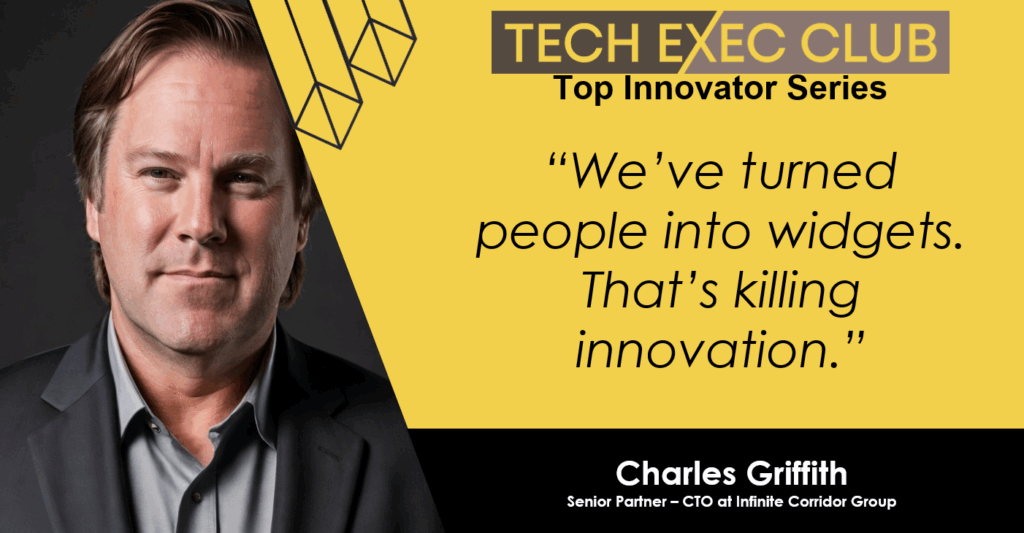
Infinite Corridor Group’s CTO shares the unconventional path that shaped his leadership—from failed startups and cultural pivots to human-centered strategy in tech.
In a world of polished success stories and perfect résumés, Charles Griffith stands out for his candor, curiosity, and commitment to growth through discomfort. As the Senior Partner and CTO at Infinite Corridor Group, Charles brings decades of cross-industry experience—from video games and CAD software to fintech and Amazon’s logistics engine. But his authentic leadership edge doesn’t come from titles or technologies—it comes from failure, movement, and a relentless pursuit of understanding people.
In this exclusive episode of the Top Innovator Series, hosted by Josef Martens, Charles opens up about the detours that shaped him: moving across industries, misreading team motivations, and learning harsh lessons from entrepreneurial attempts that didn’t go as planned. With humor, humility, and a sharp strategic lens, he explains why great leaders need to stop thinking of teams as functional groups—and start thinking of them as collections of individuals with diverse goals and energy levels.
From unlikely mentors to organizational transformation at Amazon, and from team empathy to the challenges of letting go of expertise in the AI era, Charles offers a masterclass in modern leadership—one that’s deeply human, refreshingly honest, and urgently needed.
Career Shaped by Movement: The Power of Early Career Exploration
Before Charles Griffith led enterprise-wide transformations and consulted global supply chains, he was making video games—bad ones, he jokes. But those early years, hopping between companies, industries, and even U.S. cities, weren’t random. They were formative. Charles didn’t just change jobs—he changed environments, exposing himself to vastly different cultures, work styles, and mindsets.
“I learned a lot by changing jobs multiple times,” he reflects. “You can’t put roots down and expect to grow.” That simple line contains a powerful leadership insight: career mobility isn’t chaos—it’s calibration. Each company, from startups to giants, offered a new puzzle piece. Whether it was CAD software, encryption tech, or payment systems, Charles was assembling a broad, adaptable skillset.
In an era where young professionals are urged to specialize early and stay loyal, Charles’s trajectory feels refreshingly counter-cultural. He sees those years not as instability, but as intentional diversity—a way to build a “rounded portfolio” of experiences. “My ultimate goal was to be an entrepreneur,” he says, “and I needed to fill in the gaps.”
That strategy paid off. The different domains taught him how to lead in volatile environments, how to bridge generational divides, and most importantly, how to adapt—skills that no single role could ever teach alone.
Leadership Through Failure: Learning the Hard Way
If there’s a thread running through Charles Griffith’s leadership story, it’s this: failure is not a detour—it’s the curriculum.
Before Amazon, before Infinite Corridor Group, Charles tried his hand at entrepreneurship—and fell hard. “I learned that you can’t be too focused on a single customer,” he says, recalling one of several painful early missteps. He also discovered that leadership isn’t about having a team—it’s about understanding one. And that requires diversity—not just in skills, but in locations, aspirations, and life stages.
“Everyone is not the same as you,” he says. “That’s one of the first breakthroughs as a leader.” It sounds obvious, but for many tech leaders accustomed to managing clones of themselves, it’s a lesson that comes too late—if at all.
What sets Charles apart is not that he failed—it’s that he owned it, learned fast, and never made the same mistake twice. “If you continue to fail the same way, that’s not learning. That’s a critical HR issue.”
Instead of hiding his missteps, Charles mines them for insights. Whether it was misjudging customer dependencies or failing to see how different age groups work and think, every stumble became a stepping stone. His leadership style is forged not in theories or MBAs—but in the grit of real-world failure and reflection.
Individual Over Function: Rethinking Team Management
One of Charles Griffith’s biggest revelations didn’t come from a tech breakthrough or a product launch. It came from leading a cross-functional team—and failing to understand how fundamentally different their motivations were.
“Engineers are often self-driven, deeply focused,” he says. “But when I started leading support and customer service, I realized not everyone is tuned that way.” Initially, Charles assumed a one-size-fits-all leadership model. It broke down fast. The solution? He stopped managing functions—and started leading individuals.
That shift changed everything.
Instead of optimizing for departmental KPIs, Charles began asking: What drives this person? How do I unlock their best work? “A good leader doesn’t just set goals for groups,” he says. “They figure out how to get the best out of each person, within those groups.” The result isn’t just higher engagement—it’s organic innovation.
Charles likens this transformation to coaching. You don’t treat every player the same—you tailor your approach to their strengths and challenges. It sounds simple, but in practice, it requires emotional intelligence, patience, and a willingness to slow down and listen.
And it works. Teams managed this way aren’t just efficient—they’re inspired. “It’s transformative,” he says. “Especially for organizations that have never experienced it before.”
The Mentor Mosaic: Learning from Unexpected Sources
While many leaders boast high-profile mentors and formal coaching relationships, Charles Griffith’s guidance came from a different source: observation, openness, and the ability to listen to anyone.
One of his most influential mentors wasn’t a CEO or board member—it was a Russian immigrant who had mastered the art of navigating organizational politics. “He could look at a problem in a completely different way,” Charles recalls. “He taught me how to regulate my communication in complex, political environments.”
At Amazon, Charles was inspired by operations leaders like Jeff Wilke and Marc Onetto, not for their titles, but for how they changed a global operational culture — initially implementing Six Sigma, then migrating to Lean methodology at scale. “The hardest thing as a leader is convincing people to do something in a completely different way,” Charles says. Watching those leaders pull it off taught him volumes.
His mentorship mosaic included peers, subordinates, and even temporary colleagues. “You can find wisdom in someone doing a job just to get to the next one—if you understand what truly motivates them.” It’s a radically inclusive approach to learning—and it has served him well.
In short, Charles didn’t wait for mentors to be assigned. He recognized them. And that mindset—always learning, always listening—has become a hallmark of his leadership.
Tech Leadership Today: Reinstating the Human Factor
When asked what he’d change about modern tech leadership if given a magic wand, Charles Griffith doesn’t hesitate: “We’ve moved too far from people.”
In an era where leaders chase scale, speed, and AI-led optimization, Charles calls for a return to empathy. “Many times, people become widgets as leaders rise,” he warns. “My magic wand would remind them that there’s a human component in every equation.”
This isn’t just sentimental nostalgia—it’s a warning. Leaders who ignore the emotional and psychological realities of their teams risk stalling innovation, increasing attrition, and draining morale. “You’re actually limiting the output, not improving it,” Charles says.
His solution is deceptively simple: listen more, assume less. Especially in consulting roles, Charles resists the urge to apply cookie-cutter strategies. “You have to ask: Why is this organization the way it is? Are these constraints—or habits that can be changed?” In doing so, he models a leadership style that’s adaptive, humble, and deeply attuned to context.
In short, the best tech leaders in the AI era won’t just understand systems—they’ll realize people. And that, Charles insists, is what separates transformational leadership from transactional management.
Are You Leading with Empathy, or Just Managing Outputs?
Charles Griffith’s journey is a wake-up call for today’s leaders—especially in tech. If you’re looking to evolve your leadership style, here are five actionable insights drawn directly from his hard-won experience:
1. Rotate Early, Rotate Often: Don’t lock yourself into one job, company, or industry too early. Charles intentionally moved through different sectors—games, CAD, payments, cloud—to gain exposure to various business models and cultures. Ask yourself: Are you accumulating diverse experiences, or just time?
2. Fail Fast, but Learn Faster: Failures aren’t flaws—they’re training grounds. From customer concentration to team blind spots, Charles learned the most from what went wrong. Your move: Review a recent failure. What was the root cause? What did you actually know? And how are you applying that now?
3. See the Individual, Not the Org Chart: When Charles shifted from functional leadership to individual-focused coaching, everything changed. Forget cookie-cutter management. Instead, take time to understand what drives each team member. What are their motivations, fears, and hidden talents?
4. Find Mentors Everywhere: Mentors don’t have to be senior executives or LinkedIn influencers. Charles found wisdom in peers, immigrants, and operations managers. Look around: Who in your orbit sees the world differently than you? What might they teach you—if you listened?
5. Bring People Back to the Center: Technology should serve people, not replace them. Charles’s biggest wish is for tech leaders to rehumanize their teams. Today: Ask yourself: Are you optimizing for code, or for connection? Do your people feel seen, or just assigned?
In a tech industry often obsessed with disruption, Charles Griffith offers something even more radical: perspective.
He reminds us that leadership isn’t about having all the answers—it’s about asking better questions. It’s about failure, listening, adapting, and never assuming you’ve arrived. Whether he’s speaking about his early years in video games, driving operational change at Amazon, or mentoring the next generation of CTOs, one theme is constant: great leaders build bridges—between people, perspectives, and possibilities. Charles may joke that he’s an example of what not to do—but in truth, he’s become the kind of leader tech desperately needs: curious, humble, people-first, and fiercely adaptive.
Want to hear Charles Griffith’s insights firsthand? Watch the full, live podcast interview [click here]