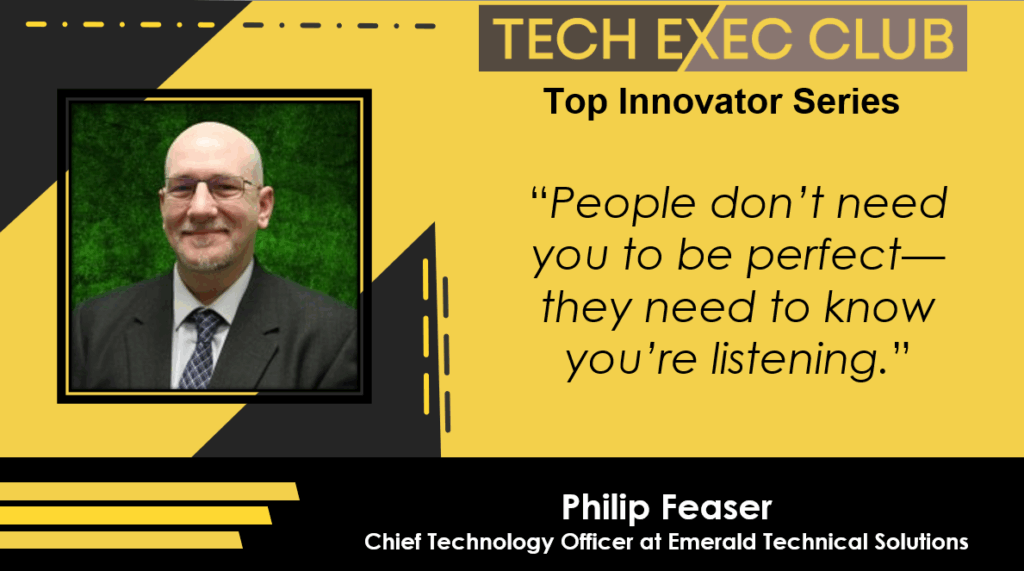
When it comes to building a career that combines purpose, resilience, and technical brilliance, few stories resonate as much as that of Philip Feaser. Currently the Chief Technology Officer (CTO) at Emerald Technical Solutions, Philip’s career didn’t begin in a corner office—it started in the trenches of military web development. His transition from Army contractor to executive technologist is a masterclass in leadership, adaptability, and what he calls the mindset to “solve for yes.”
In this episode of the Top Innovator Series, host Josef Martens sits down with Philip to unpack a leadership journey driven by hands-on grit, unwavering mentorship, and a refusal to say, “That’s not my job.” From navigating career pivots with humility to scaling impact through AI and cybersecurity initiatives, Philip’s insights are both deeply personal and widely applicable for tech leaders, veterans transitioning to the private sector, and anyone who has ever questioned their path.
This interview isn’t just about success—it’s about finding fulfillment through service, growing through failure, and leading with empathy. Whether you’re a CTO, an aspiring leader, or just someone trying to figure out your next move, Philip’s story proves one thing: solving for yes might be the most powerful tool in your leadership arsenal.
“Solve for Yes”: Building a Culture of Possibility
In corporate environments—especially in high-stakes sectors like defense contracting and technical consulting—it’s easy to default to “no.” Constraints, risk management, shifting priorities, and bureaucratic roadblocks are everyday challenges. But for Philip Feaser, CTO of Emerald Technical Solutions, those limitations are precisely why leaders need to “solve for yes.”
This phrase, coined with a mentor during a frustrating season marked by stalled projects and organizational fatigue, became more than just internal motivation—it became a cultural cornerstone. “We noticed how often people responded with ‘I don’t know,’ or ‘not my job,’ or ‘that’s above my pay grade,'” Philip recounts. “It crushed momentum. So we flipped it. Even if we couldn’t say ‘yes’ right away, we started asking how we could help move the needle forward.”
“Solve for yes” is not about saying yes to everything unthinkingly. It’s a problem-solving attitude that starts from a position of possibility rather than limitation. In Philip’s world, it means listening fully, assessing creatively, and—when appropriate—guiding someone to the right solution, even if it’s not the one you would choose. It’s about ownership without ego, agility without recklessness, and generosity of thought in complex systems.
For leaders and teams alike, this philosophy creates ripple effects. It encourages cross-functional collaboration, boosts morale, and builds a shared language of trust. When someone brings a challenge, they know the response won’t be a bureaucratic wall—but a thoughtful attempt at resolution.
Philip has carried this mindset with him through every level of leadership. And two decades later, he still checks himself with one question: Am I solving for yes right now? It’s a deceptively simple mantra that demands curiosity, empathy, and action—and it’s one that any leader in any field can apply today.
From Medicine to Tech: Redefining Career Success
Career pivots often carry with them a heavy dose of guilt, fear, and doubt—especially when they require abandoning a long-held dream. For Philip Feaser, the choice to leave medicine and fully embrace a career in technology wasn’t just a change in direction; it was a confrontation with identity.
Philip began his journey at the prestigious Johns Hopkins University, following a rigorous path toward becoming a doctor. But while immersed in the medical world, something unexpected happened: he began assisting with technical issues, from hooking up machines to optimizing basic hospital IT systems. “It started small—helping out with the tech side of things because no one else had that skill set,” he recalls. “But the more I did it, the more I enjoyed it.”
The transition didn’t happen overnight, nor was it easy. “There was guilt,” he admits. “I felt like I was letting my parents down, letting myself down. I had invested years preparing for a medical career. Walking away from that felt like a failure at the time.” But over time, that sense of loss gave way to clarity. The technical challenges excited him. The satisfaction of solving problems in real-time, of empowering others through digital tools—it felt right.
His experience is a powerful reminder that your true path isn’t always the one you start on. And sometimes, the best thing you can do is permit yourself to pivot. “We talk about sunk cost fallacy in economics,” Philip says. “Well, it’s real in careers, too. But fulfillment doesn’t come from sticking to a plan—it comes from following where your skills and passions align.”
Today, as a CTO and tech leader, Philip looks back at that moment not as a failure but as the most critical career decision he ever made.
HEAT and Human-Centered Leadership
In a world increasingly focused on data, deliverables, and speed, Philip Feaser’s approach to leadership is radically human. One of the most influential lessons he learned came not from a conference or executive training—but from a volunteer program at Harrisburg Hospital. It was there that he was introduced to HEAT: Hear them out, Empathize, Apologize, and Tell them what you’re going to do.
“Honestly, I thought it was a little corny at first,” Philip admits. “But the first time I used it, I saw its power. People want to be heard. Even in tech. Maybe especially in tech.”
HEAT isn’t just a customer service protocol—it’s a philosophy that shapes how Philip interacts with teams, clients, and leadership peers. When someone raises a concern, he doesn’t respond with immediate problem-solving or defensiveness. He listens. He connects. And he outlines a plan of action, even if it’s just to guide them to the next step.
This mindset is mighty in the world of IT and government contracting, where emotions are often treated as irrelevant or unprofessional. But Philip believes that human connection is not a weakness—it’s a leadership advantage. “When people feel seen and supported, they give their best work,” he says. “HEAT builds that kind of trust.”
Philip has embedded this model into his leadership playbook. Whether he’s dealing with a high-stakes proposal, a frustrated developer, or a concerned stakeholder, HEAT helps him stay grounded. It reminds him—and those around him—that empathy isn’t just a soft skill; it’s a leadership superpower.
Dual Roles, One Vision: Leading While Doing
Being a CTO is a demanding job. So is being a hands-on technical architect. Philip Feaser does both—simultaneously. At Emerald Technical Solutions, he doesn’t just sit in meetings and develop roadmaps; he actively works on projects, interacts with clients, and solves real-time problems as a billable cloud engineer.
This dual-role setup isn’t typical. In many companies, executives are insulated from daily operations. But Philip believes this closeness to the ground is part of what makes him effective. “When I lead, I’m not just making theoretical decisions,” he says. “I’m in the weeds. I see what works and what doesn’t. I understand my team’s challenges firsthand.”
But it’s not without its difficulties. Juggling strategic planning with technical delivery can be exhausting. Time is the scarcest resource, and Philip often finds himself stretched between urgent client needs and long-term innovation goals, such as building out AI capabilities, maturing CMMC (Cybersecurity Maturity Model Certification) standards, and crafting proposals for federal Requests for Proposals (RFPs).
Still, this hybrid role has given him a kind of 360-degree leadership vision—the ability to zoom out without losing sight of the details. It keeps him credible with engineers, respected by executives, and responsive to clients.
“I don’t see it as a burden,” he reflects. “I see it as an opportunity to lead better.” And in today’s complex, fast-changing tech environment, that might be precisely what the role of CTO needs to evolve into: not just a strategist, but a doer—someone who can think big and still roll up their sleeves.
Leadership as Service: Mentors, Humility, and Legacy
At the heart of Philip Feaser’s leadership style is a deep-rooted belief that good leaders don’t command from above—they serve from within. It’s a lesson he learned early in his career, thanks to a few pivotal mentors who saw potential in him, challenged him, and modeled what humble leadership looks like.
“I had one mentor—he wasn’t flashy or high-ranking—but he understood people,” Philip says. “He taught me how to navigate organizations, how to get things done, and most importantly, how to treat others.” That mentorship wasn’t just career guidance—it was character formation.
Now, as CTO, Philip carries forward that torch. One of his guiding principles is this: never ask your team to do something you wouldn’t do yourself. It sounds simple, but in an industry filled with egos, it’s revolutionary. His team knows he’s been in their shoes. He’s coded, deployed, debugged, and documented. And he never uses leadership as a shield from work—instead, he uses it as a platform to empower others.
Mentorship remains a significant part of his ethos. He offers time, attention, and advice to those earlier in their journey—not because he has to, but because he knows how much it matters to him.
For Philip, legacy isn’t about status or accolades. It’s about impact. It’s about whether people feel seen, supported, and inspired under your leadership. And in that regard, he’s not just building software systems—he’s building people.
If Philip Feaser’s journey has sparked something in you—whether you’re pivoting careers, growing a team, or navigating complex tech environments—here are concrete next steps inspired by his philosophy and experiences:
1. Adopt the “Solve for Yes” Mindset in Your Work Today: Before responding with “no” or “not my job,” pause and ask: What can I do to move this forward? Start building a culture of possibility within your team by modeling solution-oriented thinking. Replace blockers with bridges—connect people, guide them, or offer small ways to help.
2. Implement the HEAT Framework in Team and Client Interactions: Use Hear – Empathize – Apologies – Tell during every difficult conversation. Train your team to adopt this customer-centric model, especially in support and cross-functional roles. Build trust faster and de-escalate conflict by humanizing every response.
3. Embrace Career Pivots—Even if They Feel Like Failures: Reassess your current path honestly: does it energize you? Don’t be afraid to pivot if something else feels more aligned with your strengths or interests. Remember: even detours can lead to destinations more fulfilling than your original plan.
4. Balance Strategy with Execution—Even If You Wear Two Hats: If you’re in a hybrid role like Philip, create dedicated time blocks to focus on long-term initiatives. Identify tasks that can be delegated and establish systems for operational clarity. Leverage your dual-role insights to bring realism and empathy into your strategic decisions.
5. Lead from the Ground—Not Just from the Top: Never ask your team to do what you wouldn’t do yourself—this builds credibility and trust. Mentor someone just like you were mentored. Share what others once shared with you. Stay involved with the work to maintain technical empathy and culture alignment.
In a world saturated with tech titles and jargon, Philip Feaser stands out not for what he has built but for how he builds it. As CTO of Emerald Technical Solutions, his influence extends far beyond architecture diagrams and AI initiatives. He embodies a model of leadership rooted in service, empathy, and action—a rare blend of heart and horsepower.
From his early days in military technology roles to navigating the emotional crossroads of a career pivot, Philip has crafted a narrative that resonates with anyone who has ever questioned their path. He leads not just through experience but through example—always asking, “How can I help? Where can I contribute?” His approach to leadership, shaped by mentors and molded through hard-won lessons, is a masterclass in staying grounded while aiming high.
As he continues to balance his dual roles, grow his company, and support those transitioning from military service to civilian careers, Philip reminds us of something essential: technology may run on logic—but leadership runs on humanity.
If you’re building a team, navigating change, or searching for meaning in your mission, look to Philip Feaser’s journey—not for shortcuts, but for principles that endure.
Want to hear Philip Feaser’s insights firsthand? Watch the full, live podcast interview [click here]