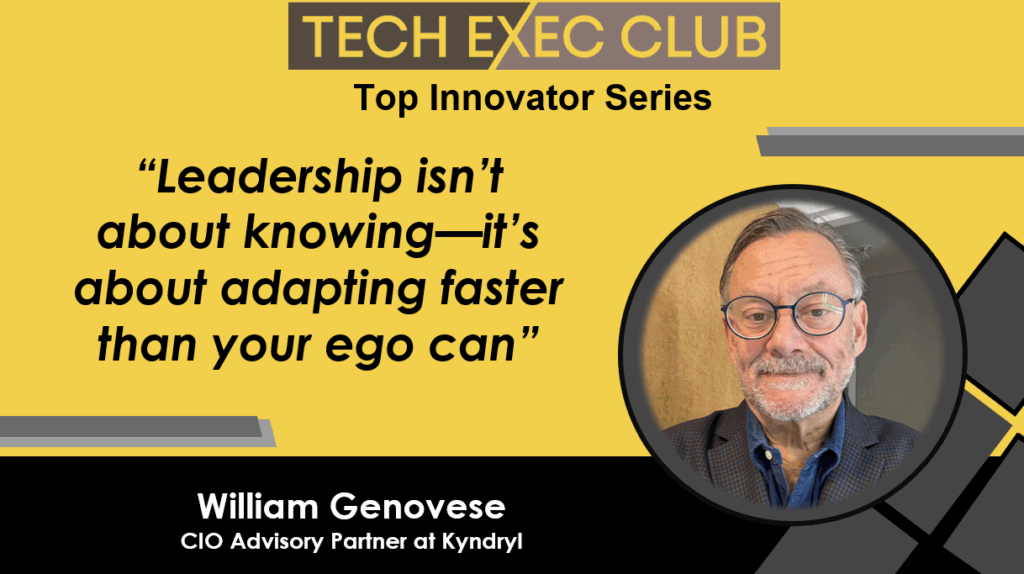
In a time where digital transformation, quantum computing, and global leadership dominate the enterprise tech landscape, few thought leaders embody the fusion of these elements better than Bill Genovese. A seasoned executive with international experience and the current Partner at Kyndryl, Bill leads the company’s cutting-edge efforts in quantum technology consulting, and his journey is anything but ordinary.
Appearing on the Top Innovator interview series with host Josef, Bill dives into what it truly takes to evolve into a resilient tech leader in a volatile, fast-moving world. From his early days navigating cultural contrasts in Switzerland to paradigm-shifting realizations in Singapore’s hypermodern tech scene, Bill’s story offers powerful insights into cross-cultural leadership, enterprise architecture, and the importance of authenticity in executive roles.
With nearly 30 years of experience and having lived and worked in six countries, and four states in differing cultures even on a US regional basis, Bill unpacks the real-world lessons that shaped his leadership philosophy. This isn’t your typical career playbook, it’s a global exploration of how discomfort, risk, and adaptability can mold a more agile, innovative, and human-centered leader.
For executives, tech professionals, and leadership enthusiasts looking to understand the future of technology leadership, this is a masterclass in learning through experience.
The Transformative Power of International Experience
When asked to reveal the key to his professional growth, Bill Genovese doesn’t cite titles, certifications, or even specific companies. Instead, he talks about something more personal and transformational: relocating to work in six different countries across three continents. This wasn’t a box-checking exercise, it was a series of immersive experiences that rewired how he thinks and leads. For Bill, international assignments weren’t just career moves; they were crucibles that forged resilience, broadened empathy, and honed a new kind of leadership that traditional boardrooms rarely teach.
Bill’s first major leap was to Switzerland, after moving throughout various U.S. regions. Each region had its nuances, but Europe was a world entirely different from the rest. As he settled into life in Zurich, Bill recognized that success wouldn’t come from speaking louder or working harder. It would come from listening, adapting, and absorbing cultural subtleties that shaped how business was done. He learned Swiss-German to connect better with clients and colleagues, and more importantly, he learned to step back and observe, to see how his American colleagues were perceived and to modify his behavior accordingly.
Each subsequent international posting added a layer to his leadership philosophy. Prague, Amsterdam, London, each city brought new insights. It wasn’t just about language or etiquette. It was about understanding how history, values, and unspoken social contracts shaped how people communicated and collaborated. These were immersive leadership labs that offered real-time feedback in real-world cultural contexts.
Today, Bill views international exposure not as an accessory to leadership but as a foundation. It taught him humility, adaptability, and how to build trust across cultures. For aspiring leaders, his message is clear: if you ever get the chance to work abroad, don’t hesitate. “Dive in with both feet,” he advises. “That single step will teach you more about leadership than any MBA ever could.”
Culture Shock and Leadership Evolution
Bill Genovese had successfully navigated roles across the U.S. and Europe and thought he had found his leadership rhythm. Then came Singapore, and with it, a jarring cultural reset. The city-state, which visually resembled modern metropolises like Miami, lulled Bill into thinking that Western models would still apply. But what he encountered was a fundamentally different pace, mindset, and operational model that challenged everything he thought he knew.
In Singapore, results mattered more than process. Efficiency trumped structure. While Western leadership often leans on extensive planning, compliance, and layered approvals, Bill quickly realized that Asian markets were optimized for speed and execution. He entered the region with what he thought were universally respected best practices in enterprise architecture, only to discover that what worked in Zurich or New York fell flat in Southeast Asia.
This wasn’t failure, it was a revelation. Bill learned the importance of cultural humility: not imposing but observing; not assuming but learning. He began listening more and talking less, stepping back to understand how his local colleagues achieved their impressive outcomes. In doing so, he discovered that his role wasn’t to teach but to co-create, to offer frameworks only when they added value and to trust in the local team’s knowledge.
It was a defining moment in his leadership evolution. Singapore taught him to shed the identity of “the expert” and embrace the mindset of “the learner.” He discovered the importance of allowing space for others to lead and that authentic leadership often means stepping aside to make room for others.
For any executive expanding into unfamiliar regions, Bill’s experience offers a critical insight: the most successful leaders aren’t those who replicate their methods globally but those who evolve with each new culture. Leadership, like language, must be localized to be understood.
Adaptive Architecture, Blending East and West
While in Singapore, Bill Genovese faced a professional paradox. His training in Western enterprise architecture had prepared him for structured, blueprint-driven delivery. However, in the high-speed environment of Southeast Asia, rigid frameworks often became bottlenecks. The region’s teams operated with impressive efficiency despite what appeared to be a lack of formalized architecture standards.
Instead of forcing conformity, Bill innovated. He introduced a rotational model for his technical teams, where individuals would switch roles every 30 days. A database administrator might become a storage architect. A developer might rotate into infrastructure. The goal? Break down silos, foster empathy between roles, and create more versatile, systems-thinking engineers.
This adaptive model was born from necessity but became a game-changer. It respected the existing strengths of the local workforce, speed, agility, domain expertise, while subtly introducing a systems-based approach that mirrored Western enterprise thinking. Bill effectively created a hybrid architecture methodology that could thrive in fast-growth environments without losing the long-term benefits of scalability and coherence.
This approach not only improved project delivery but also reshaped team dynamics, encouraged collaboration, and elevated individual contributors into cross-functional leaders. It also laid a blueprint for his current work at Kyndryl, where emerging fields like quantum computing, post-quantum encryption, and AI integration demand exactly this kind of agile architectural thinking. And even most importantly it prepared him for a successful Executive Leadership position in a Corporate Strategy function overseeing growth for the entire global banking and financial services industry vertical for a major global technology company in China where he lived in worked for 4 years (and the final two years during the global Covid crisis).
In an era where enterprise architecture is often seen as either too slow or too rigid, Bill’s method shows that with the right mindset, structure, and speed can coexist. His mantra: “Adapt frameworks to fit the people and context, not the other way around.”
Mentorship, Inner Voice, and Knowing When to Pivot
Amidst all the international moves and organizational change, one piece of advice stayed with Bill Genovese like a compass: trust your inner voice. It came from a senior mentor in Switzerland, a quiet but wise leader from Myanmar. During a period of intense culture clash and professional doubt, Bill questioned whether he belonged. It was his first major consulting gig overseas, and nothing seemed to go according to plan.
The mentor’s words were simple but profound: “Only you will know when it’s time to leave.” That advice, Bill says, taught him the importance of intuitive leadership. Throughout his career, when confronted with decisions, whether to stay, pivot, or take a leap, he would pause, listen inwardly, and trust his instinct.
That internal compass helped him avoid burnout, navigate complex career transitions, and, most importantly, stay aligned with his purpose. He didn’t jump for money or titles, but when a situation no longer served his growth or when something new deeply resonated with him, he moved.
It’s a lesson that transcends business. In a world overloaded with advice, metrics, and peer comparisons, Bill’s reminder is refreshingly human: the most critical data point in your career is your clarity. Leaders don’t just lead others; they must first lead themselves.
This kind of wisdom, born from experience and reflection, is something Bill now tries to pass on to younger professionals. The lesson isn’t about fleeing discomfort, it’s about knowing the difference between a challenge to grow and a sign to go.
Authenticity as a Leadership Imperative
As he reflects on the current stage of his career, Bill Genovese speaks with striking clarity: what matters most now is authenticity. After decades of leading technology transformations, building global teams, and working across continents, the metric for success has evolved. It’s no longer about accolades or achievements, it’s about being real.
“If I can’t be authentic at this stage, then what’s the point?” he asks. In his current role leading Global Quantum Services Consulting at Kyndryl, authenticity isn’t just a nice-to-have, it’s a necessity. He’s working in a field so novel and nascent that most people don’t fully understand it. That ambiguity requires patience, honesty, and a willingness to be humble. As colleagues look to him as a subject matter expert, he must constantly bridge knowledge gaps without arrogance, offer guidance without domination, and hold space for others’ learning journeys.
But being authentic doesn’t mean being unfiltered. Bill distinguishes honesty and wisdom. Sometimes, authenticity means speaking up; sometimes, it means knowing when to stay silent. The goal isn’t self-expression for its own sake but cultivating trust. It’s about creating a space where people can show up as they are, where vulnerability becomes a source of strength.
Bill believes that today’s leadership crisis is not one of knowledge or capability but of authenticity. In an age of personal branding and curated personas, his call is revolutionary but straightforward: bring your whole self to the table. Let your scars show. Let your principles guide you. Let truth replace posturing.
Because, in the end, technology evolves. Markets shift. But authenticity endures.
Bill Genovese’s story is more than a career retrospective, it’s a blueprint for transformational leadership in a global, fast-paced world. Here’s how you can take real action from his insights:
1. Say Yes to International Opportunities: Don’t wait for the “perfect” moment. If you’re offered a chance to work abroad, even if it’s unfamiliar or daunting, take it. Long-term international assignments will challenge your worldview, teach you adaptability, and provide invaluable opportunities for leadership growth.
2. Listen More Than You Speak: Especially in cross-cultural settings, humility is a powerful asset. Bill’s experience in Singapore taught him to shelve assumptions and create space for others to lead. Wherever you are, seek first to understand the local way of doing things.
3. Rewire Team Structures for Agility: Use rotational functional with leadership models to break down silos and build empathy among teams. Bill’s 30-day rotation for tech specialists is a smart way to build cross-functional fluency and speed without sacrificing structure.
4. Trust Your Inner Compass: When facing major career decisions, remember that no one knows your timing like you do. Bill’s mentor told him, “Only you will know when it’s time to leave.” Trust your instincts when evaluating opportunities or recognizing signs of burnout.
5. Lead with Authenticity: Don’t mold yourself to titles or trends. If you can’t be authentic in your role, it’s time to reassess. In fields such as quantum computing or emerging technologies, being transparent and grounded isn’t just ethical, it’s essential.
6. Look for Adjacent Growth Paths: If global relocation isn’t feasible, explore “adjacencies.” Bill recommends pivoting into nearby domains where you can stretch your leadership or technical skills while staying true to your core capabilities.
7. Build Cultural Intelligence as a Core Competency: Whether you’re in New York, Nairobi, Berlin, or Bangalore, develop the skills to adapt. Study cultures, learn languages, and observe social cues. This is no longer a soft skill, it’s a critical success factor in global leadership.
8. Redefine What Leadership Means to You: Bill’s career shows that leadership isn’t about being the smartest in the room. It’s about being the most aware, the most adaptable, and the most human. Start seeing leadership as a lifelong experiment, not a destination.
In a world where buzzwords often drown out real wisdom, Bill Genovese stands out not just for what he knows but for how deeply he’s lived it. As a Partner at Kyndryl and a global leader in quantum computing strategy, Bill’s technical achievements are impressive, but it’s his human-centered approach to leadership that truly resonates.
Through decades spent navigating new geographies, unfamiliar boardrooms, and fast-evolving industries, Bill has developed a voice of rare clarity. He’s not preaching theory, he’s sharing hard-won lessons from a life lived on the edge of comfort zones, where growth and discomfort often go hand in hand.
From embracing global cultures to redefining enterprise architecture, from trusting instinct to valuing authenticity above all, Bill reminds us that authentic leadership isn’t about dominating a space, it’s about understanding it deeply and leading others through it with empathy and vision. For aspiring professionals and veteran executives alike, his journey offers more than inspiration. It provides a roadmap, one paved with courage, curiosity, and conscious evolution.
Want to hear Bill Genovese’s insights firsthand? Watch the full, live podcast interview [click here]