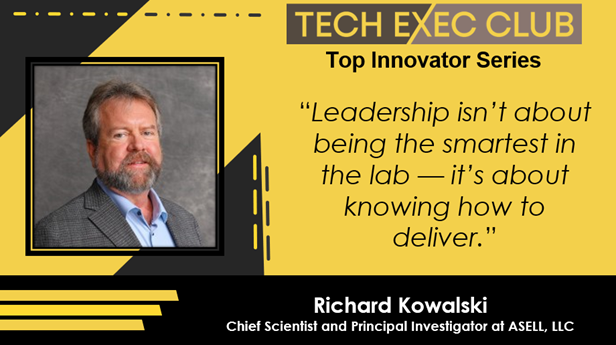
When Richard Kowalski first stepped into the world of biotech, he wasn’t just another young technician — he was a front-row witness to one of medicine’s most urgent eras: the dawn of HIV diagnostics. Fast forward to today, and Kowalski, now the Chief Scientist at ASELL and founder of NextPhaseDX, stands at the cutting edge once again — this time navigating the uncharted waters of AI-powered medical diagnostics.
In this exclusive interview, Richard shares the pivotal moments that shaped his leadership, the tension between academic credentials and real-world expertise, and his evolving perspective on what it truly takes to drive innovation in healthcare. From the rigid structure of corporate giants like Northrop Grumman to the nimble energy of startup culture, Kowalski’s journey is a masterclass in adaptation, learning, and purpose-driven leadership.
But perhaps most compelling is his unshakeable belief in the power of meaning—that every lab technician, engineer, and developer should understand the life-saving impact of their work. Whether leading with a PhD or with passion, Kowalski’s story offers a deeply human look into the heart of scientific progress and the kind of leadership that fuels it.
Credentials vs. Competence: Climbing the Corporate Ladder in Science
Richard Kowalski’s early career taught him a hard truth: your qualifications often matter more than your proven ability in science. Working at Biotech Research Labs during the pioneering days of HIV diagnostics, he led three labs simultaneously — a clear signal of trust and performance. Yet, when leadership roles opened up, Richard watched as a less-experienced PhD researcher, not a field-proven colleague, got promoted. The reason? The degree, not the results.
“I saw that I would be kind of… that’s it,” Richard reflects, recalling when he realized his ceiling without a doctorate. The decision to pursue a PhD in biochemistry and molecular biology wasn’t just about gaining knowledge — it was a career survival strategy. Without it, leadership doors remained closed, even for those already acting like leaders.
This experience shaped his outlook on professional growth and talent recognition. While he understands the need for academic rigor in biotech, he also believes that companies often overlook high-impact contributors because of rigid structures that equate academic achievement with leadership readiness.
Now, as Chief Scientist at ASELL and founder of NextPhaseDX, Richard takes a different approach. He values merit, impact, and the courage to lead over credentials alone. His story is a powerful example for companies trying to break free from the biases that can block real talent from rising. In an industry where innovation can save lives, rewarding ability over appearances isn’t just fair — it’s essential.
From Discovery to Deadlines: The Shift from Science to Strategy
For Richard Kowalski, the transition from the exploratory nature of academic science to the structured rigor of corporate biotech was both eye-opening and defining. He describes his shift into Northrop Grumman as a turning point, where the stakes were no longer just about discovery, but delivery. “You have milestones for grants, but they’re wishy-washy,” he recalls of academia. “But with government contracts and public companies, your milestones are milestones.”
Suddenly, science wasn’t just about finding something new — it was about hitting targets, managing risk, and aligning innovation with business strategy. Richard had to adapt quickly. Instead of innovating in the lab, he now had to forecast budgets, justify changes, and translate complex science into timelines that business leaders and government agencies could understand.
He admits that in this environment, some of the creative joy faded. “You start to lose… the fun of science, the creativity, the innovation,” he says. But in its place came something equally important: a sharper sense of strategic leadership. He learned how to balance scientific integrity with organizational demands, lead cross-functional teams toward contract success, and manage innovation at scale.
Rather than resisting the change, Richard embraced it. He began to view leadership not as a departure from science but as an elevation of it—a chance to guide entire programs toward impact, not just experiments toward results. This transformation reveals a vital truth for aspiring scientific leaders: at the highest levels, success depends less on what you know and more on how you deliver it.
Lifelong Learning as a Leadership Imperative
Throughout his career, Richard Kowalski has held fast to a core principle: never stop learning. This isn’t just a platitude for him — it’s a philosophy that shapes how he leads, grows, and builds his teams. The catalyst? A simple but profound advice from an early mentor: “When you stop learning, it’s time to move on.”
Richard has followed this mantra religiously. Whether it’s keeping pace with evolving FDA regulations, diving into machine learning models, or experimenting with new team performance frameworks, his hunger to learn is visible at every career stage. “Let’s try it. Let’s see if we can,” he says, reflecting on his willingness to test new leadership methods or technologies.
But he also understands the challenges of building a learning culture in a corporate setting. Not everyone is wired to be a proactive learner, especially in structured environments. That’s why Richard intentionally encourages growth, suggests communication courses for introverted staff, explores tools like LinkedIn Learning, and even supports continued education, despite the risk that it might inspire someone to leave. “It’s scary because you might give them the tools to leave,” he says. “But it can also build the team.”
For Richard, the value of lifelong learning isn’t just about staying current — it’s about staying human. It’s about the humility to say “I don’t know,” the curiosity to find out, and the leadership courage to bring others along. In a field defined by change, this mindset isn’t optional. It’s the difference between leading and being left behind.
The Promise and Paradox of AI in Healthcare
Few topics reveal the growing pains of innovation like AI in diagnostics. Richard Kowalski is on the front lines of this evolution, where the excitement of new tools meets the caution of regulation. For instance, his work on radiation diagnostics uses machine learning models to predict exposure levels from simple blood tests — a potential game-changer in emergency response and oncology. But there’s a catch.
“The FDA requires your learning to be finished when your product is approved,” he explains. In other words, it can’t keep learning once a model gets cleared. That defies the essence of AI — systems designed to evolve and improve over time. For Richard, this creates a strange paradox: to use AI, you must make it static.
His proposed solution is elegant: treat AI tools like software versions. Launch version one based on validated data sets, then iterate in a controlled, transparent way. “You have a version two… maybe a few years later,” he says, where additional post-market data can be added without compromising regulatory integrity.
But Richard’s insight goes beyond compliance. He warns that AI is only as good as its data, and that insufficient data can lead to bad decisions. This makes AI literacy an urgent leadership priority. Leaders must learn to distinguish hype from help, question model integrity, and steer innovation responsibly.
In Richard’s world, AI is a powerful ally — but one that must be understood, governed, and constantly reevaluated. His perspective offers a critical reminder: innovation isn’t just about pushing forward; it’s about knowing when, how, and why to apply the brakes.
Meaning Over Metrics: Leading with Purpose in Tech Teams
It’s easy to lose the human thread in scientific and technical work. Teams get buried in procedures, stuck in SOPs, or focused on KPIs. However, Richard Kowalski believes that authentic leadership means making the mission visible and the impact personal.
He recalls how even the most repetitive roles gain new life in manufacturing when employees see the results. “I want them to see in a newsletter or a briefing that the kits they made saved X many lives this month,” he says. “They’re not just working nine to five. They’re saving lives.” This connection between purpose and performance is at the heart of how Richard leads.
He also favors flattened hierarchies and shared direction. In his ideal teams, people don’t just follow orders — they understand the bigger picture. Whether it’s a technician assembling test kits or a data scientist designing an algorithm, everyone knows the “why” behind the “what.”
He brings the same ethos even in consulting, where projects are more fluid. “The leadership style I would continue with is less of a hierarchical structure and more of an overall team,” he explains. His goal is engagement, not compliance, ownership, not obedience.
Richard’s approach offers a powerful contrast to more transactional leadership models. He shows that even in highly technical fields, people don’t want just to be productive—they want to be meaningful. When leaders help them see that, performance becomes personal, and teams become unstoppable.
Richard Kowalski’s story isn’t just a reflection of a successful career — it’s a call to leaders and innovators in healthcare, biotech, and beyond to rethink how we lead, learn, and build systems that matter. Here’s how you can take real, actionable steps inspired by his journey:
1. Promote Based on Performance, Not Just Paper: Richard’s early leadership was overlooked because he didn’t yet have a PhD, despite managing three labs. Audit your promotion and hiring practices. Ask: Are we privileging credentials over contribution? Set up peer-nomination systems or leadership potential assessments to surface talent from within. Introduce “impact narratives” into performance reviews — stories of initiative, collaboration, or innovation, not just metrics.
2. Balance Scientific Curiosity with Operational Excellence: Richard’s move into corporate science taught him that success also requires navigating contracts, deadlines, and business expectations. Train your scientific or engineering leads in project management, budgeting, and stakeholder communication. Co-lead cross-functional milestone reviews that include both technical and business leads. This breaks silos and reinforces strategic thinking.
3. Institutionalize Lifelong Learning — and Lead by Example: Richard’s belief in continual learning shaped his leadership and his teams. Offer company-supported learning paths, and make leadership participation visible. Normalize leaders attending workshops or taking online courses. Build “learning sprints” into your team calendar — a month per quarter dedicated to skill-building, reflection, and internal knowledge sharing.
4. Embrace AI — but Don’t Automate Your Judgment: Richard is pioneering AI-based diagnostics, but is clear about its limits, especially under FDA regulation. Before deploying AI or machine learning, set clear policies for how models are trained, locked, and updated. Know the legal and ethical landscape. Create a cross-functional AI oversight group — data scientists, compliance officers, product managers — to ensure transparent and defensible decisions.
5. Build Meaning into Your Company Culture: For Richard, even the most technical teams need to see the “why” behind their work. It boosts engagement and reduces burnout. Regularly share impact stories from your products, customers, or research. Create feedback loops where even back-end roles can see their contributions. Launch a monthly “Impact Snapshot” — a brief, visual update celebrating how the team’s work has helped real people. Make it tangible.
6. Flatten Hierarchies Where You Can, Clarify Direction Where You Must: Richard values team-driven leadership, but with clear purpose and structure. Decrease layers of unnecessary approval and encourage initiative at every level. Simultaneously, it reinforces the company’s vision in everyday decision-making. Run quarterly “alignment check-ins” — brief all-hands where leadership shares progress and purpose, and every team can ask questions and give feedback.
7. Future-Proof Your Leadership by Anchoring in Values: Amid AI disruption, misinformation, and constant change, Richard reminds us that core values are a leader’s north star. Revisit your organization’s values. Are they known, lived, and used in decisions? If not, relaunch them in a way that resonates today. Create a “Values in Action” program — highlight how someone on your team demonstrated a core value each week or month.
Richard Kowalski is more than a scientist, more than a strategist, and more than an executive. He represents a new breed of leader who navigates cutting-edge technology without losing sight of human connection, balances regulatory rigor with intellectual curiosity, and champions purpose just as much as performance.
From HIV diagnostics to AI-powered blood tests, from corporate boardrooms to startup culture, Richard’s journey is a testament to what leadership in science should look like in the 21st century: bold, adaptive, ethical, and deeply aware of its impact on the world.
In an era where data is abundant but wisdom is rare, Richard offers something valuable—perspective. In doing so, he doesn’t just push science forward; he pulls people with him.
Want to hear Richard Kowalski’s insights firsthand? Watch the full, live podcast interview [click here]