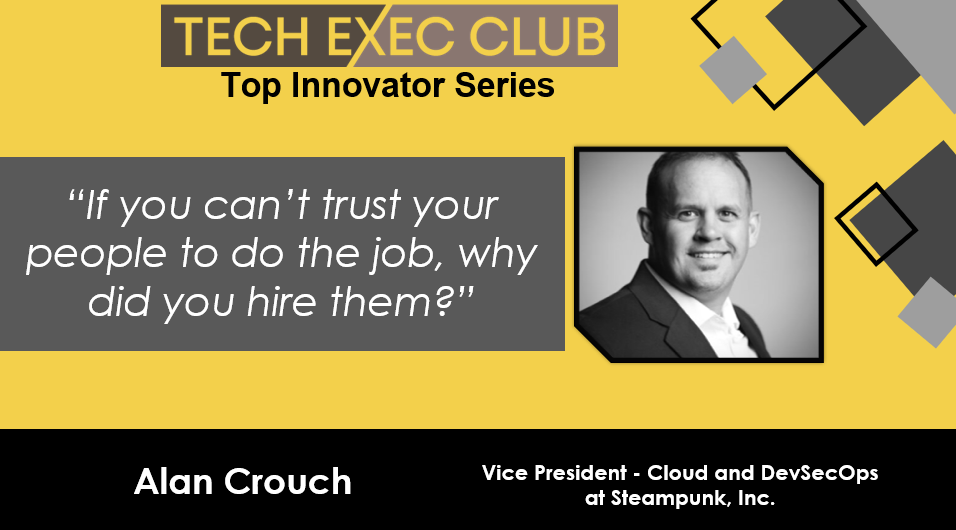
In an era dominated by disruption and digital acceleration, leadership often boils down to buzzwords and borrowed playbooks. But for Alan Crouch, Vice President of Cloud and DevSecOps at Steampunk, leadership is something far more grounded — and far more powerful. It’s about brilliance in the basics, owning your voice, and embracing the hard truths, even when it costs you.
In this exclusive interview with host Josef Martens on the Top Innovator series, Crouch offers a masterclass in leadership that’s as raw as it is refined. From his foundational belief in human-centered design to a now-legendary moment of being fired — and then begged to return — on the troubled launch of Healthcare.gov, Crouch walks us through his leadership journey with candor and conviction.
With over two decades of experience spanning Lockheed Martin, federal programs, and high-growth tech teams, Alan shares how a developer’s mindset, a people-first philosophy, and the courage to challenge groupthink have shaped his rise. Whether you’re scaling a startup, leading an enterprise, or simply trying to be better at what you do, this conversation is packed with practical wisdom.
Let’s dive into the principles, pivots, and personal breakthroughs that have defined Alan Crouch’s approach to transformative leadership.
Brilliance in the Basics: Mastering the Foundations of Leadership
Alan Crouch’s leadership philosophy doesn’t begin with buzzwords or business school jargon — it starts with the fundamentals. “Brilliance in the basics,” as he puts it, is the foundation for everything. Whether it’s writing a clear email or understanding how to place people where they can shine, Alan believes the so-called “simple things” are what leaders often neglect — and at their peril.
He draws a straight line between strong communication and organizational success. It’s not just about being heard — it’s about making sure your intent is understood, whether through a Slack message or a boardroom presentation. But perhaps more importantly, it’s about understanding people. “We have people that are all unique puzzle pieces,” he says. Great leaders don’t force-fit talent — they curate it.
By matching individuals to roles where they thrive, Alan empowers teams not just to function, but to flourish. His developer-to-leader journey taught him that effective leadership isn’t about doing everything — it’s about enabling others to do their best work. From self-awareness to team dynamics to organizational design, Alan’s basics are anything but basic — they are the architecture of sustainable leadership.
The Power of Saying “No”: The Healthcare.gov Wake-Up Call
The story of Healthcare.gov is a well-documented disaster. But behind the headlines lies a lesser-known lesson in leadership integrity — and Alan Crouch lived it firsthand. At the time, he was more of a “doer” than a decision-maker, yet he had the clarity and courage to sound the alarm: “We’re going to fail. This is not ready to go.”
That honesty didn’t land well. Executives told him to “be a team player” — code for staying quiet. Alan refused. “Being a team player is telling you the hard truths,” he told them. The next day, he was fired. The day after the disastrous launch, those same executives called, begging him to return. He declined.
This wasn’t just a personal vindication — it was a professional revelation. Alan learned that speaking the truth might get you kicked out of the room, but in the long run, integrity builds credibility. “People don’t respect a yes-man,” he says. In fact, that moment shaped how he leads today: with candor, accountability, and the courage to say no when it matters most. It’s a reminder that authentic leadership often means risking comfort for clarity.
Scaling Yourself: Leadership in a Hyper-Growth Environment
When Alan joined Steampunk, the company had just a handful of employees. Five years later, they’ve ballooned to over 300. That kind of growth doesn’t just stretch resources; it stretches leaders. What worked at 50 people breaks at 100. What worked at 100 shatters at 200. And Alan had to evolve with it.
“The principles stay the same,” he explains, “but the approach has to change.” As an organization scales, control becomes an illusion. Instead, influence, trust, and systems must take the wheel. Alan has had to “give things away,” handing responsibilities to his leadership team, not because he can’t do them, but because others need to grow. That, he says, is the essence of scaling yourself as a leader.
Letting go doesn’t come easy. For someone who loves getting into the weeds, delegation can feel like FOMO. But strategic leaders understand that growth isn’t just about doing more, it’s about empowering more people to lead alongside you. And in Alan’s case, that shift has allowed both him and his teams to thrive.
Human-Centered Design: Leading with Empathy and Purpose
While many see human-centered design as a product or UX concept, Alan Crouch applies it to everything, from leadership to recruiting to even sales. It starts with one powerful question: Who am I solving a problem for? That mindset shift transforms how decisions are made and how solutions are crafted.
Too often, organizations throw technology at problems without understanding the people behind them. Alan offers an excellent analogy: “They think they need a blue elephant. What they actually need is an orange rhino.” That’s what happens when you listen to the request, not the problem.
By focusing on user outcomes, whether the “user” is a customer, a teammate, or a stakeholder, Alan ensures that solutions are designed with real impact in mind. It’s a practice that builds empathy, drives creativity, and aligns teams around purpose rather than assumptions.
This isn’t theory. It’s a discipline he’s used to scale systems and culture alike. In an industry obsessed with velocity, Alan advocates for thoughtfulness, starting with the humans at the heart of every process.
Listening Before Leading: Trust, Ego, and the Future of Leadership
When asked what he’d change about modern leadership, Alan doesn’t hesitate: “I’d ask leaders to listen before they talk.” It’s deceptively simple and profoundly rare. Too many leaders rush to fill the room with their opinion before absorbing the facts on the ground. That erodes innovation, disempowers teams, and feeds ego.
Alan admits he’s made that mistake. But experience taught him that the best leaders create space for others to reach their own conclusions, even when they’ve already seen the path. “Let them go through the struggle,” he says. “That’s where the growth happens.”
He extends this thought into a sharp warning about the future. With AI’s rise, many leaders may outsource their thinking. “AI can become a crutch,” Alan says. “If you stop critically thinking and just press the easy button, you’ll miss the real problem.”
Instead, Alan envisions a leadership model built on trust, inquiry, and humility. He believes leaders should step back, guide rather than control, and, when possible, be a little “lazier” by empowering others. Because authentic leadership isn’t about having all the answers, it’s about creating an environment where answers can emerge.
If Alan Crouch’s leadership journey resonated with you, don’t just nod and move on. Take action. Here are concrete ways to apply his insights in your own career and organization:
- Master the Basics. Don’t Skip the Fundamentals: Focus on core communication skills (written, verbal, interpersonal). Audit your own “basics” regularly: Are you truly excelling at the simple stuff? Encourage your team to do the same. Excellence starts at the foundation.
- Understand Your People Like Puzzle Pieces: Evaluate your team members not just for skills, but for fit. Place people in roles that highlight their strengths, not just fill gaps. Spend time learning what your team’s “special sauce” is and align roles accordingly.
- Speak Up Even When It’s Hard: Be willing to challenge the status quo, especially when projects are off track. Practice saying “no” when something compromises integrity or delivery. Remember: being a real team player means telling the truth, not just being agreeable.
- Grow with the Organization: Reassess your leadership style every time your team scales. Identify what worked at your current size that might break at the next level. Delegate not just to offload but to help others grow and lead.
- Apply Human-Centered Design to Leadership: Start every initiative by asking: Who am I solving this problem for? Focus on outcomes before jumping into solutions. Use this mindset not just in products but in processes, hiring, and culture.
- Listen Before You Lead: Build habits of listening deeply before forming opinions. Empower your team by letting them work through ideas, even if you already know the answer. Shift from ego-driven leadership to trust-based collaboration.
- Use AI Wisely, Not as a Crutch: Stay skeptical and thoughtful about AI-generated suggestions. Use AI to support, not replace, your critical thinking. Keep asking more profound questions and stay close to the human impact of your decisions.
Alan Crouch is not your typical tech executive. He’s part developer, part strategist, and all heart, a rare blend of technical depth, people-centered thinking, and the courage to lead with integrity. His journey from writing code to shaping culture reveals a leader who doesn’t just adapt to change; he anticipates it, drives it, and empowers others through it.
Whether challenging broken systems, scaling a fast-growing company, or choosing to listen when others would speak, Alan leads with purpose. He reminds us that authentic leadership isn’t about control, it’s about clarity, trust, and humility. And in an age where shortcuts and surface-level fixes tempt even the best of us, Alan’s story is a powerful reminder: doing the right thing may be harder, but it always pays off.
In Alan Crouch, we don’t just meet a successful executive; we meet a successful executive. We meet a thoughtful architect of people, systems, and futures. A leader worth learning from and one we’ll be watching as the next chapter unfolds.
Want to hear Alan Crouch’s insights firsthand? Watch the full, live podcast interview [click here]