In a world where buzzwords like “innovation” and “digital transformation” dominate leadership talk, Ravi Ganti brings something refreshingly different to the table: clarity, context, and human connection. As the Chief Technology Officer of Quantum Information Systems Solutions, Ravi’s journey from hands-on developer to global technology leader is not just a tale of career advancement — it’s a masterclass in grounded, empathetic leadership.
In this episode of the Top Innovator series, host Josef Martens sits down with Ravi to uncover what truly makes a great tech leader in today’s fast-moving world. Rather than leading from a pedestal, Ravi leads from the trenches — drawing from years of experience across development, architecture, quality control, and global team management. Whether he’s breaking down complex systems into manageable problems or guiding teams through the chaos of rapid AI advancements, Ravi’s approach is always thoughtful and deeply human.
In this candid conversation, Ravi shares the guiding principles behind his success — from the power of simplifying complexity, to the importance of empowering teams with ownership, to the underrated value of just being 1% better every day. What emerges is a compelling portrait of a leader who has not only mastered technology but, more importantly, mastered the art of bringing people along with him.
From Developer to CTO — Climbing Every Rung of the Tech Ladder
Ravi Ganti didn’t land in the CTO chair by accident — he earned it one role at a time. His journey began as a manufacturing engineer with a curiosity for software. That curiosity led him into development, where he steadily moved from junior coder to senior developer, then on to technical lead and project manager. Today, as CTO of Quantum Information Systems Solutions, he brings every rung of that climb into his leadership style.
What sets Ravi apart isn’t just that he “understands” his team — it’s that he’s been them. He knows the frustrations of debugging code at 2 a.m., the challenges of balancing deadlines with architecture decisions, and the pressure of deploying software in live production. That deep empathy allows him to communicate more effectively with his team, to anticipate roadblocks, and to remove friction before it causes burnout.
When Ravi speaks with his engineers, there’s no ivory tower. There’s no abstraction. He says their language, because he’s lived their reality. That makes him not just a leader, but a trusted partner. It’s the kind of credibility you can’t fake — and the kind that today’s technical teams deeply respect.
Simplifying Complexity and Explaining the ‘Why’
At the core of Ravi’s leadership philosophy lies a deceptively simple principle: “Give people context, not just commands.” It’s not enough to assign tasks. It’s not even enough to explain what needs to be done. The real power lies in helping teams understand why something matters.
Ravi has made it his mission to break down complexity into clarity. Whether he’s guiding developers through a convoluted product requirement or aligning a cross-functional team on a deadline, his approach is the same: deconstruct the problem into smaller parts, clarify the rationale for the strategy, and let the team own execution.
This principle evolved from his early days working in factories and integrating software with production systems. Rather than dictating what users should do, Ravi and his team focused on educating people on why a system change was necessary. That sense of inclusion created engagement — and better outcomes.
He applies the same thinking today, whether working with engineers or executives. By offering the “why” and painting the bigger picture, he transforms passive employees into proactive owners. As he puts it: “If they understand the context, they’re not just being directed — they’re contributing.”
Cross-Cultural Communication and Adaptive Leadership
Ravi’s leadership extends far beyond technical savvy — it’s deeply human and globally aware. Having led teams across continents — from Europe to Asia — he’s learned that effective leadership is never one-size-fits-all. What works in one culture may fall flat in another.
In some countries, direct feedback is expected. In others, it’s considered disrespectful. Some teams are built around hierarchy, while others thrive in flat structures. Recognizing and adapting to these nuances has made Ravi a more thoughtful and effective leader.
Rather than forcing everyone into a single communication mold, he seeks to create a space where everyone feels safe to contribute — in their own style. That might mean encouraging more junior voices to speak up in hierarchical cultures, or creating moments of structure in flatter ones.
This kind of leadership requires both self-awareness and curiosity — two qualities Ravi credits with shaping his growth. “I’ve had to slow down,” he admits, “not in terms of momentum, but in making sure the team is with me.”
By adjusting his communication approach to fit the audience — whether it’s a finance executive or a software engineer — Ravi ensures that ideas don’t just get shared, they get understood. In a globalized, hybrid work world, this kind of adaptive leadership isn’t optional — it’s essential.
Embracing Imperfection and Iterative Progress
Perfectionism nearly cost Ravi a major implementation — and taught him one of his most valuable leadership lessons.
Years ago, while working on a manufacturing integration, Ravi realized mid-project that the system couldn’t be deployed at 100% completion within the tight timeline. His instinct was to halt the rollout and wait for perfection. The customer, however, pushed back: “Even if it’s 70% ready, put it in.”
At the time, Ravi resisted — and won the argument. But looking back, he sees the wisdom in that request. “There will always be issues,” he now acknowledges. “If we can balance the risk, we can go live and improve as we go.”
This shift from perfection to iteration has transformed Ravi’s leadership style. In today’s fast-moving tech landscape — especially with AI accelerating change — waiting for perfect means missing the moment. Instead, Ravi now embraces calculated risk, fast feedback, and continuous refinement.
It’s not about lowering standards — it’s about moving forward without being paralyzed by fear. His teams don’t ship unfinished work. They ship valuable work — and make it better every day.
1% Better Every Day — The Math of Continuous Improvement
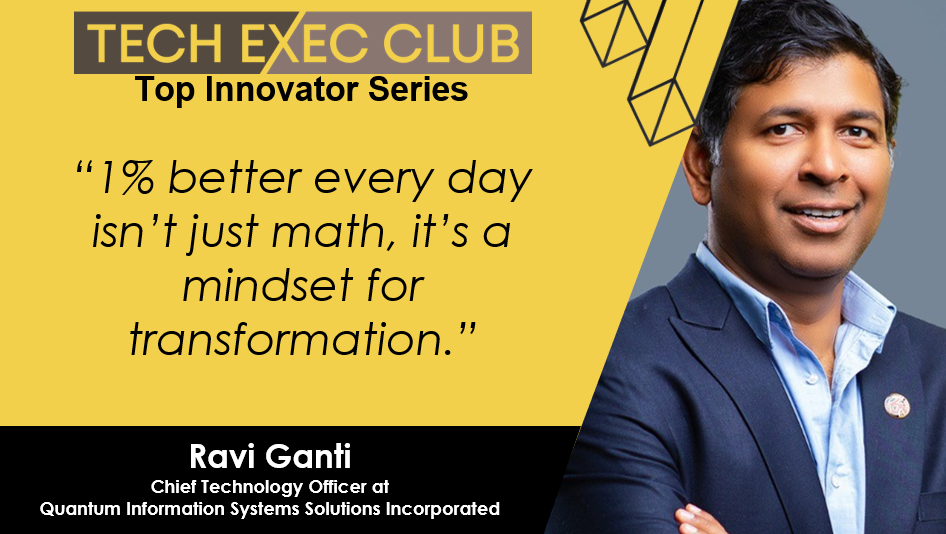
Ravi Ganti has a personal mantra that doubles as a leadership philosophy: “Just be 1% better than yesterday.”
On its surface, it’s simple — but in practice, it’s powerful. Ravi, a math enthusiast, loves the idea of compounding improvement. “If you improve by 1% every day,” he explains, “you’re nearly 38 times better by the end of the year.” That mindset permeates his leadership.
Rather than overwhelming teams with massive transformation goals, Ravi encourages minor, consistent upgrades — to code, to process, to communication. He challenges his team to ask: What’s one little thing you can do better today? Over time, these small wins add up to significant progress.
This philosophy also aligns with how he approaches personal growth. Instead of giant leaps, he values sustained, mindful evolution. It’s a mindset that keeps teams focused, motivated, and, most importantly, moving forward.
In an industry obsessed with speed and disruption, Ravi’s approach offers a calming, measurable path to excellence: consistent, deliberate, and continually improving.
If Ravi Ganti’s leadership journey resonated with you, don’t just be inspired — take action. Here’s how you can apply his proven principles to your own leadership or team-building efforts:
- Walk the Path First — Then Lead: Whether you’re a new leader or seasoned executive, invest time in truly understanding the roles of your team members. Shadow a developer. Join a QA meeting. Sit in on support calls. Experience their challenges firsthand — it builds empathy and trust.
- Always Explain the ‘Why’: Don’t just delegate tasks. Explain the bigger picture. Start your next project kickoff by outlining the context, not just the requirements. Watch how your team becomes more engaged and proactive.
- Empower Through Ownership: Shift from “task assignment” to “mission alignment.” Give your team autonomy and trust. Let them own outcomes, not just deliverables.
- Embrace Imperfection — Act Iteratively: Stop waiting for perfection. Ask: “Is this version good enough to test, learn, and evolve?” Iterate openly. Celebrate learning from mistakes — not just flawless execution.
- Build Cross-Cultural Awareness: If you lead globally distributed teams, invest time in learning cultural norms. Create space for all voices to contribute — even if they speak up differently.
- Live the 1% Better Mindset: Ask yourself and your team each day: “What’s one small thing we can improve today?” Track micro-wins. Over time, these build massive momentum.
- Practice Leadership by Example: Be hands-on when needed. Show you understand the tools, the processes, and the people. Your team will mirror your curiosity, work ethic, and transparency.
- Commit to Context-Driven Leadership: Context is the difference between compliance and commitment. Make it a habit to start every meeting, every update, and every email with why it matters.
Ravi Ganti’s leadership isn’t built on hype. It’s built on humility, clarity, and the courage to grow — one step at a time.
Ravi Ganti doesn’t lead with a loud voice or flashy slogans. He leads with presence, perspective, and purpose. His journey from a curious engineer to the CTO of a global tech company is a story of grounded leadership — one built on lived experience, clear communication, and relentless curiosity.
What makes Ravi stand out isn’t just his technical acumen — though he has that in abundance. It’s his deep belief in people. Whether he’s guiding teams through emerging technologies like AI or navigating the complexities of multicultural teams, Ravi brings empathy, clarity, and an unwavering focus on continuous growth.
In an industry obsessed with disruption, Ravi champions stability through simplicity. In a world of scale, he reminds us that small improvements compound into extraordinary outcomes. And in a culture that often prioritizes output over ownership, he invites us to focus on the “why.”
As we reflect on his insights, one thing becomes clear: great leaders don’t just move fast — they bring others with them. And Ravi Ganti is doing precisely that.
Want to hear Ravi’s insights firsthand? Watch the full, live podcast interview [click here]