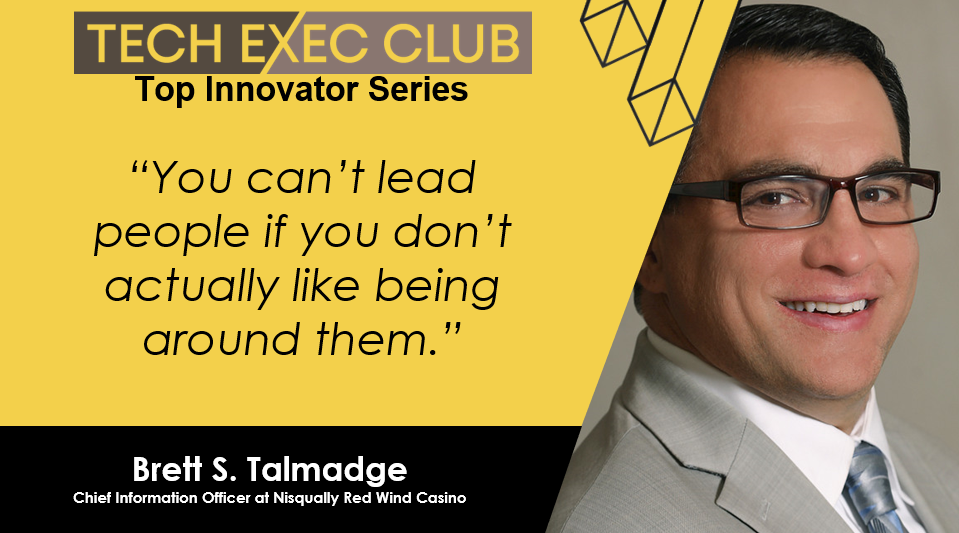
In a world where leadership often defaults to buzzwords and boardroom jargon, Brett Talmadge brings something refreshingly different to the table: heart, humor, and a deep understanding of what it really means to lead people—not just processes.
As the former CIO of Nisqually Red Wind Casino and with a career spanning high-stakes hedge funds to solo tech leadership roles, Brett has seen every corner of the IT world. But the lessons that shaped him didn’t come from code or corporate playbooks—they came from Boy Scouts, the Marine Corps, and one sage mentor who saw leadership potential before Brett saw it in himself.
In this episode of the Top Innovator series, host Josef Martens dives deep into Brett’s leadership journey—an evolution from lone technician to beloved team builder. With candor and clarity, Brett shares how isolation taught him the power of collaboration, why being “too transparent” can backfire, and how fun became the core KPI of his team’s success.
Whether you’re climbing the leadership ladder or guiding others from the top, Brett’s story is a masterclass in purpose-driven leadership—and why the best leaders are the ones who show up, shut up, and truly listen.
From Isolation to Insight: Discovering the Power of Teamwork
For Brett Talmadge, the pandemic didn’t just shake up the world—it shattered any illusions he had about working in solitude. After relocating from New York City to Washington State for a tech job, Brett found himself in a lovely lodge… completely alone. As CIO, he wore every hat, from technician to strategist, yet none of it sparked joy. “It felt like a prison,” he admits.
The absence of a team hit harder than he expected. “IT is like the medical field—you only show up when people have problems,” Brett explains. But what truly hurt wasn’t the stress; it was the lack of camaraderie. Without collaboration, creativity dried up. Without shared energy, passion disappeared.
This period became a turning point. Brett realized that, despite years of professional experience, he thrived most in environments where teamwork wasn’t optional—it was essential. From Cub Scouts to the Marine Corps, Brett’s life had always revolved around teams. And now, in that isolated role, he fully understood how critical that energy was to his success and well-being.
That clarity became the foundation for his future leadership: building teams where people don’t just work—they connect, collaborate, and care. The lesson? Leaders don’t just need people—they need purpose-driven, human-powered teams.
The Mentor Who Changed Everything
Every great leader has someone who saw their potential before they did. For Brett, that person was a seasoned manager who plucked him out of a purely technical role and told him, point-blank, “You’re ready.” Brett wasn’t so sure. The stakes were high: they were managing infrastructure for multiple hedge funds, where failure was not an option.
What made Brett listen wasn’t flattery—it was presence. “He was always there,” Brett recalls. Rain or shine, problem or panic, this mentor showed up consistently, with calm and quiet command. He wasn’t the type to yell or belittle. He challenged people with offbeat questions (“How many restaurants do you think are in Australia?”) and cultivated a culture where thinking was rewarded, not rushed.
This mentor’s leadership style became the blueprint for Brett’s own. Respectful, steady, and deeply human, he taught Brett that effective leadership is more about who you are than what you say. That presence—being with your people, showing up, holding space, guiding without dominating—is what transforms teams from functional to phenomenal.
To this day, Brett carries that influence with him. His one-on-one meetings with 27 team members as CIO? A direct legacy of that leadership model. Brett doesn’t just manage—he listens, learns, and leads by being present.
Building a Culture of Fun, Respect, and Passion
Ask most CIOs about KPIs, and you’ll hear about uptime, latency, and cost savings. Ask Brett Talmadge? You’ll listen to about fun.
“I bought a big neon sign for my team that says, ‘We Are The Fun,’” he laughs. It wasn’t a gimmick—it was a philosophy. As the leader of an IT department supporting a bustling casino, Brett realized early on that the magic on the casino floor starts behind the scenes. And if the backend teams are miserable, the experience on the front lines suffers, too.
Brett doesn’t believe in joyless work. His leadership style infuses humor, energy, and—above all—respect into the everyday grind. He refuses to yell, checks in regularly with each team member, and focuses on creating a workplace people look forward to. “We spend so much time at work,” he says, “why dread it?”
This culture doesn’t just boost morale—it drives performance. Brett’s teams consistently outshine expectations, and outsiders often wonder: Why is Brett’s team so energized? The answer is simple: they’re seen, heard, and celebrated.
For Brett, leadership is less about control and more about connection. When people feel safe, supported, and yes—even entertained—they bring their best. And when the leader is having fun, the whole team follows.
The Double-Edged Sword of Transparency
In an era that champions radical transparency, Brett Talmadge offers a surprising caution: sometimes it’s too much.
Growing up in a small Oklahoma town and serving in the Marines, Brett was taught that sharing information was part of integrity and safety. But as a leader, he learned the hard way that what you share—and with whom—matters just as much.
One experience stuck with him: he casually shared a technical update with a senior engineer, not realizing the person suffered from chronic anxiety. The issue wasn’t critical, but the engineer couldn’t sleep for days. “I realized I’d passed along stress that didn’t need to be shared,” Brett reflects.
This moment reframed how Brett approached communication. Transparency is still a pillar of his leadership—but now, it’s intentional. Leaders, he believes, must be stewards of information, curating it for clarity rather than chaos.
It’s a lesson in emotional intelligence: leading isn’t just about being open. It’s about being aware of personalities, stress triggers, and the emotional ripple effect of every Slack message and strategy update. In short, share wisely, not wildly.
The Future of Leadership: AI, Presence, and Breaking Down Silos
When Brett looks ahead, he sees a future where AI helps leaders focus less on bureaucracy and more on people. “Performance reviews, development plans—these things took so much time, they often got cut and pasted,” he says. But with agentic AI, those admin-heavy tasks can be streamlined, freeing up leaders to be present and strategic.
But don’t mistake his tech optimism for detachment. Brett is equally passionate about human presence in leadership. His “magic wand” idea? Every department should meet regularly with every other department. For him, leadership is not just about efficiency; it’s about unity.
Too often, departments operate in silos. People don’t understand how their roles intersect. “You can’t lead a team in Oklahoma from a desk in New York,” he says bluntly. The power of connection—face-to-face, honest, and frequent—is irreplaceable.
The next era of leadership, in Brett’s eyes, will be powered by AI—but it must be rooted in humanity. That means showing up, breaking down silos, and letting technology handle the red tape so people can do what they do best: innovate, connect, and grow.
If Brett Talmadge’s story resonated with you, don’t let it end as inspiration alone. Here’s how you can take his wisdom and turn it into real leadership growth—starting today:
- Evaluate Your Environment: Are You Thriving or Surviving? Ask yourself honestly: Do you feel energized at work, or are you stuck in isolation? If your creativity or passion is fading, consider whether your current role supports the kind of human connection you need to thrive. Leaders: audit your team’s emotional environment—not just productivity metrics.
- Build Presence, Not Distance: Show up for your people. Physically, when possible; emotionally and mentally, always. Schedule consistent one-on-one check-ins, even with non-direct reports. Ask real questions. Listen deeply. Don’t delegate connection.
- Make Your Culture Fun—On Purpose: Fun is not frivolous. It fuels engagement and retention. Ask your team what would make their day-to-day more enjoyable—and then implement some of those ideas. Lead by example: bring energy, humor, and humanity to every meeting.
- Practice Strategic Transparency: Before you share a new piece of information, ask: Does this help or harm? Know your team’s personalities—some need detail, others need calm. Take a moment to filter and tailor your communication with empathy.
- Break Down Silos Immediately: Create cross-departmental meetings and encourage regular collaboration. Transparency isn’t just internal—make inter-team alignment a routine. Empower departments to understand how their work impacts others.
- Embrace AI as a Leadership Ally: Start exploring AI tools that can streamline performance reviews, planning, and administration. Use automation to free up time—not replace people. Remember: AI enhances leadership—it doesn’t replace real presence.
These aren’t lofty ideas. They’re practical, proven steps from someone who’s lived both the solo grind and the team triumph. Start small. Stay consistent. And remember: when leadership is human, everything changes.
Brett Talmadge’s leadership journey isn’t about titles, tech stacks, or company prestige—it’s about people. From his early days in the Boy Scouts and the Marine Corps to the executive boardrooms of hedge funds and casinos, Brett has consistently chosen connection over ego, presence over power, and passion over process.
He reminds us that leadership is not a role—it’s a relationship. It’s showing up with consistency, listening without judgment, and creating environments where people genuinely want to succeed. It’s knowing when to push, when to pause, and sometimes, when to let the team have fun.
Brett doesn’t just lead teams—he builds cultures. He doesn’t just solve problems—he inspires people to solve them together. And in a world hungry for authentic leadership, his story is a reminder that the most powerful thing a leader can do… is be human.
As we reflect on Brett’s insights, we’re invited to look inward and lead outward—with clarity, compassion, and courage.
Want to hear Brett’s insights firsthand? Watch the full, live podcast interview [click here]