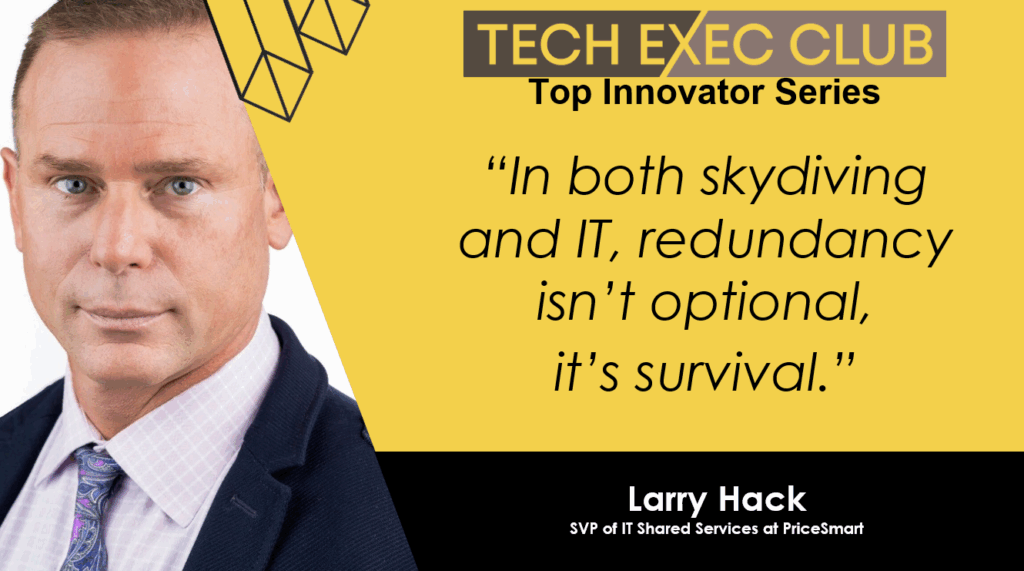
When most executives discuss leadership, they often reference books, boardrooms, and the occasional TED Talk. But for Larry Hack, leadership is tested at 13,000 feet, free-falling toward Earth in a wingsuit—or hundreds of feet underwater, exploring pitch-black caves with only a backup light to trust.
Currently Senior Vice President of IT Shared Services at PriceSmart, Larry’s resume reads like a tour through top-tier tech leadership: CTO of CPAP, SVP at Crane Worldwide Logistics, and CIO at Global Custom Commerce. But behind the titles lies a career built not just on strategy and systems—but on mentorship, trust, calculated risk, and personal evolution.
In this exclusive interview with Josef Martens as part of the Top Innovators series, Larry opens up about his unconventional path to leadership, the mentors who shaped him, and how his passion for extreme sports parallels his philosophies on empowerment, growth, and resilience in high-stakes technology environments.
What unfolds is more than a conversation—it’s a blueprint for modern leadership that’s as inspiring as it is actionable.
Mentorship as the Cornerstone of Growth
Larry Hack’s journey into leadership didn’t start with an MBA or a textbook—it began with his father’s small business, where a six-year-old Larry greeted customers at the door. That early exposure to people laid the groundwork for what would become a lifelong obsession with growth through human connection. However, Larry’s actual acceleration stemmed from a pivotal moment early in his career, when he approached Wayne Sadin, then a seasoned CTO, and asked a bold question: “Will you mentor me?”
That decision—and Wayne’s willingness to guide him—became a turning point that shaped Larry’s entire leadership philosophy. Wayne not only taught him the business side of technology but also instilled the mindset of continuous learning that Larry still carries today.
That leap of vulnerability paid off. The CTO took Larry under his wing and guided him through the complexities of technology leadership. But the lesson didn’t end there. Larry went on to seek mentors in even more intense arenas—like cave diving, where his friend and mentor Ed Sorensen taught him how advanced rebreathers, while seemingly dangerous, were in fact safer in the long run. It’s a theme that runs deep in Larry’s worldview: “Find someone who knows what you don’t. Learn. Then teach.”
Eventually, Larry himself became a mentor, a role he sees as both an honor and a heavy responsibility. “When someone asks you to be a mentor, it puts you under pressure to really know your stuff,” he says. That responsibility fuels his own continued growth—and pushes him to create a culture of development for the teams he leads.
Extreme Sports and Leadership Parallels
Larry’s not your typical executive. He’s a wingsuit flyer, base jumper, and record-breaking skydiver. While some might see these pursuits as recreational madness, Larry sees them as leadership training at 13,000 feet.
“There are so many parallels,” he says. In both extreme sports and IT leadership, redundancy is key. “In a skydive, you have a reserve chute. In IT, you need backup systems, backup people, backup plans.” He even delivers a talk called “Extreme IT,” where he breaks down the technical takeaways from sports, such as cave diving, where failing to follow the “continuous guideline” rule can be fatal, just like breaking critical rollback protocols in database transactions.
Larry practices what he preaches. His preparation for a world-record skydive (200 people, 9 planes, simultaneous exit) involved hours of ground rehearsal for a mere 60 seconds in the sky. Similarly, he advocates for hands-on disaster recovery drills in IT—not just plans on paper. “Test the system. Simulate the failure. Don’t wait for the real one to teach you.”
It’s in this high-stakes fusion of adrenaline and analysis that Larry thrives—and where he draws leadership lessons that most executives wouldn’t dare seek out.
Communicating in Business Language
Early in his tech career, Larry was determined to prove himself technically. He used all the jargon, showed off his knowledge, and spoke in terms of systems and specifications. But then a mentor—Wayne Sadin—gave him advice that initially felt counterintuitive: “You’re too technical. Speak the business’s language.”
At first, Larry resisted. “I thought being more technical made me more impressive,” he admits. But then he joined Blinds.com, where the founder, Jay Steinfeld, hired Larry precisely because of his ability to translate complex technology into business terms. When Larry asked how he was doing, Jay responded, “You’re not really a tech person—you’re a business person.” At first, Larry was crushed. Then it clicked.
That comment wasn’t a dig—it was high praise. It meant Larry was doing what no one else on the tech team had done: making himself useful to the business by speaking in terms they understood.
This transformation became a foundational part of his leadership philosophy: communication is more than clarity—it’s connection. Larry now teaches his teams to bridge that gap between engineering and enterprise, helping both sides reach common goals faster, more collaboratively, and with fewer misfires.
Empowerment and Delegation in Leadership
If Larry had a magic wand, he’d change one thing about tech leadership: he’d make leaders actually trust their teams. “We give people titles—Director, VP—but don’t give them the authority to act,” he says. That, in Larry’s eyes, is not leadership. It’s control.
He believes authentic leadership comes from letting go. That means trusting your team to make decisions, allowing them to fail, and supporting them as they grow from it. “If every decision runs through the top, the company can’t scale. It just can’t move fast enough.”
But this trust isn’t blind. It’s structured. Larry uses a decision-ownership model: everyone gets a voice, but one person owns the final call—and the rest of the team supports that decision as if it were their own. It’s a powerful way to foster both accountability and buy-in.
This approach helps eliminate bottlenecks, encourages innovation, and most importantly, empowers people to act like leaders—because they are. In Larry’s world, leadership isn’t a title; it’s a mindset. It’s a behavior. And if you’re not letting people lead, you’re not really leading at all.
Personal Growth and Cultural Awareness
Despite decades of success, Larry’s not done learning. In fact, he’s doubling down—especially in areas where he sees personal blind spots. At the top of the list? Language and cultural fluency.
“My Spanish isn’t great,” he admits, even though his wife is Puerto Rican and his company operates across Latin America. “But when I go to Costa Rica or Colombia, just using a little Spanish goes a long way. People light up.”
Larry sees language not as a skill, but as a bridge to empathy. “Business is global. If we want to lead effectively, we have to understand the people we’re leading.”
He’s also focused on keeping up with rapid tech changes. His strategy? Just-in-time learning. When asked to help draft an AI policy, he pulled up ChatGPT and started drafting live on the spot. “Why wait a week when we can do it now?” he quips.
He also battles one very human flaw: remembering names. “People think if you forget their name, you don’t care. And that’s not true—I care deeply.” So he takes notes, uses tricks, and continually refines how he connects with people, proving once again that for Larry Hack, leadership is always a work in progress.
Larry’s leadership isn’t just about philosophy—it’s about action. Here are the key takeaways he lives by, each one a principle you can apply starting today:
1. Seek a Mentor, Be a Mentor: Growth begins with learning from those ahead of you—and solidifies when you guide those behind you.
2. Build Redundancy Into Everything: Whether in IT systems or skydives, have backups for your backups—and test them regularly.
3. Translate Tech Into Business: Ditch the jargon. Speak the language of the business to become a true strategic partner.
4. Empower Your Team to Lead: Give absolute authority—not just titles. Let people make decisions, own outcomes, and learn from mistakes.
5. Practice for the Worst-Case Scenario: Don’t just write disaster plans—run them. Simulate failures and rehearse real responses.
6. Embrace Global Culture and Language: Even small efforts in local language and cultural awareness can build massive trust with international teams.
7. Learn Just-in-Time: Stay agile by learning precisely what you need, when you need it. Use tools like AI to adapt quickly.
8. Make Leadership Personal: Remember names. Understand what drives your people. Build relationships beyond the job description.
Larry Hack is not just leading technology—he’s redefining what leadership looks like in a fast-moving, high-stakes world. From the dizzying heights of world-record skydives to the boardrooms of global enterprises, he brings the same mindset: prepare relentlessly, trust deeply, and never stop growing.
Whether mentoring rising leaders, building cross-functional agile teams, or practicing emergency response protocols with the precision of a wingsuit dive, Larry leads by example. He proves that outstanding leadership isn’t about control—it’s about clarity, courage, and connection.
In an era where complexity and speed define success, Larry Hack reminds us that the best leaders are the ones who empower others, embrace change, and never forget the human element.
Want to hear Larry Hack’s insights firsthand? Watch the full, live podcast interview [click here]