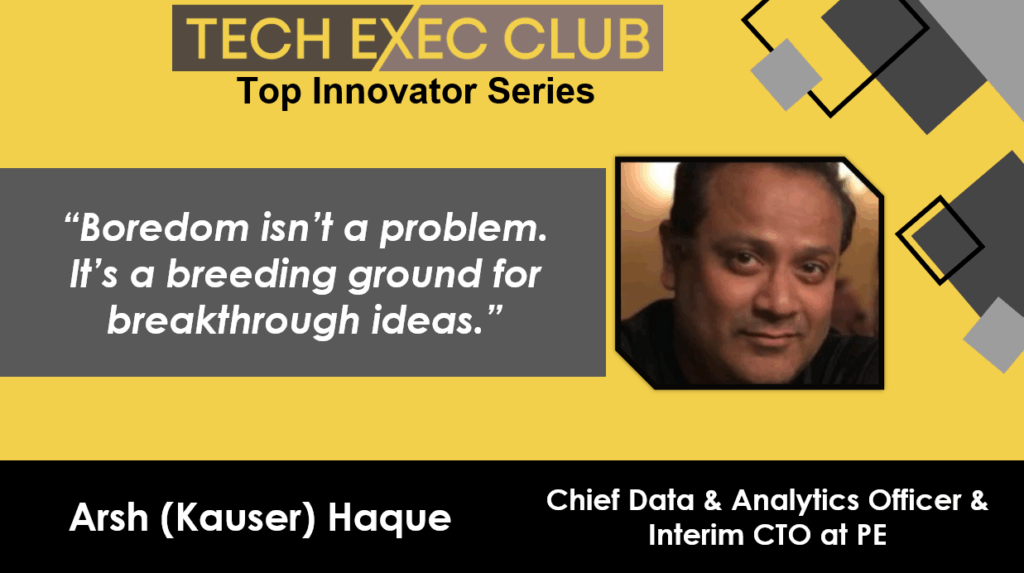
In an age where corporate culture often feels cold, transactional, and performance-obsessed, Arsh Kauser-Haque is leading with something radical: warmth.
As the Chief Data and Analytics Officer and Interim CTO at PE Group, Arsh doesn’t just lead with technical precision—he leads with heart. In this robust conversation with Josef Martens on the Top Innovator Series, Arsh challenges conventional leadership wisdom. Instead, he proposes a deeply human metaphor: what if your team were your family?
From his early days building data science teams at Verizon to navigating the tightly regulated, high-stakes world of energy compliance in the UK, Arsh has discovered that the most innovative, resilient, and high-performing teams aren’t the ones micromanaged into submission. They’re the ones who feel safe, seen, and significant.
However, don’t mistake empathy for weakness or softness. Arsh brings the same rigor to his work with people that he brings to his engineering work. Whether it’s addressing underperformance, shifting leadership styles mid-project, or balancing flexibility with specialization, Arsh approaches leadership like a dynamic system—one that demands constant evolution.
Through stories, analogies, and deeply personal insights, Arsh shares a leadership philosophy that blends accountability with empathy, structure with flexibility, and—perhaps most surprisingly—innovation with a sense of purpose.
This isn’t just an interview. It’s a masterclass in modern leadership.
“Leadership Is a Family Affair” — Why Empathy is a Strategic Advantage
For Arsh Kauser-Haque, leadership isn’t about dominance or detachment—it’s about belonging. Drawing on the metaphor of family, he challenges the cold, transactional culture so common in tech leadership today. “People say loyalty is gone. I say—it’s an unhappy family,” he quips.
In Arsh’s leadership model, teams thrive when they feel like they’re contributing to something greater than a task list. Like a well-functioning family, successful teams are built on trust, mutual accountability, and openness. But he’s quick to note: empathy doesn’t mean indulgence. A strong family sets boundaries, has tough conversations, and pushes each other to grow.
The power of this approach lies in its emotional resonance. “If my wife asks me to do something, I do it—not because I have to, but because I want to,” Arsh says. The same principle applies at work. When teams feel valued, they put their best work forward. When they trust the mission and the leadership, they innovate without being asked.
In an industry that often prioritizes systems over sentiment, Arsh’s family-style leadership is more than philosophy—it’s a performance strategy. A team that feels safe performs better. A team that feels seen gives more. And a team that feels like family can accomplish great things together.
Adapting on the Fly: How Evolving Leadership Styles Fuel High Performance
Rigid leadership is a relic. For Arsh, the true mark of a great leader is the ability to adapt in real time—to people, to projects, and to pressure.
He recounts his time at Verizon, where his team first explored data science, a field that did not yet have a formal job title at the time. Initially, innovation was exploratory, experimental, and flexible. But as the work matured into mission-critical systems, his leadership had to shift from open-ended exploration to structured execution. “The style that made us great at prototyping would have broken us in production,” he says.
This ability to pivot—sometimes mid-project—is essential. Not every team member needs the same kind of leadership. Some individuals thrive in autonomous environments, while others thrive in collaborative settings. Some projects require rapid iteration, while others demand strict compliance and risk control. “There is no one-size-fits-all. Even within the same project, you may need multiple leadership styles,” he explains.
Leadership, in Arsh’s view, is not a fixed identity but a toolbox. The job isn’t to force people into a structure—it’s to build a structure around the people. And that only happens when leaders stay awake, aware, and agile.
Hard Truths and Soft Skills: The Mentorship Moment That Changed Everything
Early in his career, Arsh had a moment that shaped his entire leadership ethos. Working late one night, he expected praise from his boss for staying up until the early hours of the morning. Instead, he got a challenge.
“My director said, ‘Either I gave you too much work, or you failed to complete it in the time you had. In both cases, something’s wrong.'” That moment flipped the script for Arsh. The goal wasn’t to overwork—it was to achieve clarity. It wasn’t about being the last to leave—it was about delivering within defined, respectful boundaries.
This perspective deeply informed how Arsh now manages teams. Leaders must give achievable goals and measure fairly. Overworking isn’t a badge of honor—it’s a sign of broken systems. “Leadership is about understanding what your team can do, should do, and must never be asked to do,” he says.
That encounter taught him that accountability and empathy must co-exist. You can be compassionate and still hold high standards. In fact, the best leaders do both. It’s a lesson many in tech leadership learn too late, but Arsh embraced it early—and built a leadership style around it.
From Fluid Teams to Focused Execution: When Specialization Saves the Day
Inspired by Dutch footballer Johan Cruyff’s philosophy, which holds that any player can play any position, Arsh long believed in building versatile teams. “In a family, anyone should be able to pick up any role when needed,” he says. This agility creates flexibility and resilience.
But over time—and especially in the high-stakes, heavily regulated world of energy—he realized that flexibility has limits. “When a crisis hits, you don’t want everyone doing everything. You want your best people doing the one thing they’re exceptional at.”
This marked a significant shift in his thinking. While cross-functional teams are powerful, there are moments—such as compliance issues, data privacy challenges, or mission-critical outages—where specialization isn’t optional. “In those moments, you need the best driver at the wheel, not someone trying the steering for the first time,” he explains.
Now, Arsh builds teams that can flex when appropriate, but snap back into deep expertise when required. It’s a model of balanced leadership: encourage learning, but know when to lean on mastery. The result is a team that’s not just adaptable, but also reliable under pressure.
The Innovation Equation: Hunger + Boredom = Breakthroughs
When asked how to build a culture of innovation, Arsh offers a surprisingly unconventional answer: hunger and boredom.
“Hunger” makes sense. He cites the Apollo 13 mission as a prime example—when oxygen systems failed, the NASA team had no choice but to innovate under pressure. “Necessity forces creativity,” he says.
But what about boredom?
“People need space to think,” Arsh argues. He points to Google’s famous 20% time, which gave engineers freedom to pursue side projects—some of which, like Gmail and Google News, became core products. “Innovation doesn’t always come from urgency. Sometimes it comes from unstructured time—when the mind can wander.”
Arsh wants to bring this principle into his own teams, even amid strict deliverables and deadlines. “Boredom” isn’t laziness—it’s the mental white space needed for insight. The challenge, he admits, is carving out that space in industries obsessed with action.
His takeaway? Innovation doesn’t just need tools or talent—it requires time. And the best leaders create room for their teams to imagine, experiment, and explore—without immediate pressure to produce.
If Arsh’s transformative leadership model inspires you, here’s how to bring those principles into your own organization—step by step:
1. Reimagine Your Team as a “Family” — Build Connection, Not Just Compliance: Create shared team missions and values that everyone buys into. Foster a sense of belonging by making each member feel seen and heard. Encourage peer support and collaboration instead of individual silos. Set healthy boundaries that protect work-life balance—don’t reward overwork, reward impact.
2. Be a Flexible Leader — Adapt Your Style to the Context: Match your leadership style to the phase of the project—exploratory innovation calls for freedom, while production demands structure. Adjust how you lead based on individual needs and working styles. Avoid one-size-fits-all management. Change your approach as the situation and team dynamics evolve.
3. Redefine Accountability — Set Clear, Attainable Expectations: Design workloads that are realistically achievable, not just impressive on paper. Create clarity on what success looks like and ensure teams have the necessary resources to achieve it. Establish a respectful feedback culture. Recognize that underperformance often points to leadership gaps, not individual flaws.
4. Balance Fluidity with Focus — Know When to Call in the Experts: Encourage cross-functional learning during normal operations to build team versatility. But in mission-critical situations, rely on specialists who excel under pressure. Understand when adaptability works—and when excellence in a defined role is non-negotiable, especially in high-risk industries like energy or compliance.
5. Make Room for Innovation — Cultivate Hunger and Design “Boredom”: Foster innovation by tapping into urgency (“hunger”) during critical problems, but also create deliberate space for free thought (“boredom”). Protect time for creative exploration. Introduce innovation hours or open sessions for idea generation. Encourage curiosity at all levels—not just from top performers.
6. Lead with Empathy, Not Ego — Build Trust Through Transparency: Always explain the rationale behind tough decisions to foster understanding and alignment. Invite ideas from all levels, including quiet voices and external sources. Take responsibility for failures and give credit where credit is due for successes. Leadership isn’t about being right—it’s about being honest, responsive, and reflective.
In a world where leadership often feels mechanical and transactional, Arsh Kauser-Haque brings something refreshingly human to the table. His philosophy—that teams function best when treated like families—offers a powerful counterpoint to conventional corporate models. But Arsh doesn’t stop at empathy. His approach is rooted in accountability, adaptability, and innovation—qualities that he not only talks about, but lives out in the high-pressure, compliance-heavy world of energy and data.
Whether he’s adapting his leadership style mid-project, encouraging team members to explore new roles, or creating space for innovation through boredom, Arsh exemplifies what it means to lead with both strategy and soul. His journey is a reminder that authentic leadership isn’t just about driving results—it’s about cultivating the conditions that enable people to do their best work, together. As companies face ever-evolving challenges, Arsh’s approach offers more than inspiration—it provides a blueprint for success.
Want to hear Arsh’s insights firsthand? Watch the full, live podcast interview [click here]