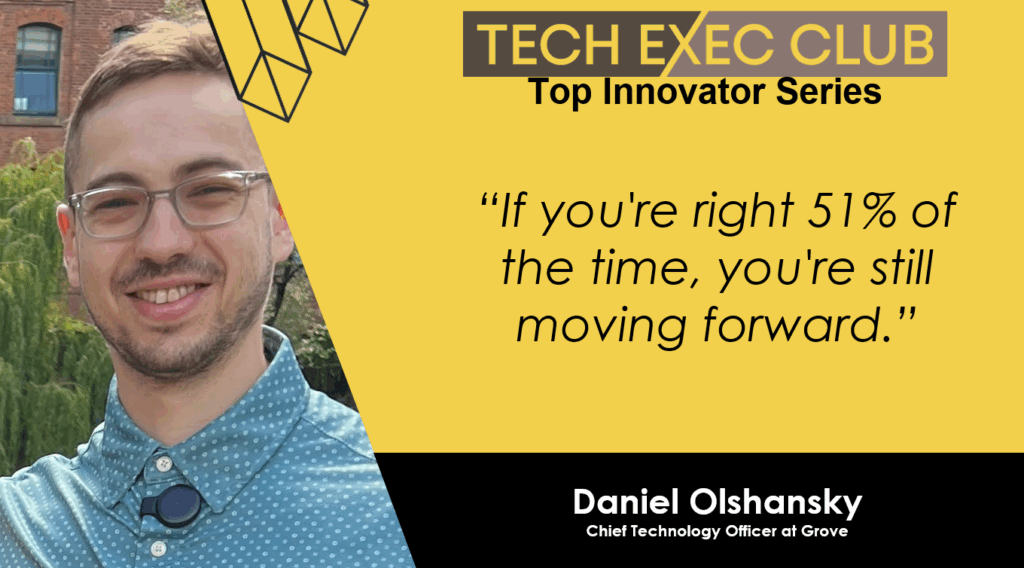
In today’s episode of the Top Innovator series, I had the privilege of sitting down with someone who’s not just building products—but building people, teams, and movements. Daniel Olshansky, the CTO of Grove and a former tech leader at Waymo and Magic Leap, brought something to this conversation that goes far beyond code or strategy.
From the moment we started talking, it became clear: Daniel is on a leadership journey that’s as reflective as it is relentless. His mantra—”every mantra has a counter-mantra”—perfectly captures his nuanced, deeply thoughtful approach to leading in a world that rarely offers clear answers.
In our conversation, Daniel unpacked the emotional complexity of leadership, the role of intuition, and the importance of knowing when to push a team—and when to protect it. He spoke candidly about his own areas for growth, his desire to inspire beyond the walls of his company, and a bold idea for the future: what if AI could provide leaders with real-time feedback, like a coach sitting invisibly on their shoulder?
This is more than a conversation about being a CTO. It’s about becoming a more conscious, more intentional, and ultimately more impactful leader.
Leadership as a Balancing Act — Choosing the Right Tool at the Right Time
“Leadership isn’t about having all the answers,” Daniel told me. “It’s about knowing which question to ask—and when.” That mindset informs his personal mantra: every mantra has a counter-mantra. In a world obsessed with playbooks and silver bullets, Daniel embraces a more nuanced, situational philosophy. Growth? Sure. But sometimes restraint is more powerful. Collaboration? Absolutely. But sometimes, what a team really needs is uninterrupted solitude.
For Daniel, the leader’s real challenge is not acquiring tools—it’s mastering the judgment to know when and how to use them. “Experience builds your toolbox,” he explained, “but leadership is knowing which tool to pull out and for how long.” It’s a framework that rejects binary thinking and champions flexibility, contextual awareness, and above all, humility.
This balancing act plays out in everything from deciding whether to hold a team-wide war room to canceling all meetings and letting engineers delve deeply into their “caves.” And it’s a decision that rarely has a perfect answer. That’s what makes it hard. But it’s also what makes it art.
The Power of Intuition and Reflection in Decision-Making
Daniel doesn’t pretend to have perfect judgment. In fact, he admits he often second-guesses himself—after the fact. But not in the moment. “I trust my gut during the day,” he said. “And I reflect on it during my evening walks.”
This rhythm of intuitive action followed by quiet reflection is the core of his decision-making strategy. He doesn’t believe in overanalyzing leadership in real-time. But he’s ruthless about learning from outcomes. Did the team’s energy level increase or decrease? Was progress made or momentum lost? These questions inform what he’ll try next—not what he’ll do now.
There’s a beautiful practicality to this approach. It allows room for imperfection while still demanding improvement. “You can’t always get it right,” he said. “But if you’re right 51% of the time, you’re moving in the right direction.” For a leader, that margin might be all it takes.
It’s an elegant reminder that leadership doesn’t mean infallibility. It means responsiveness. You act, you observe, you adjust. And over time, those small course corrections compound into something powerful.
Enduring and Channeling Pain as a Leader
When I asked Daniel about the most impactful advice he had ever received, his answer was blunt: “You need to like pain.” And not in a masochistic way. In a deeply aware, leader-driven manner. “You’ve got to be willing to push yourself—and your team—right to the edge of their potential,” he told me. “But not past it.”
Daniel believes that pain, when harnessed correctly, is a signal of growth. The goal isn’t to eliminate it—it’s to understand it, manage it, and learn where the threshold lies. Go too far, and you risk burnout. Don’t go far enough, and you risk never discovering your or your team’s real capabilities.
He referenced Ray Dalio’s concept that growth equals pain plus reflection, and it fits perfectly with Daniel’s leadership philosophy. Whether it’s a crushing deadline or an emotional setback, he sees these moments not as failures, but as opportunities to build endurance, awareness, and long-term strength.
In a startup world that idolizes hustle but rarely talks about its cost, Daniel’s take is refreshingly honest. Pain isn’t a side effect of leadership. It’s part of the job description.
From Leading Teams to Inspiring Ecosystems
As Grove’s CTO, Daniel leads a product team and a growing developer community. But his aspirations go far beyond that. “I want to expand the sphere within which I can inspire people,” he said. And that shift—from team leadership to ecosystem influence—is where he sees his next leap happening.
Leading a team is about context. You can hop on a call, explain the decision, and gauge the room’s reaction. However, leading a community—especially one that doesn’t interact with you daily—requires storytelling, clarity, and a clear vision. You’re not just making decisions anymore. You’re shaping a narrative that others want to be part of.
Daniel’s goal isn’t to be known. It’s to make something worth knowing about—something that inspires the next generation of founders the same way his heroes inspired him. He imagines a world where, 200 years from now, someone hears about a product he helped create and is moved to build something of their own.
It’s a big idea. But for Daniel, that’s the point. “Long-term thinking, short-term execution,” he said. And you can feel he’s already living both.
The Future of Feedback — A Magic Wand Called AI
I asked Daniel what he would change if he had a magic wand and could instantly improve how tech leaders operate. His answer? Real-time feedback. “I wish there was someone constantly telling me, ‘You’re pushing too hard here,’ or ‘You’re not spending enough time there.'”
Then he paused—and realized that wish might not be so far-fetched. “Actually,” he said, “we already have the magic wand. It’s AI.”
He envisions a future where leaders can record conversations, interactions, and decisions and have an AI reflect back patterns, red flags, and opportunities for growth. Not months later in a 360 review, but immediately. Like a digital angel and devil on your shoulder, whispering truths in your ear.
It’s a bold idea—and one that turns AI into something more human than we’ve ever imagined: a mentor. For Daniel, that’s the kind of future that could change leadership forever, not by removing the pain or the guesswork, but by helping us learn faster and lead better.
Whether you’re an engineering leader, an early-stage founder, or a team lead navigating ambiguity, Daniel’s insights offer a roadmap to more intentional leadership. Here’s how you can apply what he shared:
1. Build Your Toolbox — But Use It Wisely: Leadership isn’t about applying the same tactic every time. It’s about knowing which tool fits the situation. For Daniel, great leaders adapt—not react.
2. Trust Your Gut, Then Reflect: Use intuition to move forward, but carve out time to reflect. Daniel walks daily to ask himself: Did today’s decision create energy or drain it? That’s how small insights can lead to long-term growth.
3. Push Through Pain—But Know the Line: Growth lives at the edge of discomfort. Daniel believes in pushing teams to their potential, not past it. Pain is part of progress—so long as you reflect and adjust.
4. Lead Beyond the Team: Real impact means inspiring people outside your company—community, industry, even future generations. Daniel’s vision isn’t just to lead. It’s to leave a legacy.
5. Let AI Be Your Leadership Mirror: Imagine getting instant feedback on how you lead. That’s no longer fantasy. Daniel sees AI as the coach that helps good leaders get better—faster.
Daniel Olshansky doesn’t offer quick fixes or tidy leadership slogans. What he offers instead is something far more valuable: a living, breathing example of what it means to lead with awareness, humility, and courage.
From balancing mantras to reflecting in solitude, from embracing discomfort to inspiring beyond the boundaries of a company, Daniel is charting a leadership path that’s both deeply personal and widely resonant. He’s building more than just technology—he’s building a philosophy of leadership that future founders, developers, and innovators will learn from for years to come.
And perhaps that’s the most powerful takeaway of all: great leadership isn’t about having all the answers. It’s about asking better questions, listening more closely, and committing to becoming just a little better—every day.
Daniel is still on his journey. However, if this conversation is any indication, he’s well on his way to inspiring not just his teams and community but also the next generation of leaders waiting to be challenged, stretched, and awakened.
Want to hear Daniel’s insights firsthand? Watch the full, live podcast interview [click here]