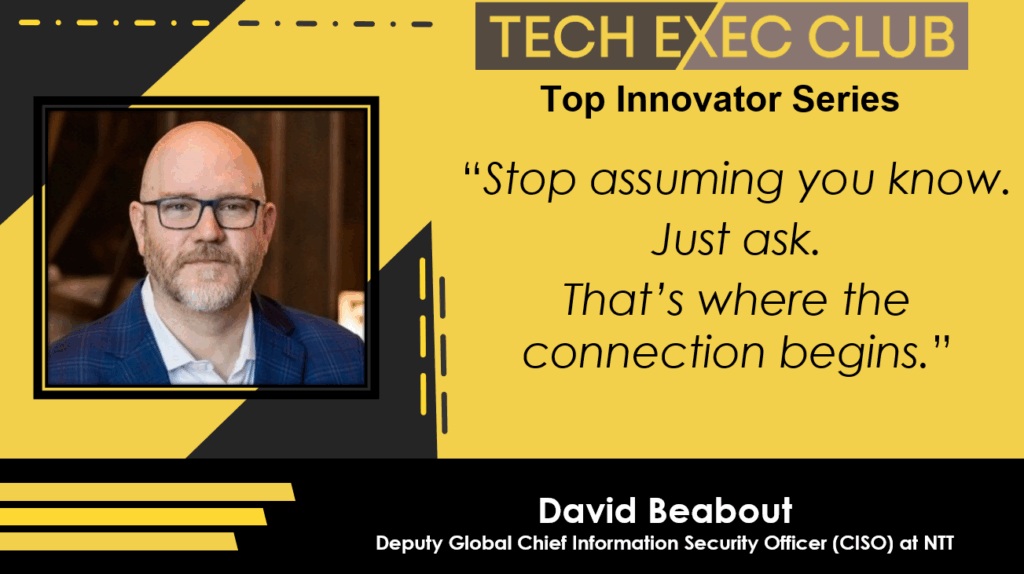
In an era where cybersecurity threats loom large and leadership often leans heavily on technical prowess, David Beabout is rewriting the rules. Currently serving as Deputy Global CISO at NTT, David’s journey didn’t begin with firewalls or frameworks — it started with a deep curiosity about humans, behavior, and the hidden levers that drive high-performing teams.
From serving as a human intelligence and foreign language specialist to redefining leadership through coaching and neuroscience, David has carved out a unique path in tech. But it’s not just his résumé that’s impressive — it’s his mindset.
In this exclusive episode of the Top Innovator Series, host Josef Martens dives deep into David’s transformational leadership journey. What emerges is a compelling story of reinvention, a shift from tactical to transformational thinking, and a powerful call for tech leaders to embrace the “inner game.”
David speaks with the grounded insight of someone who’s been behind the curtain — of both national security operations and corporate boardrooms. He shares how COVID became a turning point, how somatic intelligence influences decision-making, and why he believes the future of leadership lies not just in skills, but in self-awareness.
The Shift from Horizontal to Vertical Leadership Development
For much of his early career, David Beabout pursued what many tech leaders strive for — tools, certifications, and technical mastery. He calls this “horizontal development” — the process of adding skills to your toolbox. It’s what helps leaders solve more problems, faster. But something shifted about five to ten years ago. David began to realize that a large toolbox is useless without the self-awareness to know when and how to use it.
COVID, paradoxically, became a turning point. With the world on pause, he turned inward. Instead of seeking external validation or new tech frameworks, he asked more profound questions: How do I see the world? What am I missing in my perspective? How does my presence impact others? This deeper inquiry, what he calls “vertical development,” changed everything.
Through coaching programs and reflective practice, David began to evolve not just as a professional but as a person. He now approaches leadership as a lens — not a hammer. And it’s through this lens that he’s learned to recognize nuance, foster connection, and create the conditions for others to thrive. “It’s not just what tools you have,” he says. “It’s whether you can see the game clearly enough to use them wisely.”
Curiosity as a Career Compass
David’s career path is anything but linear — insurance analyst, military intelligence specialist, cyber-defense expert, coach, blacksmith, and now Deputy Global CISO. What connects all these seemingly disparate roles? One word: curiosity.
His fascination with people — how they think, what motivates them, and how culture and language shape their identity — led him to study foreign languages and work in human intelligence within the military. It was there that he first encountered the idea that reality is relative. Language became a portal into others’ experiences. “Through that language, I got to see another person’s reality,” he recalls.
Later, a report on a nation-state cyberattack stunned him. Cybersecurity wasn’t just about machines — it was about humans, power, psychology, and strategy. That spark of realization led him into tech, but always with a human-centric lens.
Even today, David insists that curiosity is the thread that weaves through every career pivot, leadership style, and passion project he’s pursued. “When you stay curious,” he says, “you see patterns others miss. You don’t just fill roles — you create new ones.”
Coaching and the Power of Inner Work
David doesn’t just believe in coaching — he’s lived it. His leadership evolution accelerated when he immersed himself in a coach training program that required him to be coached first. It was an awakening. “Seeing through new lenses gave me access to possibilities I hadn’t imagined,” he says.
Coaching changed how he showed up — not just in boardrooms, but in everyday interactions. Instead of rigid agendas and top-down direction, he began creating space for others to flourish. Space for ideas to emerge. Space for people to step into their full potential. Space for unpredictability, innovation, and trust.
One of his core leadership values is now this: co-creation. He no longer assumes he knows what’s best. Instead, he asks. He listens. And he collaborates to build environments that are bigger than the sum of their parts. “That’s when the magic happens,” he says.
David also became deeply engaged in conversations about neurodiversity, particularly within the cybersecurity community. Coaching provided him with the tools to understand people better and leverage their unique strengths, especially those who don’t fit the conventional mold. It’s leadership as service, amplified by empathy.
Embodied Intelligence: Why Somatics Matter in Tech
Perhaps the most unexpected turn in David’s leadership story is his deep belief in somatic intelligence — the ability to feel and interpret the body’s internal signals. In an industry obsessed with cerebral horsepower, David offers a refreshing perspective: “You can scan a server for vulnerabilities. But can you scan your own body?”
Drawing from applied neuroscience, he points out that our gut, heart, and other organs are dense with neurons — meaning the body is a thinking, sensing system in itself. Leadership, then, isn’t just a mental game. It’s a felt experience.
By tuning into his body, David has become more attuned to the invisible dynamics in a room, the unspoken struggles of a team member, or the anxiety buried beneath a polished presentation. It’s made him a better communicator, a more compassionate leader, and a sharper strategist.
He’s quick to remind others: most of the brain-body communication flows upward, not downward. “When you feel a gut instinct, it’s not just woo-woo. That’s wisdom talking,” he says. In a world where tech leaders often detach from emotion in favor of data, David is making the case for reintegrating the body into the boardroom.
Reimagining Cybersecurity as a Profession, Not Just an Industry
To David, cybersecurity still feels like the Wild West — full of brilliant minds, but lacking the mature structure and professional norms that other disciplines possess. “We’re acting like an industry, not a profession,” he says.
In fields such as sales, finance, or marketing, coaching and ongoing development are integral. Not so in cybersecurity, where heroism often takes precedence over sustainability. David believes this needs to change — and fast. The threats are evolving. The technology is advancing. But the human development of the people defending our digital front lines? That’s lagging.
He dreams of a future where coaching is as common in tech as it is in elite athletics. Where self-awareness is seen as critical as a security certification. Where leaders don’t just push product — they build people.
And perhaps most radically, he wants tech execs to understand not just how they lead, but how others experience them. “The overlay of those two things — your self-perception and how others perceive you — that’s where real transformation lies.”
The cybersecurity space is evolving, and so must its leaders. David Beabout’s journey offers more than inspiration — it delivers a blueprint for elevating leadership from reactive to intentional, from tactical to transformational. Whether you’re a seasoned executive, a rising team leader, or a technologist eager to grow, the message is clear: it’s time to lead from the inside out. Here’s how you can take action:
1. Embrace Vertical Development: Reflect on your internal “operating system.” How do you make decisions? What biases or assumptions shape your leadership? Seek experiences that challenge your worldview. Travel, mentorship, cross-functional projects, and coaching can all spark vertical growth. Journal weekly: What did I notice this week that I wouldn’t have seen five years ago?
2. Follow Your Curiosity Relentlessly: Curiosity isn’t a luxury — it’s a leadership advantage. If something fascinates you, lean in. Ask more questions than you answer. Explore paths that aren’t strictly linear or career-related. Curiosity about people, systems, and new perspectives can open unexpected doors and build bridges others won’t see. Let it guide your next big move.
3. Invest in Coaching — For You and Your Team: The best in any field — from athletes to executives — work with coaches. Find a coach who challenges your assumptions and expands your awareness. Introduce a coaching culture within your team by considering the implementation of feedback rituals, active listening, and reflective one-on-one meetings. The ROI is in how your team collaborates, adapts, and thrives.
4. Develop Somatic Awareness: Leadership isn’t just intellectual — it’s embodied. Learn to listen to your body: notice tension, energy shifts, and instinctual reactions. These signals are valuable data. Practice grounding techniques, such as breathing exercises or body scans, to help you stay centered. When you’re connected to your own body, you’re more attuned to the unspoken dynamics in the room — and to your team.
5. Champion Professionalization in Tech: Tech and cybersecurity need to evolve from “start-up hustle” to sustained, intentional leadership. Advocate for professional development — coaching, certification, peer learning — as standard practice. Create a team culture that encourages growth, reflection, and resilience. Help shift tech from reactive firefighting to proactive, people-first leadership.
6. Understand How Others experience you: Leadership isn’t just how you see yourself — it’s also how others experience you. Ask for honest feedback: What’s it like working with me? What energy do I bring into a room? Stay open and curious, not defensive. The magic lies in bridging the gap between intention and impact.
David Beabout’s story is a refreshing reminder that leadership isn’t just about climbing the ranks or mastering technology — it’s about evolving as a human. His path from military intelligence to the C-suite, from tactical execution to coaching and somatic awareness, is a testament to the power of inner work. In an industry often consumed by speed, scale, and surface-level metrics, David brings depth.
His message is clear: the future belongs to leaders who are curious, reflective, and intentional. Those who invest in themselves and the people around them will create teams that are more than efficient — they’ll be exceptional. David isn’t just keeping systems secure; he’s making leadership more human, more connected, and ultimately more transformative.
Want to hear David Beabout’s insights firsthand? Watch the full, live podcast interview [click here]