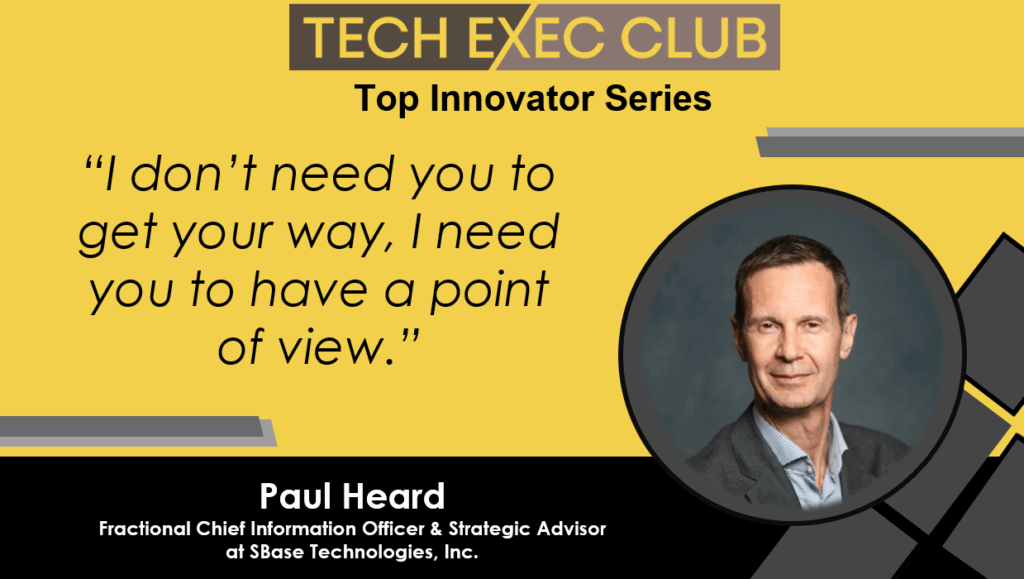
In a tech world often obsessed with knowing the most and coding the fastest, Paul Heard has taken a refreshingly different path to the top. A seasoned CIO and now a trusted advisor to AI startups, Paul’s leadership philosophy centers not on technical mastery, but on curiosity, relationships, and bold risk-taking. In this exclusive conversation on the Top Innovator series, Paul opens up about his transition from developer to executive, the humbling realizations that shaped his leadership style, and the future of AI in management.
Far from simply climbing the corporate ladder, Paul’s journey is a masterclass in unlearning. As he shares with host Josef Martens, the most impactful moves he made weren’t about getting smarter—they were about getting more human. Whether you’re a tech leader, an aspiring manager, or just someone wondering how AI will reshape the C-suite, Paul’s story offers a roadmap worth following.
The Shift from Tech Expert to Leader
For Paul Heard, the move from developer to CIO wasn’t a promotion—it was a profound identity shift. In the early stages of his career, Paul thrived on technical mastery. He loved rolling up his sleeves and solving complex problems, believing that excellence in execution was the surest path to advancement. But as he transitioned into leadership roles, he realized that the skills that got him there were not the ones that would carry him forward.
“You start out being the best on the team,” Paul says, “but leadership means you need to be okay with not knowing all the answers.” The transition was not immediate, nor was it comfortable. As Paul climbed the ranks, he found himself managing people who were far more technically proficient than he was in specific areas. This reality forced him to redefine his value—not as a super-coder, but as someone who could guide, support, and inspire a team to operate at its highest potential.
What emerged was a robust understanding: leadership isn’t about doing, it’s about enabling. Paul learned to focus on the team’s outcome rather than his output. His shift in mindset—from being the smartest in the room to being the one who asks the right questions—became the foundation of his leadership philosophy. “It’s about what we achieve as a team, not what I can personally execute,” he explains.
In a world where many tech leaders cling to their technical edge, Paul’s evolution reminds us that authentic leadership begins when you’re no longer the expert—and that’s precisely the point.
Influence Over Authority: Building Relationships
For Paul Heard, executing flawlessly has never been enough. In the early days of his leadership journey, he often found himself puzzled: his teams delivered results, met deadlines, and solved problems—yet recognition and advancement didn’t come automatically. The realization was sobering: “Execution is only a fraction of the picture,” Paul reflects. “Relationships matter more than people think.”
That lesson would go on to fundamentally reshape Paul’s approach to leadership. Beyond just achieving results, he learned to focus on building trust, cultivating rapport, and engaging in genuine dialogue. Success in corporate environments, Paul explains, often comes down to being in the right room at the right time—and having the right relationships to get you there.
He challenges the notion that strong performance alone should be rewarded. In reality, leaders rise because others trust them. “People make decisions based on relationships, not just metrics,” Paul says. This shift in thinking helped him recognize the soft power of influence—being able to guide outcomes not through authority, but through credibility and connection.
But Paul doesn’t stop at realizing this for himself. He works actively to coach his teams, especially technical experts, to understand this dynamic. While many engineers view influence as “politics,” Paul reframes it in their language: as impact. “You want your architecture adopted? You need to earn trust. You want the business to fund your project? You need to help them understand it in their terms.”
By shifting from a command-and-control style to one based on influence and trust, Paul has cultivated environments where innovation thrives and people feel heard. And in the modern workplace, that’s not just a nice-to-have—it’s essential.
Coaching Technical Teams to Speak Up
When Paul Heard took over his first major tech team, he encountered a common but toxic dynamic: brilliant engineers who believed their only job was to execute orders. “They were waiting to be told what to do,” he recalls. “There was no sense of ownership, no point of view. Just obedience.” For Paul, this wasn’t just ineffective—it was unacceptable.
His solution wasn’t more directives; it was coaching. Paul began with a deceptively simple request: “I want to hear your point of view.” That line became a rallying cry inside the team. At first, it was met with resistance. Many engineers defaulted to saying, “We’re waiting for the business to tell us what’s needed.” But Paul insisted: “It’s not about doing what you’re told—it’s about having a perspective and being part of shaping the direction.”
Paul knew that changing behavior in highly technical environments requires more than motivation—it requires language that resonates. So he didn’t talk about politics or soft skills. He spoke of influence, impact, and decision-making. “I didn’t need them to charm people,” he says. “I needed them to be effective.”
Slowly, the culture shifted. Engineers who once kept their heads down started speaking up. They shared ideas with business partners. They saw those ideas considered, sometimes adopted. The result wasn’t just better technology, but better alignment across the organization.
Most importantly, it removed a significant source of frustration from the team. “When people don’t feel heard, they disengage,” Paul explains. “But when you give them a voice, you give them power.”
In a world where technical talent is abundant but influence is scarce, Paul’s coaching approach is a blueprint for turning engineers into leaders.
Learning to Take (Smart) Risks
For much of his early leadership career, Paul Heard prided himself on one thing: delivering flawlessly. He was the kind of leader who designed projects meticulously, factored in every dependency, and made sure his team hit their targets—every time. That seemed like the gold standard of leadership… until it wasn’t.
Then came a boss who challenged everything Paul thought he knew. “He said, ‘We need to go faster,'” Paul remembers. “And I told him, ‘But we could fail.'” That was the moment Paul realized: he wasn’t being ambitious—he was being cautious. “I was designing for certainty. He was pushing for impact.”
The insight hit hard: success wasn’t about having a perfect track record. If you’re constantly hitting 100% of your goals, you’re probably not aiming high enough. Paul learned that competent leadership means embracing a degree of failure—intentionally. “My manager wanted me to aim higher, even if we didn’t hit it,” he says. “And honestly, we didn’t always succeed. But we got further than we ever would have with a conservative plan.”
This lesson transformed Paul’s view of risk. Instead of avoiding failure, he began treating it as a tool. Take on something bold, move fast, learn as you go. Today, that same mindset shapes how he advises AI startups: “Be ambitious. Be flexible. And be okay with recalibrating on the fly.”
In an industry often paralyzed by risk aversion, Paul’s approach is radically pragmatic. True innovation, he says, isn’t born from safe bets—it comes from bold moves backed by trust, agility, and resilience.
Preparing for an AI-Driven Future
As someone embedded in the front lines of tech innovation, Paul Heard sees what’s coming next with sharp clarity—and it isn’t just more innovative tools or faster automation. It’s a fundamental reshaping of leadership, decision-making, and management. “We’re heading toward a world where AI becomes part of the leadership team,” he says, not as science fiction—but as near-term strategy.
Paul’s advisory work already places him shoulder-to-shoulder with AI startups, and the shift is unmistakable. Many of his clients are developing AI-powered roles that mimic real employees: AI-based BDRs (Business Development Representatives), AI copilots for product development, even AI assistants that engage with customers. “What nobody’s talking about yet,” Paul notes, “is how we manage these AI workers.”
This, in Paul’s view, is leadership’s next great challenge: not just using AI, but guiding it. “Think about how you mentor a human employee—you motivate them, set expectations, and ensure compliance. We’ll need the same for AI,” he explains. “Except the language is different, the guardrails are technical, and the feedback loops are algorithmic.”
And then there’s the boardroom. Paul sees a time—soon—when AI advisors will take a virtual seat at the leadership table. “They’ll help interpret data, offer strategy, maybe even vote on decisions. And we’ll need to figure out how to integrate those voices.”
For Paul, this isn’t a threat—it’s an opportunity. But it requires today’s leaders to start evolving now: to think like systems architects, but act like humanists. Because in the hybrid future of AI and humans, empathy, vision, and judgment will matter more than ever.
If you’re a leader in tech—or aspiring to be—Paul Heard’s journey is more than a story. It’s a roadmap. Here’s how you can put his wisdom into action:
1. Stop Being the Smartest Person in the Room: Shift your mindset from “I need to know everything” to “I need to help others thrive.” Measure your success by your team’s performance, not your contributions.
2. Invest in Relationships, Not Just Results: Focus on building trust with peers and stakeholders—relationships—not just KPIs—open doors to influence, opportunities, and impact.
3. Coach Your Team to Speak Up: Encourage your team to develop and express their point of view. Help them understand that influence isn’t about politics—it’s about creating real impact through ideas and solutions.
4. Aim Higher—Even If You Might Miss: If you’re constantly hitting your goals, you’re not aiming high enough. Take on bold challenges that stretch you and your team, even if the risk of failure increases. Growth lies beyond the comfort zone.
5. Start Preparing for AI Leadership Now: Begin thinking about how AI will not just support, but become part of, your organization. Prepare to manage AI agents with the same clarity, intention, and ethical framework you’d use with human teams.
6. Stay Curious—Always: Make curiosity your competitive edge. Stay in learning mode no matter how senior you are. Seek out diverse perspectives, new ideas, and emerging trends that challenge your current way of thinking.
Paul Heard is not your typical tech executive. He’s a rare blend of technologist, strategist, coach, and visionary—someone who has successfully traded mastery for impact and embraced the discomfort of growth to become the kind of leader today’s world needs. From his early days as a hands-on developer to his current role as a trusted advisor to AI startups, Paul has consistently challenged the status quo—not just in what technology can do, but in how people can lead through it.
He reminds us that leadership isn’t a title; it’s a commitment to elevate others, even when that means stepping back from the spotlight. His emphasis on curiosity, coaching, risk-taking, and future readiness makes him a role model not just for CIOs or tech leaders, but for anyone navigating change in a rapidly evolving world.
As AI continues to redefine the very nature of work, Paul is already there—asking the hard questions, mentoring the next generation, and proving that influence, empathy, and adaptability will always be the most powerful technologies we have.
Want to hear Paul’s insights firsthand? Watch the full, live podcast interview [click here]