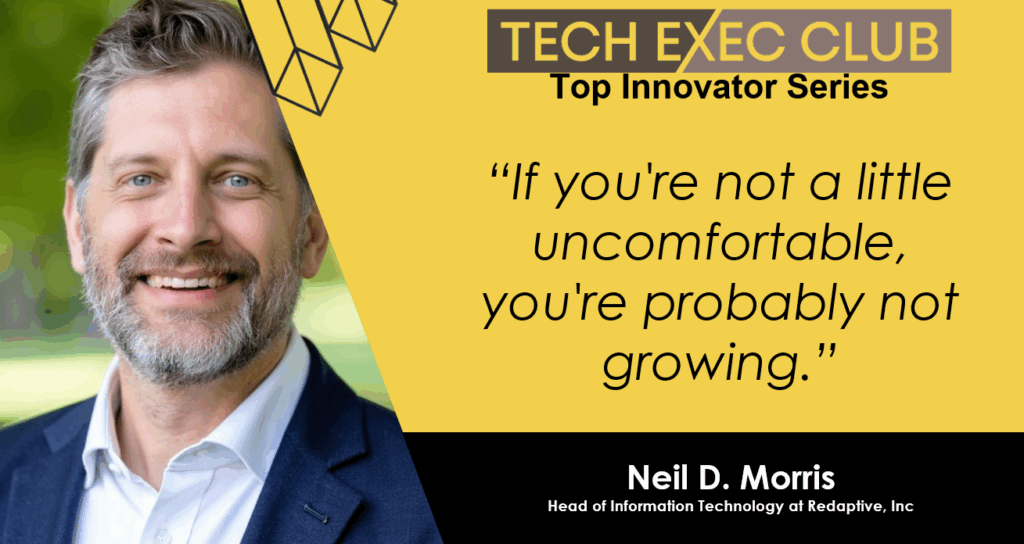
In an industry driven by innovation and disruption, few tech leaders embody transformation as authentically as Neil Morris. From making tacos at a local Taco Bell to Orbie-nominated CIO leading IT strategies at aerospace giants like Ball Aerospace and Maxar Technologies, Neil’s leadership journey defies convention—and rewrites the rules on what it means to lead well with authenticity in tech.
Now Head of IT at Redaptive, an energy-as-a-service trailblazer, and a Forbes Technology Council member, Neil shares the hard-earned wisdom behind his leadership evolution. In this candid conversation, he opens up about his early failures, his breakthrough realizations, and how putting the customer at the center of every decision became his north star.
But this isn’t just another “how I made it” story. It’s a masterclass in authentic leadership—from overcoming imposter syndrome with non-traditional education and the pressure to be liked to building systems that scale, managing complex M&A, embracing discomfort as a catalyst for growth. If you’ve ever wondered how to transition from a great technologist to a transformational leader, Neil Morris offers a roadmap forged through resilience and authenticity you didn’t know you needed.
Early Leadership Failures & the Taco Bell Origin Story
Before he became a high-level IT executive, Neil Morris learned some of his most valuable leadership lessons under the fluorescent lights of a Taco Bell kitchen. At just 20 years old, Neil found himself managing an entire restaurant—with 50 employees, many of them close to his own age. What sounded like a promising early leadership opportunity soon revealed itself to be a trial by fire.
Back then, Neil thought leadership meant being liked. He invested his energy in forming friendships and maintaining harmony with his staff. But that inward focus—on peer approval and internal dynamics—quickly unraveled. The team lacked structure. Decisions weren’t aligned with the store’s mission. And the responsibility weighed heavily on someone still finding his professional footing while pursuing his non-traditional education path through the University of Phoenix.
“It was a fairly painful experiment in leadership,” Neil reflects. The experience ultimately pushed him away from management for years, redirecting him into individual contributor roles in the tech world. But, as he would later realize, the seeds of leadership were planted right there—just waiting for a stronger foundation.
That early failure became a defining chapter, not a dead end. It taught Neil what leadership is not, and gave him the humility and hunger to figure out what it truly takes to lead people and drive measurable business outcomes – lessons that would prove invaluable when leading enterprise transformations worth millions.
Customer Obsession Meets Authentic Leadership Philosophy
The turning point in Neil’s leadership journey came when he stopped trying to be liked—and started focusing obsessively on the customer. Whether it was the end user of a platform, a business stakeholder, or a frontline worker, Neil realized that every decision needed to serve someone beyond the org chart.
“When you start with the focus on, ‘Is this the right thing for our customer?’ it keeps you laser focused,” he explains. This shift in mindset enabled him to navigate tough choices without the emotional burden of internal politics or ego. Suddenly, difficult conversations weren’t personal—they were reframed as value conversations. “That’s not being excellent,” he would say, “because it’s not excellent for our customers.”
This philosophy didn’t just improve decision-making; it reshaped how Neil communicated, inspired, and led through personal challenges. It became a tool, a compass, and a filter—one that helped cut through ambiguity and align teams around a shared mission. As someone who balanced family responsibilities including special needs advocacy while climbing to Tech Leadership, Neil understand that authentic leadership means brining your whole self to work – vulnerabilities and add.
Today, Neil sees customer-centricity not as a corporate buzzword but as the core of effective leadership. It enables transparency, justifies bold moves, and gives meaning to daily work. Most importantly, it anchors leaders to purpose—something that no spreadsheet or sprint planning meeting can provide on its own
The Power of Mentorship & Modeling Inclusive Leadership
Neil didn’t become a strategic leader in isolation. Throughout his journey, he sought out and learned from leaders who led by example while also becoming a mentor himself – particularly for those navigating non-transitional paths to executive roles. Two key figures—Jeff Robertson and Tammy Highland—played especially pivotal roles.
Jeff, a former COO at Maxar, impressed upon Neil the value of stepping into discomfort. “Always stay a little bit uncomfortable,” Jeff would say, encouraging Neil to stretch into roles that felt just beyond his grasp. That tension, Jeff believed, was the soil in which actual growth occurred—for individuals and organizations alike.
Tammy, a long-time CIO and colleague, modeled the quieter but equally powerful art of coaching leadership. She taught Neil the value of asking the right question at the right time—and then allowing Silence to do the heavy lifting. Instead of dictating answers, she created space for reflection and alignment.
These mentors didn’t just teach strategy. They showed Neil how to listen more effectively, reframe conflicts, and lead with both strength, humility, and vulnerability. Their lessons helped him transition from being a problem-solver to a people developer. And in today’s fast-paced tech landscape, that difference is everything – crucial when building inclusive, resilient organizations that drive innovation.
Balancing Vision with Operational Discipline: The AI Era Challenge
After decades of building and leading technology transformations, Neil now finds himself at a new edge of growth—operations. At Redaptive, where the organization is scaling quickly, Neil is deepening his fluency in the structured, detail-driven world of operational excellence and the forefront of AI strategy implementation.
It’s a domain he once outsourced to others. In larger enterprises, he had the luxury of hiring operations-focused experts while he drove strategy and transformation. But today, in a leaner, fast-moving environment, he must be both the visionary and the builder. Neil is deepening his expertise in marrying cutting-edge AI capabilities with operational excellence. This requires balancing innovation with the structured, detail-driven world of cybersecurity governance and compliance frameworks.
This evolution forces him to confront his natural discomfort with rigidity and the challenge many technology leaders face: how to drive innovation while ensuring robust governance. Frameworks like ITIL and COBIT, as well as process-heavy disciplines like change and incident management, aren’t exactly sexy—but they are essential for long-term scalability, especially in the era of AI adoption. Neil describes it as “putting more structure into my unstructured brain,” and though it’s not instinctual, he’s committed to mastering it. It requires both visionary thinking and operational rigor. In his previous roles at Maxar and Ball Aerospace, he led digital transformation initiatives while maintaining stringent security measures in highly regulated industries. But today’s AI landscape demands even greater agility and strategic foresight.
The beauty of this evolution? It’s making him a more complete leader. By embracing the grind of operations, Neil is building empathy for the very teams that keep systems running, and learning how to scale innovation sustainably—not just start it.
The Hard Pivot: From Technologist to Leader
One of the clearest takeaways from Neil’s career, validated by his Orbie nominations and Forbes Technology Council selection, is this: being a great technologist does not automatically make you a great leader. Many in the tech industry, however, often confuse the two.
Leadership, Neil argues, is not an extension of technical expertise—it’s a fundamentally different skillset that requires emotional intelligence, strategic thinking, and the ability to drive business transformation. “Don’t underestimate the time and effort it takes to lead well,” he says. Too many tech professionals transition into management roles without first learning how to truly lead—and the consequences are evident in disengaged teams, poor communication, and stalled careers.
His advice to up-and-coming tech leaders? Find a mentor who isn’t just a better coder—but someone who exemplifies leadership, and executive presence. Study business strategy and management like you studied systems architecture. Embrace the pivot. “Leadership isn’t about knowing the tech anymore—it’s about bringing people along and focusing on value.”
It’s a hard truth, but Neil doesn’t sugarcoat it. Having to overcome imposter syndrome from his non-traditional education path, he challenges his peers to treat leadership as a craft, not a promotion – requiring continuous learning. In doing so, he’s helping shape the next generation of tech leaders who not only understand technology but also know how to move it forward.
Actional Insights for Aspiring Technology Leaders
Neil Morris’s story is more than personal success—it’s a practical guide for anyone ready to grow from skilled contributor into a trusted, authentic transformational leader. His approach to leadership isn’t about charisma or perfection. It’s about clarity, focus, and the courage to evolve, refined through leading major acquisitions and transformations, and offering a roadmap for authentic technology leadership. If you’re ready to shift your mindset and lead with impact, here’s how to begin:
1. Reframe Leadership Around the Customer: Stop focusing on internal validation. Every decision, every project, every conversation—ask yourself: “How does this serve the customer?” This shift keeps your leadership purposeful, sharp, and relevant.
2. Be Comfortable Being Uncomfortable: Step into roles that stretch you beyond your comfort zone. Let that slight anxiety be a sign you’re growing, not failing.
3. Find Mentors Who Model What You Need to Learn: Look beyond your field. Learn from leaders in HR, finance, and operations who demonstrate emotional intelligence, strategic clarity, and humility.
4. Balance Vision with Operational Rigor: Big ideas are great—but structure scales. Embrace frameworks like ITIL and a KPI discipline to ensure your strategy remains effective and efficient.
5. Don’t Confuse Technical Excellence with Leadership: Leading people is not an extension of coding—study leadership like a new language. Read, reflect, and treat it like the skill it is.
6. Use Silence as a Leadership Tool: Ask powerful questions and stop talking. Let Silence do the heavy lifting in meetings and 1:1s—it invites thought, not just reaction.
7. Lead With Humility, Not Ego: Own your gaps. Stay curious. Neil’s rise was rooted not in bravado, but in learning, listening, and leading with purpose.
The Authentic Executive: Redefining Technology Leadership
Neil Morris is not your typical tech executive. He’s a builder of systems, a challenger of comfort zones, and a quiet revolutionary in how leadership is learned and lived. From the backlines of a Taco Bell kitchen to the frontlines of enterprise IT innovation, Neil’s story is proof that authentic leadership isn’t about titles—it’s about transformation.
What sets Neil apart isn’t just his resume—it’s his relentless commitment to growth, humility, and service. He leads by asking better questions, modeling courage, and anchoring every decision in the value of the customer. Whether he’s navigating the complexities of AI adoption or learning to appreciate the rigor of operational frameworks, Neil is a leader who constantly evolves—and brings others with him.
In a world flooded with noise, Neil’s voice reminds us: to lead well is to serve well. And in tech—or anywhere—that’s the kind of leadership we need more of.
Want to hear Neil’s insights firsthand? Watch the full, live podcast interview [click here]