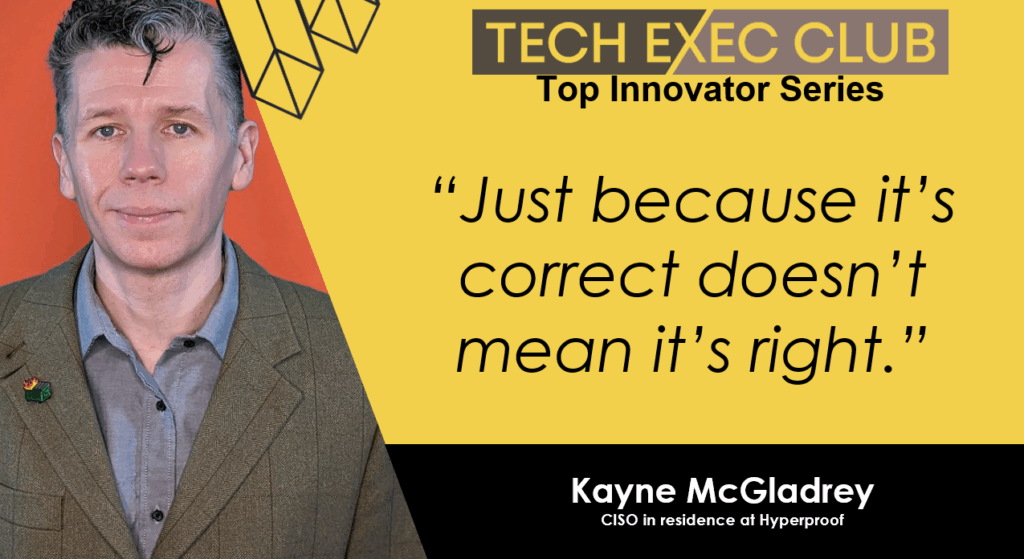
When you imagine the career trajectory of a global cybersecurity leader, “theater kid” probably isn’t the first origin story that comes to mind. But for Kayne McGladrey, CISO-in-Residence at Hyperproof and the world’s top-ranked cybersecurity thought leader according to Thinkers360, his unconventional background is exactly what shaped his distinct and powerful approach to leadership.
In a profoundly insightful and refreshingly candid conversation with Josef Martens on the Top Innovator podcast, McGladrey takes us behind the curtain of executive life in cybersecurity. He reveals a leadership philosophy rooted in humility, empathy, and intellectual rigor. He doesn’t just talk about success — he demystifies it.
From the challenges of being misunderstood early in his career to leading multi-national investigations and now writing a book to give back to the community, McGladrey doesn’t mince words. His perspective on AI, risk, and the fundamental responsibilities of leadership is as grounded as it is provocative.
This isn’t just an interview — it’s a masterclass in modern leadership from someone who’s been in the trenches and still chooses curiosity over certainty, service over ego, and perspective over platitudes.
The Power of Intellectual Curiosity and Skepticism
For Kayne McGladrey, curiosity isn’t just a virtue — it’s a survival skill. In a world dominated by media noise, exaggerated vendor claims, and the seductive confidence of AI systems, McGladrey says the most effective leaders must cultivate both “intellectual curiosity” and “a healthy level of skepticism.” It’s a striking contrast to the typical tech-exec bravado.
“Just because something is factually correct doesn’t mean it’s right,” he says — an idea that’s particularly potent in cybersecurity, where decisions are rarely black-and-white. Leaders today, he warns, are being bombarded with agendas: marketing pitches dressed as solutions, sensationalized news cycles, and macroeconomic narratives that may or may not apply to their realities. The antidote? Ask hard questions. Stay curious. Don’t take things at face value.
But this isn’t the kind of skepticism that borders on cynicism. McGladrey is quick to emphasize that it’s about discernment, not dismissal. It’s about knowing that AI might be confidently wrong, or that geopolitical “bad actors” may not even see themselves that way. His perspective is informed by global travel and a commitment to understanding other worldviews — elements that sharpen his leadership lens and underscore a core truth: the best leaders don’t assume; they investigate.
Lessons from Mentors and the Importance of Empathy
Some of Kayne McGladrey’s most powerful leadership tools didn’t come from books or boot camps — they came from blunt feedback. One mentor’s words still echo in his mind: “People think you’re talking down to them.” That realization wasn’t a jab — it was a gift. It pushed him to consider not just what he said, but how it was received.
This moment catalyzed a profound transformation. With help from media training and guidance from industry veterans, McGladrey began developing what he calls “empathetic communication” — the ability to adjust your tone, message, and approach to meet people where they are. Especially in cybersecurity, where highly technical experts are often tasked with explaining complex issues to non-technical stakeholders, this skill is everything.
It’s why McGladrey encourages young professionals to rotate across departments: spend time on the help desk, join the marketing team, and shadow engineers. These experiences, he says, create a leadership lens that’s not only more informed — but more human.
Empathy, for McGladrey, is more than a buzzword. It’s the difference between being heard and being effective.
Letting Go of Ego and Accepting Other Priorities
There’s a kind of maturity in leadership that only comes with experience — and it’s defined, McGladrey says, by knowing when to let go. After presenting a carefully built cybersecurity proposal to the board of a Fortune 10 company, he learned a hard truth: even the best ideas might be shelved.
“This is my team’s best work,” he recalls thinking. “But it might not be important to solve right now.”
Rather than take it personally, McGladrey leaned into the lesson. Leadership isn’t about winning every battle. It’s about showing up with integrity, offering your perspective, and accepting that others have their own priorities, timelines, and pressures.
He likens it to parenting: you can’t make others’ mistakes for them. Sometimes people have to learn the hard way. And when your job is to lead — not to control — you need to have the humility to offer guidance and the wisdom to step back.
This ego-detached approach not only fosters trust but also enables long-term influence. As McGladrey sees it, the job of a leader isn’t to always be right — it’s always to be ready.
Reality vs. Expectation in Cybersecurity Leadership
The gap between perception and reality in cybersecurity leadership is vast — and McGladrey isn’t shy about calling it out.
Many aspiring CISOs chase certifications like the CISSP, assuming it’s a golden ticket to success. But according to McGladrey, those credentials barely scratch the surface. The real job? Reviewing contracts, fielding soul-crushing vendor questionnaires, navigating legal complexity, and translating cyber risk into boardroom language.
He points to the stark contrast between commercial risk — where the threat is primarily financial — and sectors like defense or construction, where real human lives are at stake. “I’ve had to do risk assessments where the top concern wasn’t data — it was death,” he says.
It’s an unsettling but vital perspective shift. Leaders must move beyond thinking about cyber as “hackers in hoodies” and start understanding the operational, physical, and human impacts of risk.
If you want to lead in this field, McGladrey says, forget the fantasy. Embrace the grind. And above all, stay grounded in the reality that cybersecurity is more about people than it is about code.
Shaping the Future by Giving Back
For McGladrey, the next evolution of leadership isn’t about climbing higher — it’s about lifting others. After decades in cybersecurity, his focus has turned outward: mentorship, community building, and perhaps most ambitiously, a book.
But don’t mistake it for a vanity project. Writing a business book, he says, has been more challenging than conducting cross-border cyber investigations. He’s not just aiming to “publish” — he’s aiming to contribute meaningfully, to offer a resource that empowers professionals across the industry.
And in a world swept up in AI hype, McGladrey urges caution. He sees the potential — but also the risks. Will executive conversations with AI be subject to legal discovery? What happens when AI systems offer bad advice, confidently? “We haven’t figured this out yet,” he warns.
That’s why his approach remains steadfast: be curious, be skeptical, and stay human. Because, as powerful as AI may become, leadership will always come down to trust, clarity, and connection.
Kayne McGladrey’s leadership journey is a masterclass in curiosity, humility, and clarity. If you’re serious about evolving as a leader — especially in a tech-driven, AI-infused world — his experience offers a roadmap. Below are actionable steps, directly inspired by his insights, that you can apply today to lead with more intelligence, empathy, and impact.
1. Cultivate Intellectual Curiosity — Then Question Everything: Don’t just consume industry news — analyze the motives behind it. Ask yourself, “Who benefits from me believing this?” whenever you encounter bold claims, especially around technology and AI. Develop the habit of reading outside your field to understand global perspectives and nuanced risks better.
2. Embrace Feedback — Even When It Stings: Seek out honest feedback on how your tone and communication style are received. You may think you’re being direct — others may hear condescension. Kayne learned this lesson early, and it transformed his leadership. Incorporate that feedback, and evolve accordingly.
3. Rotate Across Functions to Build Real Empathy: Step out of your silo — shadow teams in support, marketing, or engineering. Leaders who understand different roles lead more effectively. If you manage others, create pathways for your team to gain exposure across departments. Empathy is built through experience, not assumption.
4. Detach from the Outcome — But Never the Effort: Even your best work may be shelved by leadership — and that’s okay. Pride of authorship is fine; ego is not. Present your ideas with clarity and conviction, but be ready to let them go without resentment. Long-term trust is more valuable than short-term wins.
5. Share What You Know — Even If It’s Not Polished: Start writing. Blog. Mentor. Speak. Kayne is channeling decades of insight into a book — not to sell, but to serve. You don’t need to wait for perfection; you need to start. Knowledge shared is legacy built.
6. Use AI Thoughtfully — But Know the Legal Risks: Before feeding your strategic thinking into an AI tool, ask: “Would I want this shown in court?” The legal frameworks haven’t caught up to our tools, and executive misuse of AI could be a compliance time bomb. Be cautious, not careless.
Kayne McGladrey isn’t your typical cybersecurity executive. He’s not here to dazzle with jargon or posture from a pedestal. Instead, he leads with rare clarity — fueled by curiosity, anchored by empathy, and shaped by real-world experience across sectors and cultures.
From theater stages to boardrooms, from global risk assessments to AI-driven futures, Kayne’s journey proves that outstanding leadership isn’t about having all the answers — it’s about asking better questions, listening longer, and sharing what you’ve learned along the way.
As he continues writing his upcoming book, mentoring the next generation of cybersecurity talent, and challenging the tech industry to think more critically and lead more humanely, Kayne McGladrey reminds us of a truth too often forgotten in business: the best leaders aren’t the loudest — they’re the ones who help others speak and grow.
Want to hear Kayne’s insights firsthand? Watch the full, live podcast interview [click here]