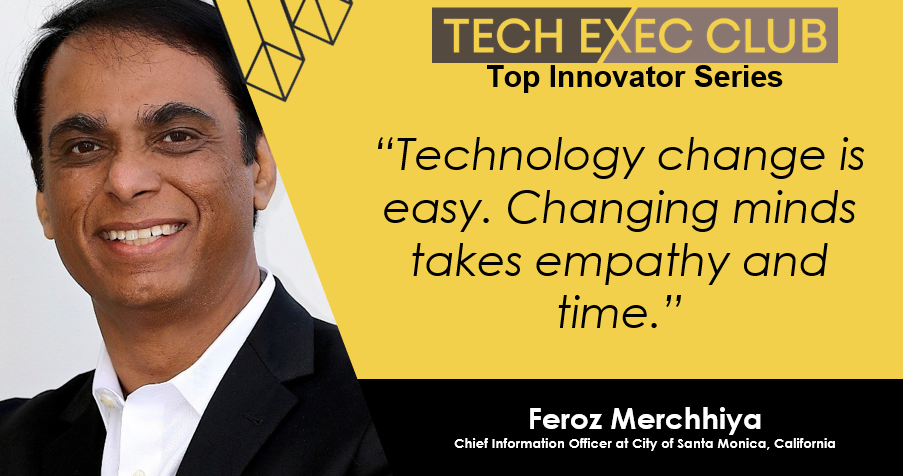
When you think of visionary tech leaders, your mind might jump to Silicon Valley startups or Fortune 500 giants. But Feroz Merchhiya proves that true innovation isn’t confined to the private sector—it thrives in city halls, too. As the Chief Information Officer (CIO) of Santa Monica, California, Feroz brings decades of technology leadership experience into an arena where every decision impacts the daily lives of thousands.
His journey is not a story of titles or climbing ladders; it’s a narrative of curiosity, adaptability, and an unwavering belief in trust. From learning basic programming in a summer class to leading transformative digital strategies for entire cities, Feroz has embraced one guiding principle: technology will constantly evolve, and so should we.
In this candid conversation, Feroz opens up about the mentors who shaped him, the unexpected lessons in leadership, the discomfort of growth, and why moving from private industry to the public sector became his most rewarding challenge yet. From navigating a global tech outage just four days into his role to spearheading innovative solutions for local governments, Feroz’s story is as much about resilience as it is about reinvention.
The Power of Mentorship and Continuous Learning
When asked about the roots of his leadership success, Feroz Merchhiya credits one principle above all: never stop learning. This belief was planted early, during a summer programming class when his instructor told him, “The beauty of technology is that tomorrow it will change, and you’ll always be in a state of learning.” That statement became Feroz’s north star, shaping a leadership philosophy grounded in curiosity and adaptability.
Rather than chasing titles or rigid career plans, Feroz approached every stage as a student first. His progression from individual contributor to CIO wasn’t an orchestrated climb—it was the result of absorbing lessons from teachers, mentors, and colleagues along the way. For Feroz, learning isn’t confined to formal education; it’s embedded in every challenge and interaction.
This mindset translates directly into his leadership style today. When solving business challenges, he advocates for balancing future vision with present constraints. “Plan for one, two, three years ahead,” he says, “but respect ground realities—budgets aren’t unlimited, teams aren’t perfect.” That pragmatic yet forward-looking approach reflects a leader who understands both ambition and accountability.
In an industry defined by rapid change, Feroz’s insistence on continuous learning isn’t just advice—it’s survival. By modeling intellectual humility and curiosity, he empowers his teams to embrace growth rather than fear it. His message is clear: in technology and leadership, adaptability is the ultimate competitive advantage.
Trust as the Cornerstone of Leadership
For Feroz, trust isn’t a buzzword—it’s the foundation of every successful team, project, and organization. “You have to trust your ability to endure discomfort and trust others around you,” he explains. But trust isn’t demanded; it’s cultivated through openness, honesty, and deliberate investment.
When Feroz stepped into his first public sector CIO role for the City of Glendale, Arizona, he knew he was an outsider. Many candidates had decades of municipal experience, while Feroz brought a fresh perspective from the private sector. So why did the city manager choose him? “He wanted a fresh set of eyes,” Feroz recalls. That decision required courage and trust—not just from the city manager but also from the team Feroz would lead.
To build that trust, Feroz didn’t start with technology. Instead, he began with conversations—five key questions for his peers about their business priorities, successes, and pain points. He opened the door for honest feedback, good or bad, and made it clear that technology would serve their goals, not dictate them. That approach paid off, creating an environment of mutual respect that enabled fundamental transformation.
Trust isn’t static; it deepens in moments of crisis. Four days after joining Santa Monica, Feroz faced a global CrowdStrike outage that paralyzed systems worldwide. With limited knowledge of the local environment, he rolled up his sleeves, stayed on calls all weekend, and worked side by side with his team to restore services. That weekend forged bonds no onboarding plan could match.
In leadership, trust is the currency of influence. Feroz invests in it relentlessly—and it shows.
The Cultural Side of Technology Change
Ask any tech leader about their biggest surprise, and you’ll hear stories that have little to do with code and everything to do with people. Feroz is no exception. Reflecting on a major merger-and-acquisition project, he admits, “I thought offering cost savings and better systems would be enough. It wasn’t.”
Coming from the acquiring organization, Feroz assumed rational arguments—reduced budgets, streamlined integrations—would win support from the acquired entity. But logic collided with reality. “What I failed to recognize,” he says, “was the emotional attachment people had to their systems. These weren’t just tools; they were the manifestation of their hard work.”
This misstep became a pivotal leadership lesson: change isn’t just technical; it’s deeply cultural. Systems symbolize ownership, identity, and pride. Ignoring that dimension guarantees resistance, no matter how compelling the ROI. It wasn’t until Feroz shifted his approach—acknowledging the human element and engaging stakeholders in co-creating the future—that progress began.
Today, he applies this insight across all transformation efforts. Before introducing a solution, he seeks to understand the story behind existing systems and the people who built them. For Feroz, success isn’t about imposing change but inspiring ownership of the new. “Technology change is easy,” he says. “Changing minds takes empathy and time.”
In an era where digital transformation dominates boardroom agendas, Feroz’s experience is a reminder: innovation is as much about hearts as it is about hardware.
Innovation Beyond Technology: Driving Impact in Public Service
Why would a successful private sector leader pivot to local government? For Feroz, the answer is simple: impact. “If you want to make a difference in people’s lives truly, the city level is where it happens,” he explains. Unlike corporate projects where results can feel abstract, municipal technology delivers tangible benefits—safer streets, cleaner water, faster emergency response.
Feroz compares it to performing live theater: “In the private sector, feedback comes weeks or months later, like waiting for TV ratings. In a city, the audience is live. City council meetings happen weekly, and if citizens don’t like your service, you hear it immediately.” That accountability fuels his drive to innovate, not for accolades but for the satisfaction of solving real problems for real people.
His first week in Santa Monica proved that reality. Just four days into the job, a global CrowdStrike outage disrupted critical systems. With minimal knowledge of the city’s infrastructure, Feroz worked through the weekend alongside his team to restore services. That trial by fire didn’t just resolve a crisis; it forged trust and reinforced his belief in public service as a calling.
For Feroz, technology is not an end—it’s a means to enhance livability. From water utilities to emergency management, digital tools now underpin every city function. And for a leader who thrives on meaningful impact, there’s no greater reward than delivering solutions that citizens can see, feel, and trust.
Leading Through Uncertainty and Future Challenges
Feroz’s outlook on leadership is rooted in curiosity and courage. When asked what excites him about the future, he doesn’t hesitate: solving problems we can’t yet see. “AI is a perfect example,” he says. “It’s not just about deploying tools; it’s about shaping how organizations think.”
One of his proudest achievements illustrates this philosophy. In 2017, a state policy change in Arizona created massive headaches for small cities that relied on sales tax revenue. Manual processes consumed hours of staff time, and no commercial solution existed. Feroz’s team built an internal system to solve the problem. But he didn’t stop there—he challenged his city employees to think like entrepreneurs: What if we turn this into a SaaS product for other municipalities?
For a team of long-tenured government staff, the idea was radical. Yet under Feroz’s guidance, they embraced the challenge, launched the product at a statewide finance conference, and secured 15 leads in one day. Today, 40% of Arizona cities use the solution.
The lesson? Leadership isn’t about writing code; it’s about writing new possibilities into the organizational DNA. It’s about fostering a culture where innovation means more than buzzwords—it means solving real problems creatively, with limited resources, and inspiring people to believe in what they can achieve.
Looking ahead, Feroz expects his most significant growth to come from tackling the unknown. Because in a world defined by change, the leaders who thrive aren’t those who predict the future—they’re the ones who build it.
Inspired by Feroz Merchhiya’s leadership journey? Here are actionable steps you can take to lead with impact, adapt to change, and build trust in your career:
1. Embrace Continuous Learning: Stay curious and adaptable. Technology—and leadership—evolves daily. Commit to being a lifelong learner. Seek out mentors and advisors. Just like Feroz did, surround yourself with people who challenge and guide you. Plan for the future, but respect the present. Always design strategies that anticipate change while accounting for current constraints.
2. Build Trust Deliberately: Start with openness by asking your team and peers meaningful questions about their priorities, successes, and challenges. Invest in relationships because trust isn’t demanded—it’s earned through authenticity and consistency. Show up in moments of crisis; credibility as a leader is forged when you stand shoulder-to-shoulder with your team in tough times.
3. Lead Change with Empathy: Recognize that technology is personal for many—it’s often tied to pride and ownership. Respect those emotions when driving change. Engage stakeholders early, making them co-owners of the solution. Remember that logic and cost savings alone won’t win hearts; acknowledge the cultural side of transformation.
4. Redefine Innovation: Innovation is not about chasing the latest buzzword or shiny tool. It’s about solving real problems with creativity and available resources. Empower your team to think differently, experiment, and even transform internal solutions into scalable products. Celebrate small wins to build momentum and inspire confidence in your team’s ability to innovate.
5. Prepare for Uncertainty: Disruptions are inevitable, whether caused by technology failures, market shifts, or global events. Build resilience into your culture by expecting the unexpected. Stay proactive—anticipate challenges like AI integration or cybersecurity risks before they escalate. Lead with vision and confidence so your team sees opportunity where others see obstacles.
Feroz Merchhiya’s journey is a testament to what leadership looks like when fueled by curiosity, trust, and a genuine desire to make a difference. From his early days learning programming to leading complex technology initiatives in major cities, he has consistently demonstrated that innovation isn’t just about tools—it’s about people, purpose, and adaptability.
As CIO of Santa Monica, Feroz continues to redefine what technology leadership means in the public sector, proving that meaningful impact happens where technology meets community. His ability to build trust, inspire teams, and tackle challenges head-on makes him not just a leader but a changemaker.
Feroz’s story reminds us that the future belongs to those who never stop learning, who lead with empathy, and who dare to innovate—even when the path ahead is uncertain. For anyone aspiring to lead in technology—or in any field—his journey offers a blueprint for success grounded in resilience, vision, and authenticity.
Want to hear Feroz’s insights firsthand? Watch the full, live podcast interview [click here]