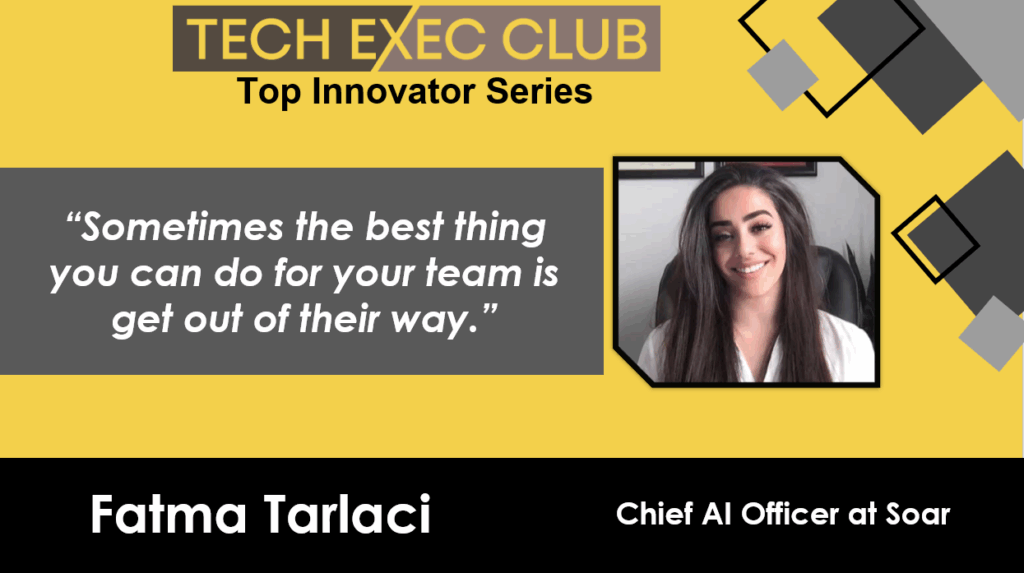
In the ever-evolving world of artificial intelligence, where yesterday’s breakthrough becomes today’s baseline, speed is often mistaken for strategy. But Fatma Tarlaci, Chief AI Officer at Soar and adjunct assistant professor at the University of Texas at Austin, sees things differently. For her, authentic Leadership in tech isn’t about being the fastest or loudest in the room—it’s about seeing the big picture, building trust, and solving problems that matter.
In this compelling conversation, Fatma invites us into the mindset of a modern tech leader—one who has risen through the ranks not by micromanaging or mastering every technical detail, but by knowing when to let go. With a career that spans engineering, academia, and executive Leadership, she has learned the hard way that second-order thinking—considering not just immediate outcomes but long-term impact—is what separates good decisions from great ones. And in a time when AI tools are flooding the market and companies scramble to adopt the next big thing, her voice is a calm, clarifying force.
But Fatma’s story is more than a strategy guide. It’s a profoundly human narrative about growth, humility, and the power of teaching others. She speaks openly about the insecurities she once had—the belief that she had to be the most intelligent person in the room, the temptation to “do it herself” when things moved too slowly. She shares how patience, once her most significant challenge, has become her leadership edge. And she reveals the moment she realized that sales—yes, sales—is a critical skill for any tech executive who wants to influence and lead truly.
Whether you’re a founder racing against time, an engineering manager seeking alignment, or a developer dreaming of a bigger impact, Fatma’s insights offer a rare blend of heart and hard-earned wisdom. She reminds us that AI isn’t just about algorithms—it’s about people. And that the most powerful transformation doesn’t come from technology alone, but from the frictionless adoption of tools that meet users exactly where they are.
This is more than a conversation—it’s a masterclass in thoughtful Leadership.
Second-Order Thinking in Tech Leadership
In today’s tech landscape, where the pressure to act fast is relentless, second-order thinking is Fatma Tarlaci’s secret superpower. It’s not just about predicting the next step, she says—it’s about seeing several steps ahead. “Especially in AI, speed is everything,” she acknowledges, “but what happens if I ship this today versus tomorrow? What do I set in motion long-term?”
Fatma’s approach challenges the prevailing culture of short-termism. Many tech leaders, she warns, become so caught up in performance metrics and product deadlines that they fail to pause and consider the irreversible consequences. This kind of foresight is particularly crucial in AI, where a feature released hastily can carry ethical, reputational, or even legal implications down the line. It’s not about moving slowly; it’s about moving wisely.
Her strategic thinking also includes an essential human layer—understanding when rapid adoption may not follow rapid development. Fatma points out that the hottest new technology can fall flat if users aren’t ready to integrate it into their daily lives. “If you’re only following technical advances and performance benchmarks, but not considering where adoption happens, you’re missing the point.”
Second-order thinking is her buffer against becoming obsolete or irrelevant. It requires striking a balance between innovation and reflection, as well as urgency and sustainability. And it’s a mental model she believes more leaders should develop—not just to survive in tech, but to shape its future.
Trust as a Cornerstone of Team Performance
Trust isn’t a buzzword for Fatma—it’s a working strategy. In her teams, trust is built by doing the one thing many tech leaders struggle with: letting go. “I make sure I’m not micromanaging unless someone specifically asks for help,” she says. Instead, she gives her team full ownership of problems, clearly communicating the business context and leaving the implementation to them.
This autonomy unlocks something powerful. Whether it’s a junior developer or a senior engineer, Fatma believes every team member thrives when they’re allowed to make decisions and learn from them. “That unleashes a lot of potential,” she explains. And trust, she notes, isn’t just about delegation—it’s also about showing vulnerability. Fatma openly admits when she doesn’t know something. “Early in my career, I thought I had to be the best engineer in the room. Now I say, ‘I don’t know yet, but here’s how I’ll figure it out.'”
The result? A culture of psychological safety. When a leader admits gaps in knowledge, it creates space for others to do the same, without fear of judgment. “If your CTO can say ‘I don’t know,’ then it’s safe for everyone else to learn, too,” she says.
Trust, in Fatma’s world, isn’t accidental. It’s intentional. And in high-performing tech teams, it’s the foundation on which everything else is built.
Letting Go of the Need to Know Everything
Fatma’s growth from engineer to executive was shaped less by gaining technical expertise and more by letting go of the need to control every detail. “At first, I felt I had to know everything,” she recalls. “I even created development guidelines from the ground up, covering the smallest points.” With time, she realized that this approach limited both her own progress and her teams’ potential.
The turning point came when she stopped seeing Leadership as technical omniscience and started viewing it as strategic empowerment. By stepping back, she created space for others to lead. “You’d be surprised how much creativity can come from a junior engineer if you just give them the room,” she says.
This shift didn’t happen overnight. Fatma had to intentionally pull back from the urge to solve everything herself, especially when the stakes were high. “Sometimes you catch yourself thinking, ‘I’ll just do it,’ but that robs someone else of the chance to learn,” she explains. Letting go meant trusting not just her team, but the process itself.
Now, instead of needing all the answers, she focuses on asking better questions—and trusting her team to find the answers. It’s a subtle but powerful pivot, and one that reflects true leadership maturity. In her words, “Leadership isn’t about knowing everything. It’s about knowing where you’re needed—and where you’re just in the way.”
The Surprising Importance of Sales for Tech Executives
If there’s one revelation that caught Fatma off guard in her journey to executive Leadership, it’s this: technical leaders need to master sales. Not just sales in the traditional sense—like pitching a product to a customer—but internal sales, too. “I didn’t expect that as a technical person, I’d need to get good at selling ideas,” she laughs.
In reality, this skill has become essential. Whether it’s convincing stakeholders of a new technical direction or aligning cross-functional teams behind a roadmap, being able to communicate the ‘why’ behind the ‘what’ is crucial. “It doesn’t matter how great your technical idea is if others don’t buy into it,” she explains.
Fatma has learned to translate complex engineering logic into language that resonates with business stakeholders, executives, or even clients. It’s not manipulation—it’s clarity. “Sales is really about getting buy-in and creating alignment,” she says. And that buy-in is what turns isolated innovation into scalable, cross-functional success.
What began as an unexpected skill has become a competitive advantage. Fatma now sees sales as part of her leadership toolkit—something every rising tech executive should embrace. “You need to be able to sell your priorities, your vision, even your disagreements,” she notes. Because without it, great ideas remain stuck in technical silos, never reaching the people who need to believe in them.
Technology Alone Doesn’t Drive Transformation—Adoption Does
Fatma’s final insight may be her most disruptive: technology doesn’t change the world—adoption does. “We talk about AI transformation like it’s automatic,” she says. “But tech alone doesn’t create transformation. It’s about how seamlessly users can adopt it.”
She warns against a common pitfall: shipping new features simply because they’re innovative. Leaders often get caught in the hype cycle, chasing the latest AI trend without considering the user experience. But for Fatma, real value comes from embedding new tools so naturally into users’ workflows that they require zero extra effort. “If they need to click ten more buttons or change their habits, you’ve already lost,” she explains.
That’s why she’s laser-focused on frictionless integration. A successful product, in her view, isn’t just cutting-edge—it’s invisible, working so seamlessly that users barely notice the transition, only the benefits. This is where her earlier themes come full circle: second-order thinking, trust, and sales all lead here. Because when adoption is effortless, transformation is inevitable.
And this, she believes, is the gap too many tech leaders are missing. “There’s pressure to integrate every shiny new thing. But unless we think about how it fits into people’s lives, we’ll keep building tools no one uses.”
Fatma’s call is clear: innovation isn’t about speed or novelty—it’s about impact. And impact only happens when adoption leads the way.
Based on Fatma Tarlaci’s powerful insights, here’s a clear and actionable roadmap for current and aspiring tech leaders who want to lead more effectively in high-growth, AI-driven environments.
1. Practice Second-Order Thinking: Pause before acting: Don’t just focus on what happens tomorrow—think about what your decision will trigger a month, a year, or five years down the line. Challenge short-termism: In product development and leadership decisions, evaluate the ripple effects. What does this change set in motion? Prioritize reversibility: If a decision is irreversible and high-risk, take a moment to slow down. Don’t let urgency become recklessness.
2. Build Real Trust Through Autonomy: Empower your team: Assign problems, not tasks. Let your engineers design the solutions—don’t prescribe them. Give context, not control: Explain the why behind the what, and let the team handle the how. Model vulnerability: Admit when you don’t know something. This builds psychological safety and sets a tone for learning and collaboration.
3. Let Go of the “Know-It-All” Trap: Stop micromanaging: Step back and allow others to bring their strengths and ideas forward, even if they approach things differently. Unlearn perfectionism: Don’t let the need for control hinder innovation. Let your team surprise you. Celebrate creative independence: Recognize when junior team members take initiative—it fosters ownership and growth.
4. Learn to Sell—Internally and Externally: Translate tech into value: Explain technical initiatives in ways business stakeholders can relate to—user impact, efficiency, revenue. Get buy-in across functions: Frame ideas to resonate with different audiences (marketing, sales, Leadership). Advocate effectively: Whether pitching a roadmap or defending priorities, use influence and storytelling to win support.
5. Focus on Frictionless Adoption, Not Just Innovation: Design for behavior, not features: Build products that integrate seamlessly into user workflows. Obsess over usability: Innovation should feel effortless for the user. Slow down for success: Sometimes, delaying release to improve user experience is the smarter path to long-term adoption.
Fatma Tarlaci isn’t your typical tech executive. She’s a systems thinker in a speed-obsessed industry, a teacher who leads by listening, and a technologist who believes that adoption—not innovation—is the accurate marker of progress. As Chief AI Officer at Soar and a faculty member at the University of Texas at Austin, she lives at the intersection of future-forward technology and people-first Leadership.
What makes her truly remarkable, though, is her ability to combine strategic depth with human connection. Fatma doesn’t just talk about empowering others—she practices it in how she runs teams, how she learns, and how she leads. Whether she’s navigating ambiguity in AI, shaping high-performing engineering cultures, or translating complex ideas into shared vision, she brings a level of clarity and integrity that’s rare.
For anyone looking to grow as a leader in tech—or in any fast-moving field—Fatma’s journey is more than inspiring. It’s instructive. She reminds us that the future isn’t just built by those who move fast—it’s shaped by those who think deeply, trust fully, and lead with both humility and courage.
Want to hear Fatma Tarlaci’s insights firsthand? Watch the full, live podcast interview [click here]