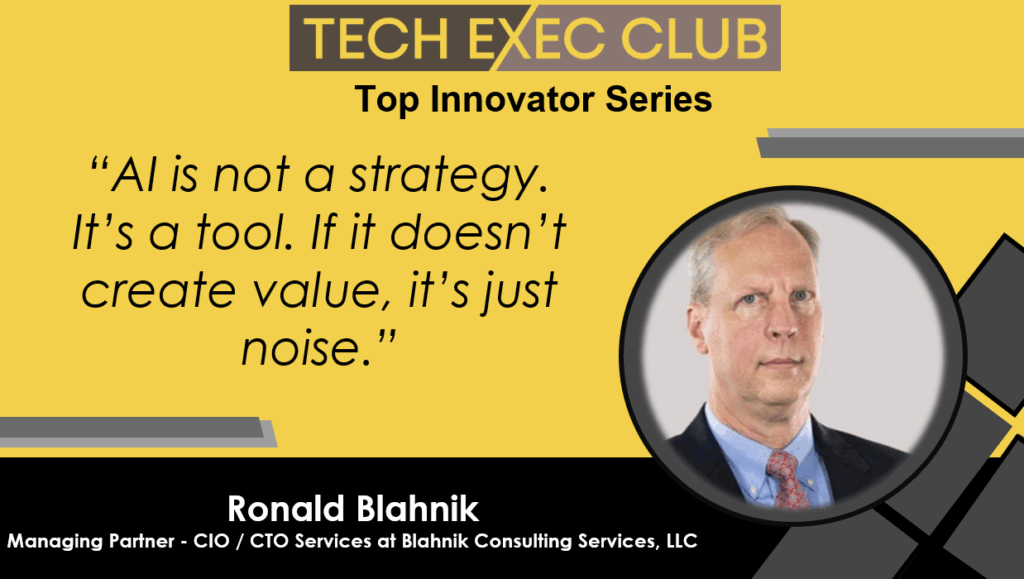
When Ron Blahnik stepped onto the basketball court as a towering high school athlete in Michigan, he had one thing in mind: the NBA. That was before he faced a young Magic Johnson and watched him score 99 points in a single game—a moment that didn’t just humble Ron but also altered the trajectory of his life. It was in that humiliating defeat that Ron made one of the most important decisions of his career: to pivot. And that decision, born from a moment of clarity, became the first of many in a leadership journey spanning over four decades.
Today, Ron Blahnik is far from the basketball court—but he’s every bit the strategist, tactician, and team builder. A former CIO/CTO and Senior Vice President of Strategy with executive experience at companies such as Lowe’s Home Improvement, Hudson Bay, The Home Depot, JD Sports, and Hibbett Retail, Ron now leads his IT consulting practice. Yet what makes his story compelling isn’t just the job titles; it’s the intentionality behind every move. From joining the Army to fund his education in data processing, to deciding at age 17 that he would become a CIO, Ron didn’t just let life happen to him. He engineered it.
In this episode of the Top Innovators Series, Josef delves deep into Ron’s leadership ethos—his thoughts on career-defining decisions, how to nurture rising stars, and why chasing shiny tech trends like AI can often be more of a distraction than a disruption. Ron doesn’t just offer advice; he provides a roadmap—complete with detours, missteps, and the kind of clarity that only comes from experience.
This is more than a story about corporate ascension—it’s about legacy, mentorship, and the kind of leadership that prioritizes purpose over prestige. Whether you’re a young professional wondering what to do next or a seasoned executive reconsidering what it means to lead, Ron’s journey will leave you inspired—and maybe just a bit uncomfortable in the best possible way.
The Power of Early, Intentional Decisions
Ron Blahnik’s leadership story doesn’t begin in a boardroom—it starts on a basketball court in Michigan, facing off against none other than Magic Johnson. The final score? A brutal 136 to 46. Magic scored 99 points. But rather than being crushed, Ron found clarity. That moment wasn’t a defeat—it was a turning point. “Am I going to the NBA,” he asked himself, “or have I just witnessed someone who is?” It was his first major decision: to pivot away from a dream that wasn’t his to claim, and toward one he could build for himself.
From there, his life unfolded with the same intentionality. Born into a large family of nine children, Ron understood that financial resources were limited. At 18, he joined the military—not just for duty, but as a strategic decision to secure an education in data processing, programming, and analysis. It was a calculated investment in his future, one that many would only consider in retrospect.
But perhaps the most remarkable part? At just 17 years old, Ron decided that his ultimate goal was to become a Chief Information Officer (CIO). “I was going to be a CIO,” he said, not with bravado but with clarity. That decision wasn’t a fantasy—it was a compass. For years, he calibrated short-term moves toward that long-term north star.
Many professionals stumble into their careers. Not Ron. He engineered his. From selecting his educational route to choosing his life partner—someone who deeply and unconditionally supported him and his career. He noted that without her, there would be have been far less success in goal achievement—Ron framed life as a series of deliberate decisions rather than a string of reactions. Even Warren Buffett, he noted, considers the choice of a life partner to be the most important decision one can make.
Ron’s clarity offers a powerful lesson: Success isn’t built solely on ambition. It’s built on intentional decisions made early and executed with focus over decades. For young professionals uncertain about their paths, Ron’s story is a call to clarity, a reminder that decisive beginnings often lead to extraordinary outcomes.
Leadership Is Built on Learning—from the Good and the Bad
In the mythology of leadership, we often hear about mentors who inspire and guide. But what about the leaders who fail us? Ron Blahnik’s career includes both, and his growth came just as much from the bad as from the good.
“I worked for 23 leaders in one consulting organization,” Ron recounts. “I’d only work for two of them again.” That statement isn’t bitter—it’s reflective. For Ron, those 21 leaders who fell short became influential teachers. “Sometimes it’s not just what you learn to do well, but what you learn not to do,” he says.
In an era that glorifies the guru-mentor archetype, Ron flips the script: every experience is a classroom. Even in poor leadership environments, he studied behaviors, communication styles, and team dynamics. He learned which traits stifled innovation, broke trust, or created dysfunction—and he vowed never to emulate them.
But it wasn’t just about avoiding bad habits. Ron absorbed enduring lessons from the two leaders he admired. They inspired loyalty so deep that, decades later, Ron says he would follow them “anywhere.” What set them apart? Consistency, trust, curiosity, and a quiet strength. Ron remembers his father lowering his voice when angry, not raising it. The best leaders, he says, don’t need to shout to be heard.
One piece of advice stuck with him above all: Be curious. Read voraciously. Understand the business beyond your silo. It’s why Ron made it a point not just to understand IT, but merchandising, supply chains, store/omni operations and the customer experience, finance, and HR. Leadership isn’t just about command. It’s about context.
Ron’s story underscores that leadership maturity comes from observing, analyzing, and synthesizing what we see in others, both the aspirational and the cautionary. His journey reminds us that no experience is wasted if we choose to learn from it.
Developing Others Is the Heart of Leadership
For Ron Blahnik, leadership isn’t defined by titles; it’s determined by the impact one has on others. And the most significant impact, he believes, comes not from climbing ladders but from building them for others.
From his earliest days managing teams, Ron made it clear: his job wasn’t to be the most intelligent person in the room, it was to grow the most intelligent people in the room. “Leadership is about working your way out of a job,” he says. That philosophy reframes leadership from one of authority to one of empowerment.
One of Ron’s core tools is job rotation. Too often, he explains, people don’t know what they’re truly passionate about because they haven’t had enough exposure. By rotating rising talent through different departments, such as IT departments including, infrastructure, operations, applications, analytics, enterprise program management, etc. -plus business departments of the Buy, Move and Sell of retail (merchandising, supply chain, and store/omni operations) when possible, he helps them discover where their strengths and interests naturally align. “You can’t choose for them,” he says. “But you can help them find the right question to ask themselves.”
This developmental mindset is especially critical in preparing for succession. In his current consulting work, Ron partners with companies that need to groom internal talent for executive roles, as well as small to mid-sized businesses that can’t always afford to hire externally. His work involves identifying rising stars and preparing them to assume mission-critical roles well in advance of vacancies.
He also believes in pushing people just beyond their comfort zones. “Being comfortably uncomfortable” is how he describes it. (A tactic learned from one of the good leaders he worked for) When you stretch talent just enough to challenge them—but not break them—that’s where the real growth happens. It also when mentorship and coaching are the most critical.
Ultimately, Ron believes that organizations only grow when people grow. Leadership, in his view, is not about how many people report to you—it’s about how many people emerge because of you.
Tech Leaders Must Be Business Leaders First
Despite a 40-year career in IT, Ron Blahnik doesn’t speak in acronyms. That’s not by accident. It’s by design.
“I don’t talk tech,” he says. “I run IT like a business.” That one statement reflects a radical shift in how Ron approaches his role—and how he believes all technology leaders should approach their roles. He framed helping business partners and the board to better understand you is more like how you might explain something to your neighbor. They are not IT experts and do not need to be if you take a more friendly communication approach. A tip he picked up from someone who worked from him.
Too often, CIOs and tech executives become siloed. They focus on uptime, infrastructure, cybersecurity, or transformation projects. Ron does all that—but with a business-first lens. He runs his IT functions with a P&L mindset, making decisions not just based on tech capabilities but on business outcomes. His job, as he sees it, is to generate revenue, reduce costs, and make life easier for departments such as sales, HR, marketing, and logistics.
This perspective is why Ron prioritizes cross-functional understanding. He doesn’t just want his team to execute on requests; he wants them to understand the why behind the request. “Learn everything you can about where information flows from and flows to, it is often bi-directional and getting the data right will lead to less complicated integrations and increase the potential to leverage advance analytics and AI,” he advises.
It’s also why he believes tech leaders must be strong communicators. Forget the three-letter acronyms and buzzwords. Focus on clarity, relevance, and impact. Whether talking to board members or store associates, Ron adapts his language to the audience, not the other way around.
Ron’s approach signals a profound truth: IT is not a support function—it’s a strategic partner. And the more tech leaders embed themselves into the business, the more value they’ll drive. In today’s digital economy, it’s not enough to deploy tools. Tech leaders must speak the language of value.
Tools Are Only Valuable If They Create Value
Ron Blahnik is not anti-technology, but he is anti-distraction. In a time when AI dominates headlines and executives chase the next digital trend, Ron offers a sobering reminder: “Chasing shiny pennies is a waste of time.”
He’s not dismissing AI—far from it. He’s evaluated and implemented AI solutions in various organizations. But his litmus test is simple: does it deliver measurable value? If it doesn’t help grow revenue, reduce costs, or improve customer or employee experience, then it doesn’t cut it. “AI is not a goal,” he says. “It’s a tool—just like anything else.” He reminds us that a bad process made faster only leads to poor outcomes at speed. Look hard at the process before throwing tech at the problem.
Ron’s perspective was tested and proven during the COVID-19 pandemic. While many companies contracted, his organization doubled in revenue. The reason? They embraced agility and speed to decision. By instituting daily leadership standups, his executive team made fast, informed decisions with all stakeholders present. No PowerPoints. No delayed approvals. Just execution.
Those daily meetings—just 15 to 30 minutes—became a cornerstone of their resilience. And they continue today.
Ron’s military background also shaped his approach. He adapted practices like “After Action Reviews” (AARs) to civilian environments, extracting learning from every project. Whether called AAR or “What, So What, Now What,” the idea is the same: extract insights, determine implications, and act with clarity.
In a world obsessed with Technology for its own sake, Ron reminds us: the real innovation is using tools to create outcomes, not headlines.
1. Make Intentional Career Decisions—Now: Don’t wait for clarity to arrive on its own. Define your long-term goal now—even if it feels audacious. Map out short-term steps that align with that north star. Revisit and refine them often. Remember: Clarity today avoids drift tomorrow.
2. Rotate, Stretch, and Develop Your People: Create internal opportunities for job shadowing, rotations, or lateral moves—especially for rising stars. Help your team discover their strengths by allowing them to explore various disciplines. Encourage “comfortable discomfort.” Growth happens just beyond the comfort zone.
3. Lead Like a Learner: Read voraciously. Expand your understanding beyond your role or industry. Be curious about your organization’s whole value chain—from supply chain to marketing to HR. Treat every leader—good or bad—as a lesson in leadership. Observe, reflect, and integrate.
4. Run Tech (and Teams) Like a Business: Drop the jargon. Focus on impact. Operate with a profit-and-loss (P&L) mindset, even if you’re not in a revenue-generating function. Build bridges between functions. Think beyond your silo.
5. Use Technology as a Lever, Not a Trophy: Apply emerging tools (like AI) based on ROI and relevance, not buzz or pressure. Prioritize projects that save money, generate revenue, or enhance the human experience. Conduct regular after-action reviews to ensure continuous learning from every initiative.
6. Implement Speed-Oriented Decision-Making Structures: Adopt short daily standups or leadership huddles to align teams and reduce decision lag. Encourage transparency in blockers, resource needs, and cross-departmental dependencies. Speed is life. Lead like time matters—because it does.
7. Prepare for Your Replacement: Build succession plans today. You won’t always be at the helm. Train future leaders now, not when a vacancy arises. Your legacy isn’t what you build or what you make. It’s who you build and the sustainable methodology, best practices, and approach you leave behind.
Ron Blahnik’s leadership journey isn’t a story of flashy headlines or overnight success. It’s a testament to the quiet power of intentionality—the kind that begins with clarity at 17 and carries through decades of discipline, learning, and relentless focus on others. He didn’t stumble into the CIO chair. He built toward it—deliberately, methodically, with a vision shaped as much by humble beginnings as by elite boardrooms.
In Ron, we find a rare breed of leader—one who views career not as a title to be attained, but as a craft to be nurtured. One who believes that authentic leadership lies not in authority but in the elevation of others. One who treats Technology not as a shiny solution but as a strategic lever for real, measurable value.
And perhaps most powerfully, we see a leader who never stops evolving. Whether mentoring tomorrow’s executives, advising boards, or shaping strategies for C-suites, Ron brings a lifetime of lessons wrapped in humility and delivered with quiet precision.
In an age that rewards noise, Ron Blahnik’s leadership reminds us that clarity speaks louder than charisma. That growing people is the surest path to growing organizations. And that being “comfortably uncomfortable” is precisely where the best leaders choose to live. So if you’re still searching for your direction, unsure of your path, or simply wondering what makes a great leader today, look no further than Ron’s story. It’s not just a roadmap. It’s a reminder: your best leadership begins the moment you decide who you want to become.
Want to hear Ron Blahnik’s insights firsthand? Watch the full, live podcast interview [click here]