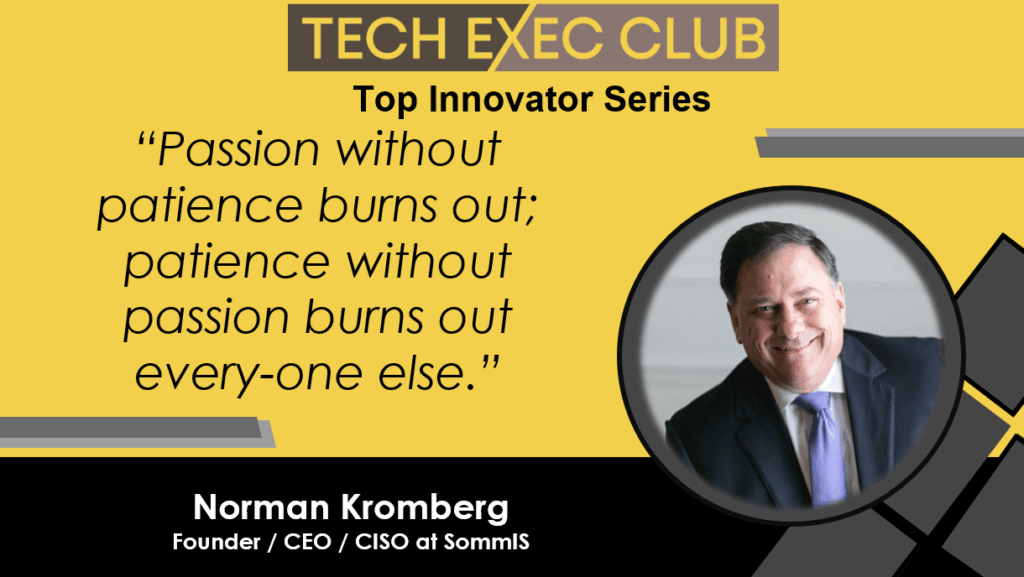
In a rapidly evolving cybersecurity landscape, where technological innovation meets constant disruption, one leader has quietly shaped the future from behind the scenes. Norman Kromberg—executive, advisor, and visionary—brings over three decades of leadership experience to the table, marked not just by his technical expertise but by a rare combination of passion, patience, and an unwavering commitment to growth.
As the CISO and CEO of SommIS and an advisor to both TrustCloud and Wolfpack Security, Norman is not merely leading organizations—he’s mentoring future leaders and reshaping how the industry views transformation. In this compelling conversation with Josef Martens for the Top Innovator Series, Norman pulls back the curtain on the inner workings of his leadership evolution, sharing candid moments of insight, surprise, and revelation.
From the surreal possibility of lobbying Congress to “repeat 1999” during Y2K to the lessons learned from mentors who challenged his mindset, Norman takes us through a journey filled with bold thinking, authentic reflection, and timeless leadership wisdom. His story is a blueprint for those navigating both the chaos of cybersecurity and the complexities of human leadership.
Passion and Patience: The Dual Engines of Lasting Leadership
For Norman Kromberg, a veteran executive in the cybersecurity industry, leadership has always been more about temperament than titles. Reflecting on over three decades in the field, Norman shared that his success didn’t come solely from academic credentials or technical proficiency—those were just the starting points. What truly set him apart were two deeply human qualities: Passion and patience.
“Passion is that internal fire,” Norman explained, “but patience is what lets it burn without consuming everything around it.”
He emphasized that in leadership, passion without patience can lead to burnout or impulsive decisions. Conversely, patience without passion can lead to complacency. Norman’s approach is a harmonized blend, allowing him to evolve with the industry while staying true to his core values. In a world where many leaders are obsessed with quick wins and immediate recognition, Norman believes that patience allows for deep listening, longer-term thinking, and stronger, more enduring relationships. Passion, on the other hand, fuels the resilience necessary to stay the course when things get tough.
He recounted moments in his career when projects failed, mergers changed everything overnight, or organizational loyalties dissolved. Yet, his internal compass—a patient pursuit of purposeful work—kept him steady. He sees passion and patience not as static traits but as muscles that leaders must exercise deliberately.
Norman’s insight? Anyone can earn a certification or a degree. But becoming a leader who inspires change? That requires mastering the art of emotional sustainability through passion and patience.
The Power of Reflective Growth and Reinvention
Throughout the conversation, Norman revealed a critical aspect of enduring leadership: the ability to evolve and adapt. When Josef asked how he maintained his passion over time, especially as companies changed and roles shifted, Norman was candid: “PassionPassion can and should evolve. The key is knowing when to redirect it.”
Gone are the days, Norman explained, when people stayed with one company for 30 years. Today’s corporate environment is fluid and often unpredictable, and the concept of mutual loyalty between employees and employers has significantly eroded. For Norman, this meant developing the capacity for continuous reinvention. As his interests evolved, so too did his career focus. “I deploy my passion where it aligns with the business model and where it benefits the industry most,” he said.
Rather than resist change, Norman leaned into it. He took on multiple roles—advisor, executive, mentor—finding meaning and motivation in new contexts. It’s a mindset that views change not as a loss but as an opportunity.
What keeps him going? Purpose. Norman now channels his energy into smaller firms, startups, and organizations where he can make an immediate impact. This shift has enabled him to maintain his passion while contributing to innovation and transformation in a sector that desperately needs it.
His story is a lesson for all professionals: staying relevant isn’t just about keeping up with technology—it’s about knowing yourself well enough to pivot, adapt, and thrive when the landscape changes.
Building and Rebuilding Teams Through Understanding
One of Norman’s most actionable leadership philosophies centers on team dynamics and individual understanding. Early in his leadership journey, Norman recognized that success wasn’t just about directing teams—it was about decoding them.
“You have to know who people are,” he said. To that end, Norman routinely used personality assessments to understand how team members process information, make decisions, and interact with others. He categorized himself as conceptual and analytical but made sure to surround himself with individuals who brought other strengths—whether that be detail orientation, emotional intelligence, or social cohesion.
This diversity wasn’t just welcomed; it was essential. It allowed Norman to build balanced teams where members complemented, rather than mirrored, one another. In his view, the goal of a leader isn’t to mold everyone into one type of worker but to create a space where different minds can collaborate toward shared goals.
But Norman’s wisdom went further. He spoke openly about recognizing when someone’s passion had waned or when their role no longer aligned with their growth. In such cases, he wouldn’t hesitate to guide them toward new opportunities—even if it meant helping them leave the organization.
This empathetic approach fostered trust, loyalty, and high performance. Leaders who understand their people at a deeper level can not only build better teams but they can also rebuild them with integrity when needed.
Thinking Beyond the Playbook: The Y2K and ‘Repeat 1999’ Story
Perhaps the most memorable moment in the interview came when Norman described a sur-real yet serious conversation during the Y2K crisis. Faced with the looming uncertainty of the millennium bug, Norman and a group of senior executives explored the unthinkable: lobbying Congress to legally “repeat 1999” and delay the new millennium.
“We spent a solid hour discussing it,” Norman laughed, “and not one person dismissed the idea outright.”
While the plan was ultimately impractical, the story revealed a core element of Norman’s leadership style: fearless ideation. He champions the idea that no concept should be off-limits during the brainstorming phase. Even the most absurd ideas can unlock new perspectives, strategies, or pathways that traditional thinking would overlook.
It also underscored a crucial leadership lesson: effective collaboration among alpha personalities is possible when mutual respect and open dialogue are prioritized. In that high-stakes meeting, despite the presence of multiple senior leaders with competing visions, the team listened, debated, and ultimately came to a more informed decision.
Norman’s takeaway? Encourage contrarian thinking. Allow space for creativity, even if it seems outlandish. Because in doing so, you elevate the quality of your decision-making and empower your team to think courageously.
Mentorship and Multiplying Impact
Later in his career, Norman shifted focus from leading operations to developing leaders. This phase of his journey is deeply intentional: “I may never be CEO of a major company, but I can help someone else become one.”
Norman’s current roles are a mosaic of influence comprising advisory work, nonprofit board participation, and one-on-one mentorship. He views his decades of experience as a resource not to be hoarded but to be shared. From helping early-stage companies design security frameworks to guiding young professionals through complex career decisions, Norman’s impact now lies in enabling others.
He credited his mentors for shaping his career and philosophy. Early on, Norman’s fast-paced and high-intensity approach didn’t always resonate well with others. Mentors helped him understand the value of pacing, perspective, and collaboration. That wisdom transformed his leadership style, and today, he pays it forward by encouraging others to embrace diverse thinking and patient growth.
He also emphasized that mentorship is not a one-size-fits-all formula. “Sometimes mentors find you. Sometimes, you seek them out. Either way, the relationship needs to be real.”
Norman’s commitment to mentorship is about more than legacy. It’s about creating a ripple effect—where every leader he supports goes on to empower others, ultimately building a stronger, more resilient leadership community.
Inspired by Norman Kromberg’s transformative insights? Here are actionable steps you can take today to evolve as a leader, no matter your industry or stage in your career:
1. Reflect on Your Leadership DNA: Ask yourself: What fuels your leadership—Passion, patience, or both? Identify moments in your career where these traits helped or hindered you. Journal or discuss with a peer to clarify your core leadership attributes.
2. Reignite and Redirect Your Passion: Evaluate whether your current role aligns with your evolving passions. Seek projects or roles that challenge and inspire you, not just maintain you. Consider advisory or mentoring roles if you’re entering a new chapter in your life.
3. Assess and Understand Your Team’s Thinking Styles: Introduce personality or work style assessments to uncover your team’s strengths. Align responsibilities with individual styles to increase engagement and performance. Promote diversity of thought by balancing analytical, conceptual, and emotional thinking.
4. Foster Bold, Contrarian Thinking: Host “What if?” sessions where no idea is too wild or unrealistic. Encourage open debate in a respectful, ego-free environment. Use unlikely scenarios (like Norman’s “repeat 1999” story) as thought experiments to spark innovation.
5. Find and Be a Mentor: Identify mentors who challenge your thinking, not just validate it. Offer your own experience to rising professionals who could benefit from your perspective. Set up regular check-ins with mentees or peers to keep the mentoring dialogue alive and evolving.
6. Think Beyond Titles and Roles: Leadership is less about job descriptions and more about influence and impact. Focus on how you can elevate others—even if that means stepping out of the spotlight. Reframe success in terms of the legacy and culture you build, not just milestones.
As we close this journey through the career and philosophy of Norman Kromberg, what emerges is more than a portrait of a successful executive—it’s a blueprint for sustainable, human-centered leadership in an age of constant change. Norman’s insights remind us that leadership isn’t about dominating headlines or holding the most prestigious title; it’s about inspiring others to achieve their goals. Instead, it’s about consistency in character, clarity in vision, and courage in transformation.
From igniting passion to exercising patience, from mentoring the next generation to uniting diverse teams, Norman’s leadership is rooted in awareness—of self, of others, and the ever-shifting business terrain. He doesn’t just respond to change; he anticipates it, embraces it, and uses it to cultivate growth—not just for himself but for the people and organizations around him.
His story offers more than inspiration; it provides a practical model for others to follow. Whether it’s daring to propose “repeating 1999” in the face of uncertainty or stepping aside to empower a mentee’s rise, Norman’s approach shows that leadership is a living discipline—one that adapts, matures, and multiplies over time.
In an era where authenticity is often sacrificed for optics, Norman Kromberg’s journey is refreshingly grounded. It’s a story of impact without ego, influence without arrogance, and wisdom without pretense. His career is proof that when you lead with purpose and evolve with intention, you don’t just stay relevant—you stay invaluable.
As readers and fellow professionals, the call is clear: Reflect. Recalibrate. Reignite. Just like Norman, we all have the potential to become the next “new norm” of leadership.
Want to hear Norman Kromberg’s insights firsthand? Watch the full, live podcast interview [click here]