In a world obsessed with doing more, faster, and louder, David Emerson takes a radically different approach: do less—but do it with intention. As the Chief Technology Officer at SolCyber Managed Security Services, David embodies a minimalist leadership style rooted in deep strategy, empowered teams, and the hard-won wisdom of building tech organizations from the ground up.
From early roles in resource-rich environments to navigating the intricate pressures of constrained, high-stakes companies, David has developed a sharp sense of how to scale teams, cultivate ownership, and balance healthy tension. He doesn’t lead with brute force or endless directives. Instead, he curates environments where people thrive, take accountability, and grow into roles that stretch far beyond job descriptions.
In this episode of the Top Innovator podcast, David joins host Josef Martens for an unfiltered conversation on what makes a team great, why too many orders can sabotage leadership, and how the future of leadership will hinge less on administration and more on strategic clarity. This is a story not just about technology or security but about the quiet power of giving people the freedom—and the responsibility—to lead themselves.
Building Teams That Scale: The Power of Self-Actualization
For David Emerson, team building isn’t about finding the most intelligent people in the room—it’s about fostering a culture where individuals are empowered to grow beyond their roles. In his leadership philosophy, the best teams aren’t merely collections of qualified professionals but ecosystems of self-actualizing contributors who take genuine ownership of their work.
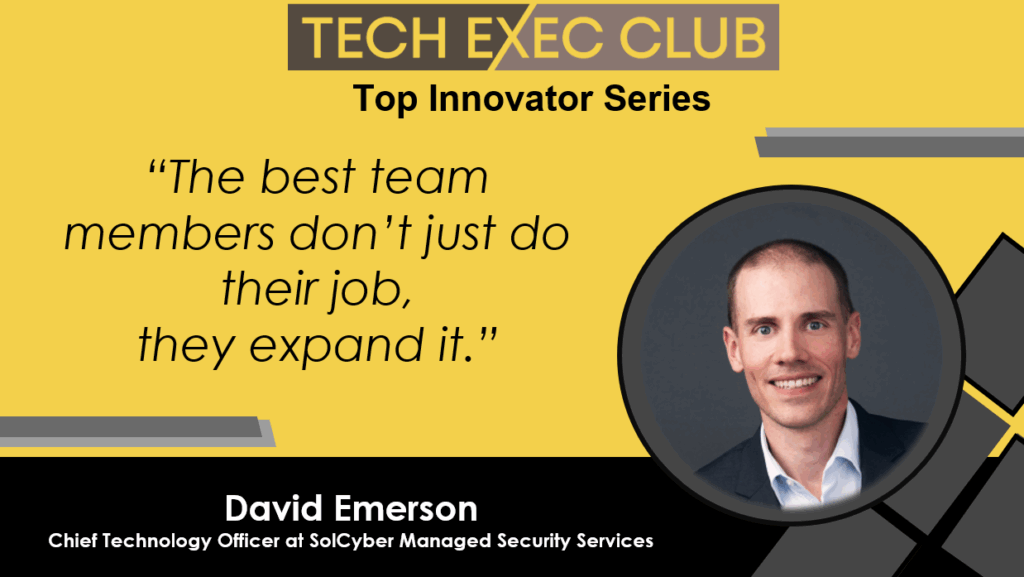
“In my experience, one of the strongest leading indicators of a successful team member is self-actualization,” David shares. “You want people who don’t just do the job they’re assigned. You want people who are expanding the boundaries of that job, who are organically influencing adjacent roles, who feel empowered to shape outcomes.”
This isn’t just leadership-speak—it’s a practical necessity in fast-moving, complex organizations. David believes that the key to sustainable growth lies in fostering autonomy, not micromanagement. But he’s quick to acknowledge that this approach places a significant burden on leadership. “You can’t just tell people to be owners. You need to create an environment where they feel safe, encouraged, and incentivized to take initiative. And that includes setting clear boundaries so that ownership doesn’t turn into chaos.”
In David’s world, the ideal team member takes accountability well beyond what’s written in a job description—but also has the emotional intelligence to know when collaboration and restraint matter more than being right. That blend of initiative and respect forms the bedrock of teams that scale not just in numbers but in impact.
Healthy Tension and Rational Conflict: A Leadership Balancing Act
At the heart of David Emerson’s leadership philosophy lies a nuanced understanding of conflict—not as something to be avoided but as a vital sign of a dynamic, functioning organization. For David, healthy tension is not only inevitable, it’s essential.
“You have to be able to differentiate a healthy optimized tension from an unhealthy tension,” he explains. “There are situations where conflict is not only expected but desirable—especially when it’s rooted in different priorities or perspectives that challenge the status quo.”
He cites the classic friction between sales and engineering teams as a prime example. Salespeople are incentivized to push boundaries, to make bold promises, and to open doors. Engineers, on the other hand, are grounded in reality—what can be built, what will scale, what won’t break. David argues that this tension isn’t a failure of alignment; it’s a structural necessity that can drive better outcomes if managed skillfully.
But there’s a catch: unmanaged or culturally toxic conflict can sink even the most promising teams. That’s why David emphasizes hiring individuals who are not only smart and driven but also capable of engaging in rational discourse. “It’s not enough to hire rock stars,” he cautions. “You need people who know when to assert when to listen, and how to navigate disagreement in a way that’s constructive, not corrosive.”
In David’s model, the role of leadership isn’t to eliminate tension—it’s to manage it. Leaders must set the tone for open dialogue, frame conflict as a creative force, and establish boundaries that keep it from becoming personal or political. When done right, these tensions become levers of innovation, not landmines.
The Art of Constraints: Why Limited Resources Build Better Leaders
Early in his career, David Emerson worked in environments where money flowed freely, and uptime was the ultimate mandate. These roles offered him a front-row seat to what he calls “the art of the possible”—projects unbound by tight budgets or resource scarcity. But it was only later, when he stepped into more constrained environments, that he discovered the true crucible of leadership.
“In a low-constraint environment, you learn what could be done,” David reflects. “But in a high-constraint one, you learn what must be done. And that distinction is everything when it comes to becoming a focused, effective leader.”
The real growth, he argues, happens in those middle chapters of a career when the luxuries of abundant resources are stripped away, and leaders are forced to prioritize with precision. For David, this was a pivotal shift. Instead of just dreaming up solutions, he had to weigh every decision against financial, regulatory, or organizational limits. This forced clarity, he says, shaped his leadership in a way no unconstrained environment ever could.
Constraints, David believes, act as a sharpening tool. They force leaders to develop discernment—to distinguish between the urgent and the important, the good and the truly transformative. They also help refine a leader’s expectations: “If you’ve never worked in a resource-constrained setting, you might never learn how to make real trade-offs. You won’t know what a dollar should buy you. And that’s a dangerous blind spot.”
For David, the lesson is clear: constraints are not obstacles—they are accelerants. They distill strategy, refine decision-making, and forge leaders who understand not just what is possible but what is necessary.
The Case for Minimalist Leadership
In a culture where productivity is often conflated with busyness, David Emerson offers a contrarian perspective: outstanding leadership is less about doing more and more about doing less—strategically. His mantra? “Anything that you give an order on, you’re going to have always to give an order on.” It’s a subtle but radical insight into the nature of authority and delegation.
For David, leadership is not about command and control. It’s about intentionality—knowing what truly matters and resisting the urge to intervene in every detail. He describes his leadership approach as “minimalist,” not because it shies away from responsibility but because it intentionally seeks to empower others. “If you’re constantly giving orders, you’re building a system that’s dependent on you. That doesn’t scale, and it doesn’t foster accountability.”
Minimalist leadership demands a high degree of trust in your team—and an even higher degree of clarity in your priorities. David believes leaders must be ruthless in choosing where to apply their attention and influence. This involves identifying high-leverage points, setting a strategic direction, and then stepping back to let the team own the execution.
But minimalism doesn’t mean abdication. David is quick to stress that this leadership style still requires clear boundaries, effective systems, and regular feedback. “You give people the freedom to do a job professionally,” he explains, “and then you also give them the accountability to that job.” It’s about setting up structures where people know the guardrails but are encouraged to navigate their paths within them.
Ultimately, David’s minimalist philosophy is about scale. You can’t grow a team—or a company—by micromanaging. You grow by giving people room to lead, to stretch, and sometimes to fail. And in that space, authentic leadership flourishes.
The Future of Leadership in an Automated World
Looking ahead, David Emerson envisions a world where the administrative weight of leadership is no longer the primary burden. Automation, he says, is already beginning to unshackle leaders from the minutiae of process and workflow. However, rather than making leadership obsolete, this evolution is sharpening its focus—toward the deeply human, strategic core of what truly leading means.
“In five years, we won’t be having conversations about how to manage development workflows,” David predicts. “Those conversations are going to be automated out of relevance. And thank goodness, because no one wakes up excited to manage a workflow.”
But he doesn’t view this shift as a threat. Instead, it’s an opportunity. As AI and automation increasingly handle the transactional layers of business, leaders will be called upon to deliver enduring value—value that can’t be coded or delegated to an algorithm. This includes vision, culture-building, ethical judgment, and the kind of cross-functional thinking that integrates human needs with technical possibility.
David is particularly passionate about preserving what he calls the “why of humans” in the workforce. “You don’t hire humans because they can write code all day long,” he explains. “Soon, that won’t be a distinguishing trait. You hire humans because they can adapt. They can think in context because they can handle the unexpected with grace and creativity.”
In the future, David imagines, leadership will require an even more refined sense of purpose. It will be about choosing the right battles, amplifying human strengths, and orchestrating teams in a way that leverages both people and machines to their full potential. Strategic, not procedural. Visionary, not administrative. And in that future, leaders who cling to the old models of control and process may find themselves automated out—while those who embrace change and empower people will thrive.
Inspired by David Emerson’s leadership journey? Here are actionable takeaways to apply his minimalist, empowered, and forward-thinking leadership philosophy in your work:
1. Build Empowered Teams: Hire for ownership and initiative, not just technical skills. Look for candidates who self-actualize—those who see beyond job descriptions and take natural ownership of outcomes. Create a culture where autonomy is not just allowed but expected.
2. Curate Healthy Tension: Encourage diverse perspectives and don’t shy away from conflict; manage it constructively. Train your team to engage in rational and respectful discussions. Set boundaries when stepping into someone else’s lane is collaborative—not combative.
3. Embrace Constraints as Catalysts: Redefine constraints as creative opportunities. Use limited resources as a forcing function to sharpen focus and prioritize what truly matters. Reflect on what constraints have taught you and your team about value, efficiency, and resilience.
4. Lead Minimally, Delegate Strategically: Don’t build systems that rely on your constant direction. Be intentional with every order you give—ask yourself if you want to keep giving it forever. Trust your team to perform, and hold them accountable to results, not micromanagement.
5. Prepare for the Post-Automation Era: Focus your leadership energy on what AI can’t do—strategic decision-making, empathy, creativity, and ethical judgment. Hire and develop talent based on adaptable, human-centered strengths. Cultivate a vision for your team that leverages automation to enhance, not replace, human contribution.
David Emerson doesn’t lead with ego or noise—he leads with clarity, intention, and a deep respect for the human element in business. His journey from high-resource tech environments to constraint-driven operations has forged a leadership philosophy that’s refreshingly unorthodox in today’s hyperactive corporate culture. He shows us that the real art of leadership isn’t about control but about cultivating trust, embracing complexity, and empowering others to rise.
In an era when automation threatens to reduce the human contribution to lines of code, David reminds us of what truly endures: ownership, conflict resolution, strategic focus, and the raw ingenuity that comes from people working together. His minimalist leadership style isn’t about stepping back—it’s about lifting others and knowing exactly when to get out of their way.
For leaders looking to scale impact, inspire high-performing teams, and stay relevant in a rapidly shifting landscape, David offers not just insight—but a blueprint. His message is clear: Do less. Think deeper. Lead smarter.
Want to hear David Emerson’s insights firsthand? Watch the full, live podcast interview [click here]