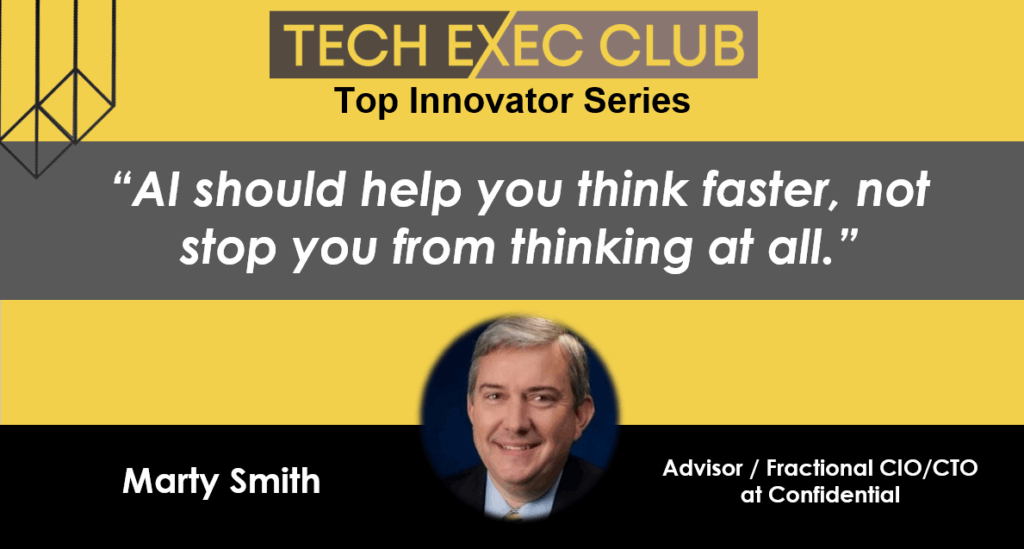
In a world where technology accelerates at breakneck speed, and leadership often equates to pushing metrics and deploying systems, Marty Smith brings a rare and refreshing philosophy to the table—one rooted not in machines but in mindfulness. With a career spanning powerhouse names like Goldman Sachs, LexisNexis, and Home Depot, Marty has held the roles of CIO and CTO across multiple sectors. Yet, when he speaks about success, he doesn’t launch into cloud architecture or software pipelines—he talks about body language, tone of voice, and the art of listening.
In this episode of Top Innovator, host Josef Martens guides us through a deeply insightful conversation with Marty, who now serves as a fractional CIO and CTO and is a prolific writer on leadership. But what makes this conversation truly gripping isn’t just Marty’s resume—it’s the way he turns traditional tech leadership on its head.
He tells disarmingly human stories—like his early days in the restaurant industry, where he first learned that good service isn’t about speed but sensitivity. He shares lessons forged in trial and humility as the time ego and haste led to missteps that reshaped his entire approach. And most poignantly, he opens up about today’s most pressing challenge: navigating the rise of artificial intelligence without losing the very human skills that define outstanding leadership.
As Marty puts it, “Technology should be an enabler—not a crutch.” His clarity on the CIO’s evolving role, his commitment to emotional intelligence, and his sharp awareness of how AI can both empower and endanger creative thinking make this conversation not just timely but vital.
This is more than an interview. It’s a leadership wake-up call. Whether you’re a rising tech executive, a seasoned leader, or someone curious about the future of work, Marty Smith’s insights will challenge your assumptions, spark reflection, and—maybe—transform the way you lead.
Customer-Centric Leadership: The Foundation of Marty’s Success
Before Marty Smith became the tech executive trusted by industry giants, he was learning about human behavior one tip at a time. His career began not in the corridors of corporate strategy but in the fast-paced, emotionally charged environment of restaurant service. There, Marty learned that people don’t just remember what you do—they remember how you make them feel. That early immersion in reading customer cues, decoding body language, and understanding pain points shaped his philosophy forever: leadership is first and foremost about people.
When he transitioned into tech, Marty didn’t leave those lessons behind. He brought them into the digital trenches of software support, where he faced real-time customer issues that couldn’t be deferred or ignored. This role demanded not just technical acumen but emotional clarity—patience under pressure, empathy in the face of frustration, and a deep-rooted desire to resolve problems rather than deflect blame.
One pivotal moment came when the company’s owner, impressed by Marty’s calming influence and problem-solving skills, suddenly reassigned him to lead the development team—after firing the previous head. Marty had never asked for the role. He earned it by being the person customers trusted.
His takeaway? Customer experience isn’t a department. It’s the frontline of leadership. Marty’s customer-centric ethos became his superpower—and it’s one that today’s tech leaders often overlook. In his eyes, coding, architecture, and systems are essential, but the real differentiator is empathy on a large scale.
The Art of Listening and Emotional Intelligence in Leadership
To Marty Smith, leadership isn’t about being the loudest voice in the room—it’s about hearing the ones that aren’t speaking. Emotional intelligence, in his framework, isn’t a soft skill; it’s a survival skill. It means paying attention to what people are saying and, more importantly, what they’re not. A glance, a hesitation, a shift in tone—all of these are data points for the emotionally attuned leader.
Marty has seen firsthand how quickly meetings can spiral when leaders react instead of reflect. He describes a common trap: leaders who talk at each other rather than to each other. This dynamic breeds misalignment, confusion, and sometimes outright conflict. The solution? Slow down. Listen. Confirm understanding before jumping into action.
In emotionally charged moments, Marty takes a deliberate pause—literally. He counts to five. If it’s an email that’s provoked him, he writes a furious reply and then deletes it. The goal isn’t to suppress emotions but to process them privately rather than project them publicly.
In team settings, Marty acts as a facilitator of clarity. He oversees the room—scanning eyes, posture, and silence. If someone looks confused or disengaged, he stops the meeting to realign everyone. This is leadership as emotional choreography. Every participant needs to feel seen, heard, and respected before collective progress is possible.
The brilliance of Marty’s approach lies in its humility. He doesn’t pretend to have all the answers. Instead, he creates space for others to share their truths—because real innovation begins with genuine conversation.
Mistakes, Ego, and the Growth Curve of Leadership
Marty Smith isn’t the kind of leader who tells a polished, ego-driven story. He tells the truth. And one of the most profound truths he shares is how unchecked confidence nearly derailed his trajectory. In an unnamed but pivotal moment in his career, Marty let his own belief in his instincts and team override his usual process of inquiry. A soundbite—a voicemail—triggered him. He reacted fast without gathering context. The result was chaos.
But it wasn’t the chaos that defined him—it was how he responded. Marty didn’t double down or deflect. He analyzed the error, recognized the ego behind it, and changed his behavior. “No matter how big you think you are or how smart,” he reflects, “you still have to pause and get the facts.”
This mistake became a transformative leadership lesson: reacting makes you feel powerful, but reflecting makes you wise.
Marty shifted his strategy. Now, when someone brings a problem to him, his first response is to ask, “What do you think we should do?” This small question does two things. First, it slows down the situation, reducing the chance of emotional escalation. Second, it empowers his team, giving them space to think, act, and grow.
The net effect? Marty’s days are no longer consumed with firefighting. By developing leaders around him instead of commanding them, he creates a system that runs on trust, reflection and shared responsibility.
In a culture obsessed with always knowing, Marty models something more powerful: the strength of saying, “Let’s figure this out—together.”
Leading in the Age of AI: Preserving Human Creativity
We live in an age where artificial intelligence promises speed, efficiency, and solutions at scale—but Marty Smith offers a warning: don’t let AI rob us of our most precious resource—our thinking. As organizations increasingly integrate AI into workflows, Marty sees a subtle, creeping threat to innovation itself. The problem isn’t AI—it’s dependency.
In Marty’s view, AI is a tool, not a replacement for human ingenuity. He uses AI regularly but with surgical precision. When drafting articles, he begins with handwritten notes—his ideas are raw and unfiltered. Only then does he turn to AI for assistance, using it to format, summarize, or refine his work. He describes it as an expert assistant—not a ghostwriter.
But Marty worries about a future where leaders don’t start with ideas—they begin with prompts. “What happens,” he asks, “when the thinking stops altogether?” His concern isn’t theoretical. He sees teams relying on AI to brainstorm, write, strategize—even to decide. The human becomes the afterthought, not the initiator.
Leadership in this new era, Marty argues, must be intentional. It must resist the temptation to automate our creativity. Instead, it must utilize AI to clear mental space for creativity—to remove the friction of menial tasks, allowing the human mind to soar.
His call to action is clear: Don’t just learn to use AI. Learn when not to use it. Preserve the spark. Protect the pause. Because AI can simulate intelligence, but it can’t feel insight. That’s still our domain—and it’s worth fighting for.
Shifting the Role of Tech Executives from Support to Strategic Enablers
If there’s one point where Marty Smith doesn’t pull punches, it’s this: many tech executives are still stuck in the wrong era. They see themselves as support functions—IT troubleshooters, digital firefighters, and system maintainers. Marty says that mindset is not just outdated—it’s dangerous.
Today’s CIO or CTO holds a unique vantage point. Technology touches every function, every department, every strategic priority. The tech leader is often the only one with a holistic view of the organization. But visibility is useless without vision.
Marty challenges tech executives to evolve from “fixers” to “forgers.” That means shifting from a reactive to a proactive approach. It means asking, “How can we use tech to accelerate growth, scale impact, and break through our next ceiling?” He’s particularly focused on those glass ceilings that all organizations hit—resource constraints, market limitations, and stagnating innovation. For Marty, the tech leader is the one who must identify those limits before they become crises—and who must design the runway to overcome them.
Too often, he warns, the default response to constraint is to cut—budgets, people, and ambition. But great leaders invest. “You don’t grow by shrinking,” he says. “You grow by building.” That might mean investing in better systems, processes, or personnel. But it always means leading from the front, not reacting from the rear.
Marty’s advice is seismic but straightforward: stop supporting—start enabling. The future belongs to those who don’t just understand technology—but who know how to turn it into a competitive advantage.
Marty Smith’s leadership playbook isn’t built on trends, titles, or technology—it’s rooted in timeless human truth: leadership is about connection, clarity, and courage. Whether you’re leading a startup or scaling an enterprise, the principles he’s shared are not abstract—they’re immediately actionable.
Here’s how to apply Marty’s wisdom in your role, starting right now:
1. Master the Pause: Create Space Between Stimulus and Response: When tension rises—be it an email, a tough meeting, or a challenge from a colleague—resist the urge to react. Take a breath. Step away if needed. Count to five. Write the angry email, then delete it. Emotional self-regulation is leadership’s secret weapon. The pause gives you power—not to control others, but to control your outcome.
2. Lead by Asking, Not Telling: When a team member brings up a problem, shift from being a solution-giver to a facilitator. Ask, “What do you think we should do?” Invite their ideas, challenge their assumptions, and co-create the solution. You build thinkers, not followers. Empowering others increases ownership, reduces dependency, and strengthens the organization at its core.
3. Watch the Room, Not Just the Numbers: In every meeting, observe facial expressions, posture, and eye contact. If someone’s disengaged or confused—pause. Ask for input. Re-clarify. Leadership is part of psychology. When people feel seen and heard, trust deepens—and execution sharpens.
4. Use AI Intelligently—But Never As a Substitute for Your Brain: Brainstorm offline. Map your thoughts manually. Use AI only to format, polish, or extend—not originate—your work. Tools like ChatGPT and image generators are powerful. But leadership begins in the mind, not the machine. Let AI work for you, not instead of you.
5. Shift Your Role: From Technologist to Business Enabler – Reframe Your Position. Don’t ask, “How do we support the business?” Ask, “How do we accelerate its growth?” The modern CIO/CTO must be strategic. Visibility across all systems means you have the map. Now, it’s your job to navigate—and lead others forward.
6. Invest in Growth—Even When It Feels Risky: Instead of defaulting to cuts during plateaus, analyze what’s missing: talent, tools, and mindset. Spend wisely to break through. You don’t overcome glass ceilings by trimming ambition. You shatter them with courage and investment.
7. Be Public With Your Thinking—Build Intellectual Leadership: Write, share, and contribute your frameworks and leadership philosophies. Post weekly insights on LinkedIn, speak at events, and engage in forums. As Marty demonstrates with his 250+ articles, thought leadership builds influence, attracts collaboration, and sharpens your clarity.
Don’t wait for permission. Don’t wait for the perfect moment. Leadership is forged in decisions made daily—in how you listen, how you pause, how you think, and how you show up for others.
Pick one step. Implement it today. And then watch as your leadership—like Marty’s—becomes a catalyst for transformation.
Marty Smith isn’t your typical technologist. He doesn’t lead with code, credentials, or corporate jargon—he leads with conviction, empathy, and a relentless focus on the human heartbeat of innovation. From his humble beginnings in customer service to becoming a trusted executive voice across global enterprises, Marty has never lost sight of one simple truth: outstanding leadership starts with listening, reflection, and a willingness to evolve.
He’s not only shaping organizations—he’s shaping the conversation about what leadership must become in the age of AI. As a fractional CIO, award-winning tech strategist, and prolific thought leader with over 250 articles to his name, Marty is a voice of clarity in a noisy world.
But perhaps his most profound impact lies not in what he builds—but in how he leads. By challenging tech executives to rise above support roles and step into the realm of strategic enablers, Marty is helping redefine leadership for the 21st century. His insights don’t just speak to the mind—they speak to the mission of every leader who wants to grow, inspire, and make a difference. Marty Smith isn’t just innovating technology—he’s humanizing leadership. And in a world increasingly driven by algorithms, that may be the most radical innovation of all.
Want to hear Marty Smith’s insights firsthand? Watch the full, live podcast interview [click here]