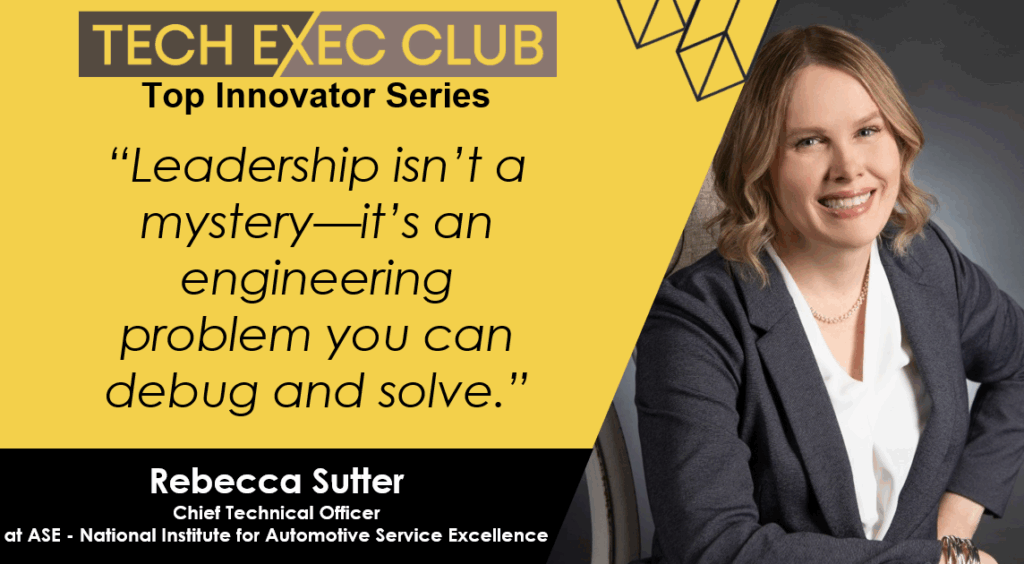
In an industry obsessed with speed, disruption, and automation, Rebecca Sutter is charting a different course—one grounded in empathy, stability, and the irreducible value of human insight. As the CTO of the National Institute of Automotive Service Excellence (ASE), Rebecca’s four-decade career has spanned the inception of the internet, the rise of Linux, and the latest waves of artificial intelligence. Yet, her most compelling innovation might be her pivot into psychotherapy.
In this episode of the Top Innovator Series, host Josef Martens uncovers the fascinating duality at the heart of Rebecca’s leadership philosophy. Once a quiet programmer at the U.S. Navy’s Naval Research Lab, she has evolved into a people-focused technologist who sees every technical challenge as, first and foremost, a people problem. With a degree in psychotherapy and a track record in tech leadership, Rebecca bridges two worlds—showing that the future of IT leadership lies not just in algorithms but in understanding the human beings who use and build them.
From Programmer to People-Centered Technologist
Rebecca Sutter’s journey into tech leadership wasn’t mapped out in a strategic career plan—it began with a curiosity for problem-solving and an unexpected opportunity. In the 1980s, while pursuing her degree in computer science at the University of Maryland, she landed an internship at the U.S. Navy’s Naval Research Lab. She didn’t yet know if IT would become her life’s work, but she was fascinated by its potential. The environment was electric—Unix was gaining traction, the internet was in its infancy, and concepts like parallel computing were still being defined. Rebecca was there for all of it.
As her technical skills developed, so too did her understanding of technology’s broader role in organizations. She was among the earliest adopters of Linux, deploying a CERN web server on version 0.01 in 1991. She later updated to NCSE in 1994 after Netscape’s release. She even registered the now-invaluable three-letter domain, nlc.org, in 1991—a testament to her foresight. But her ambitions gradually shifted. She wasn’t just solving problems with code; she was helping people and organizations solve problems with technology.
Over time, Rebecca acted as a tech ambassador, helping companies bridge the intimidating gap between technical systems and practical business needs. That meant learning the language of business—prompting her to earn a business degree—and sharpening her ability to translate complex systems into tools that executives and front-line employees could use. Her leadership path wasn’t about climbing; it was about connecting. She didn’t set out to lead—but once she began doing so, her impact was unmistakable.
Technology as a Tool for Human Empowerment
Rebecca’s philosophy on technology stands in stark contrast to today’s automation-first mindset. Where some executives chase the latest tech trends to boost efficiency or cut costs, she evaluates new tools through a very different lens: does this technology genuinely help people do their jobs better? Her role as a tech leader isn’t about replacing people—it’s about empowering them.
Too often, she explains, organizations see technology as a way to eliminate the human element. That’s a mistake. “While I’m not a soft, squishy kind of girl constantly encouraging a complete people focus,” she says, “I don’t try to remove people from things pointlessly.” To her, keeping people involved in processes—especially as a control layer—isn’t just about protecting jobs; it’s about ensuring quality, reliability, and resilience.
Rebecca has repeatedly observed how attempts to automate everything can lead to disaster fully. A single flaw in an automated process can scale into a systemic failure. By contrast, a person in the loop brings judgment, adaptability, and accountability—qualities machines don’t possess. In her view, automation should be thoughtful and selective, not blind or sweeping.
This isn’t to say she’s anti-innovation. On the contrary, she enthusiastically embraces new tools—when they’re mature enough to add real value. She’s cautious about hype, mindful of the adoption curve, and always thinking about long-term sustainability. For Rebecca, technology’s highest function is to amplify human potential—not marginalize it. That mindset has kept her grounded through every wave of disruption, from the rise of the web to today’s AI revolution.
Building and Sustaining High-Performing Teams
For Rebecca, great technology starts with excellent teams—and those teams don’t build themselves. In a field known for volatility and turnover, she has made stability and continuity a cornerstone of her leadership. IT departments, she notes, often suffer from high staff turnover, with personnel parachuting in to complete a project before vanishing again. The hidden cost? Lost knowledge, broken momentum, and fragile systems that no one fully understands.
Her approach has been to counter that instability with culture. Rebecca invests in people—deeply and intentionally. She focuses on building psychologically safe environments where team members feel supported and challenged in equal measure. “You learn more from your failures than your successes,” she says, and she means it. That’s why she cultivates a space where calculated risk is encouraged, and failure isn’t punished but mined for insight.
She also believes in tailored growth. There is no one-size-fits-all development plan in her team. Instead, she emphasizes individual growth paths, helping her staff avoid stagnation and find purpose in their roles. From balancing skill levels to navigating personality dynamics, Rebecca’s leadership is hands-on and human-centered.
It’s not just about retention—it’s about elevation. When people feel safe, challenged, and supported, they don’t just stay—they thrive. That’s why many of her team members have stayed with her for years, building systems and relationships that endure. In a sector where change is constant, Rebecca has found a decisive competitive advantage: continuity.
Mentorship, Continuous Learning, and Humility in Tech
If there’s one constant in Rebecca’s career, it’s the relentless pace of change. Technologies morph, best practices evolve, and what was cutting-edge yesterday may be obsolete tomorrow. “There’s no rest for wicked IT leaders,” she jokes. But behind that humor is a powerful truth: in tech, the learning never stops. And that’s something Rebecca has embraced—not just as a necessity, but as a mindset.
From mastering early TCP/IP stacks to adopting agile methodologies across entire organizations, Rebecca has consistently maintained a learning mindset. But she doesn’t just study technology. She also studies people, psychology, and leadership—areas she believes are just as critical for long-term success. As she transitioned from coding to architecture to mentorship, she discovered that listening and curiosity were her most effective tools for success.
One of her key takeaways is the importance of Humility. “Sometimes we have a tendency not to exercise humility,” she says. In IT, where egos and expertise often clash, Rebecca stands out for her willingness to question her assumptions. She doesn’t rush to solutions. Instead, she leads with questions: Why is this a problem? What’s the real issue behind the request? What’s the missing context?
She also avoids the trap of over-specialization. The common advice to “stick to your core” might sound smart, but Rebecca finds it limiting. Growth, she insists, comes from stretching into the uncomfortable, exploring the adjacent and even the seemingly unrelated. That belief has led her to some surprising places—including the world of psychotherapy.
Psychology Meets IT: A Unique Leadership Lens
If Rebecca Sutter’s journey from tech leader to pre-licensed psychotherapist sounds unusual, that’s because it is—few CTOs moonlight as therapists. Fewer still treat it as a critical part of their leadership strategy. But for Rebecca, diving into psychology wasn’t about a career shift—it was about understanding the human engine behind every organizational system.
“I realized all problems are people’s problems,” she explains. So, she set out to understand people better. The result? A degree in psychotherapy, a practice with up to 15 weekly clients, and a radically enriched approach to leadership. Where once she saw technical issues, she now sees psychological dynamics—fear, resistance, communication gaps, and hidden motivations.
This dual lens has transformed her relationship with both her teams and her customers. She no longer views technological change as purely a rollout challenge—it’s also an emotional one. People fear being displaced. They fear not understanding. They fear failing. And unless those fears are addressed, no amount of training or technical wizardry will take hold.
Her background in therapy has helped her defuse those fears, build trust more quickly, and foster a more authentic collaboration. It’s also shaped her leadership philosophy: that innovation comes from combining seemingly disparate fields. “There’s so much growth that comes from trying to combine two different things that seemingly have nothing in common,” she says.
Rebecca Sutter’s hybrid expertise isn’t just impressive—it’s a glimpse into what the future of leadership could look like: deeply technical, deeply human, and unafraid to blend the two.
Rebecca Sutter’s journey offers more than inspiration—it provides a playbook for transformational leadership in tech. Her example encourages IT professionals, executives, and aspiring leaders to rethink how they present themselves, lead, and grow. Here are the actionable insights you can take from her story:
1. Embrace Continuous Learning—Even Outside Your Field: Don’t limit yourself to technical certifications or management theory alone. Rebecca pursued a degree in psychotherapy to understand human behavior better—and it became a leadership superpower. Look beyond the obvious to deepen your leadership lens.
2. Prioritize People Over Processes: Technology is never just about technology. Whether you’re designing systems or implementing change, consider the human impact first. Don’t automate for the sake of efficiency alone—automate to empower.
3. Build Cultures of Psychological Safety: People thrive when they feel secure enough to take risks, fail, and try again. Create environments where experimentation is encouraged, and failure is viewed as a step in the learning process rather than a career-ending mistake.
4. Invest in Team Stability: High turnover costs more than you think. Institutional knowledge, morale, and project continuity all suffer as a result. Support your team with individualized growth paths, honest communication, and balanced workloads.
5. Stay Curious, Stay Humble: Expertise is valuable—but not infallible. Approach every challenge with curiosity. Ask more questions than you answer Humility is your default setting, especially in a world where the pace of change constantly rewrites the rules.
6. Bridge the Tech-Business Divide: Learn to speak the language of business. Tech is most effective when it aligns with organizational goals and customer needs. As Rebecca did, consider expanding your education to understand both sides of the table.
7. Understand and Address Fear: Behind resistance to change is often a fear of being replaced, misunderstood, or left behind. Bring empathy into your change management process. Don’t bulldoze opposition—unpack it.
8. Lead with Questions, Not Just Answers: Before solving a problem, ensure you fully understand it. Ask more profound questions about why something is a problem in the first place. Resist the urge to “fix” before listening.
9. Leverage Innovation by Fusing Disciplines: Innovation doesn’t only come from new technology. Sometimes, it comes from new combinations. Blend your core expertise with something unexpected. That’s where real breakthroughs begin.
Rebecca Sutter’s story is not just about personal evolution—it’s about reshaping what leadership in tech can and should look like. Through decades of navigating the bleeding edge of innovation, she’s never lost sight of the people behind the processes. She has proven that curiosity can coexist with expertise and that leadership isn’t about having all the answers—it’s about asking the right questions.
Her hybrid path—part technologist, part therapist—isn’t a novelty. It’s a model. In a world that often pits efficiency against empathy, she demonstrates how to achieve both integrity and impact. She’s not just coding systems—she’s designing cultures. She’s not just leading teams—she’s cultivating ecosystems.
As organizations navigate digital transformation and the rise of AI, Rebecca’s insights serve as a guiding compass. Her work reminds us that no matter how powerful our tools become, our success will still depend on how well we understand, empower, and connect with people.
Rebecca isn’t just building technology—she’s building a legacy: one conversation, one breakthrough, one team at a time.
Want to hear Rebecca Sutter’s insights firsthand? Watch the full, live podcast interview [click here]