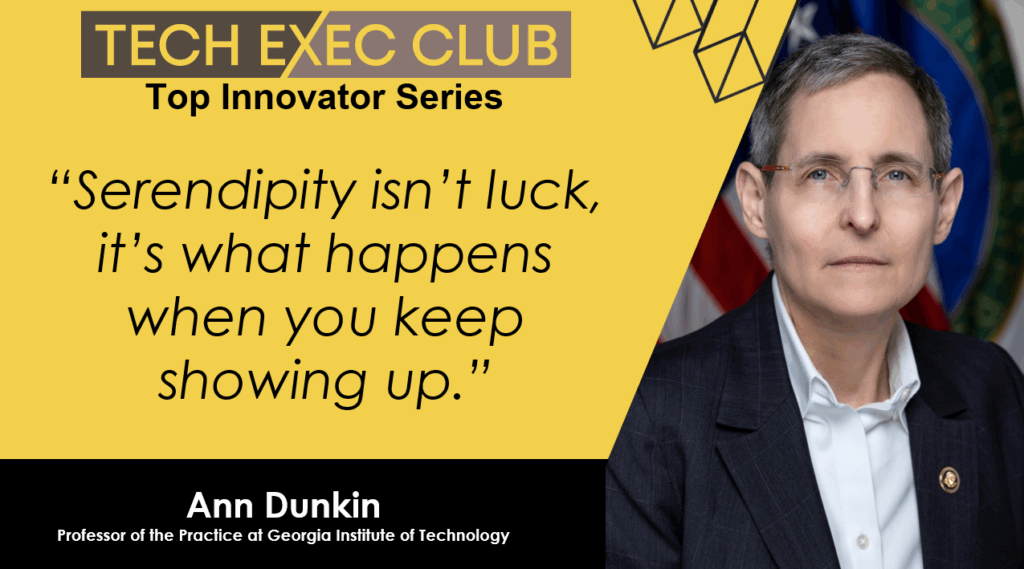
In today’s fast-paced, hyper-connected world, success often stems from being in the right place at the right time. But for Ann Dunkin—former CIO of the U.S. Department of Energy, current professor at the Georgia Institute of Technology, and a veteran of both public and private sector tech leadership—the truth is more nuanced. In this enlightening episode of the Top Innovator series, hosted by Josef Martens, Ann shares the powerful yet underappreciated combination that shaped her career: preparation, bold decision-making, and the willingness to put herself in the path of opportunity.
Ann’s journey began at Hewlett-Packard, where she was deeply influenced by the legendary “HP Way”—a culture that prioritized excellent management, employee happiness, and long-term value creation over short-term gains. That early experience instilled in her a leadership philosophy that continues to guide her: happy people build great things. From there, she went on to hold senior roles in both Silicon Valley and Washington, D.C., helping shape the technological backbone of major institutions.
In the interview, Ann discusses candidly the importance of engineering your luck by meeting people, showing up in the right places, and saying yes to uncomfortable but potentially transformational opportunities. Whether it was pivoting from the private sector to government work after a layoff or investing in a self-funded trip to Davos at a career crossroads, Ann demonstrates how strategic risk-taking and purpose-driven networking can open unimaginable doors.
But it’s not just about bold moves. She also reflects on the quieter, more profound lessons of leadership—like learning when not to give advice, how to empower teams without micromanaging, and the value of saying “no” to the wrong opportunities, even when they’re wrapped in prestige.
This conversation is rich with insight for anyone leading teams, building a career, or simply trying to create meaning through their work. With humility, humor, and clarity, Ann Dunkin reminds us that success isn’t a straight line—and that leadership, when done right, is deeply human.
The Power of Culture: Learning Leadership at Hewlett-Packard
At the heart of Ann Dunkin’s leadership journey lies a robust foundation: culture. Specifically, the culture of Hewlett-Packard in its prime was what insiders affectionately referred to as “The HP Way.” Early in her career, Ann was immersed in an environment that didn’t just talk about leadership; it lived it. She credits that immersion with shaping her views on performance, people management, and the long-term value of investing in employees.
“The HP Way,” as she explains, was rooted in a human-first approach. Founders Bill Hewlett and Dave Packard believed in hiring smart, passionate people, giving them challenging work, and treating them with dignity and trust. The result? Happy employees who built extraordinary products and delighted customers. And only then did profits follow. “They didn’t start with money,” Ann says. “They started with people.”
That model stands in sharp contrast to many modern corporate environments, where revenue is the first—and sometimes only—priority. Ann worries that this reversal of the formula, where profits are pursued at the expense of people, undermines the very ecosystem that sustains great companies. She believes it’s a recipe for employee burnout, lackluster performance, and eventually, customer dissatisfaction.
But her admiration for HP wasn’t blind. She’s candid about the company’s later struggles, particularly in leadership. Still, even in that decline, she credits HP with two gifts: hiring her and then laying her off. That moment of disruption, although painful, became the gateway to new opportunities.
For Ann, leadership begins with culture. It’s about embedding values into the day-to-day practices of an organization. It’s about creating a space where people want to be, grow, and stay. In her view, that’s not just good ethics—it’s innovative business. And it all started for her at HP, where she learned that successful leadership is built not on control, but on a culture that empowers its people.
Making Your Luck: Serendipity Through Action
If there’s one myth Ann Dunkin is quick to dismantle, it’s the idea that luck is passive. “People talk about luck like it’s magic,” she says, “but most of the time, it’s the result of showing up.” Throughout her career, Ann has found herself in extraordinary places—inside the White House, at the top of the tech ranks of major corporations, and speaking on global stages like Davos. None of these happened by accident. They happened because she moved toward possibility, not away from uncertainty.
One of the defining moments of her career came from what seemed like a casual encounter. While organizing an event near the end of her tenure at HP, Ann connected with someone in Washington, D.C. A few years later, that same person remembered her and invited her to submit her resume for a presidential appointment. “And then the White House called,” she recalls, as if even she’s still surprised. But that moment wasn’t just about being remembered—it was about having shown up in the first place.
Ann believes that creating serendipity is a proactive process. It involves speaking at events, attending conferences, and meeting people from various industries and across different borders. In government, she took every opportunity to engage, representing federal agencies, collaborating across departments, and building bridges internationally. “You want to collaborate,” she says, “so people know you, and you know them. Then, when the opportunity comes, you’re the one they call.”
Even after stepping away from federal service, Ann continued to lean into opportunities. One of her first moves after leaving DOE was attending Davos—on her dime, with no full-time employer. It was a bold, expensive bet on herself. And it paid off. Once word got out she was attending, her calendar filled with speaking engagements and introductions that turned into long-term partnerships.
At every step, Ann emphasizes that you can’t wait for luck to find you; you have to go out and make it happen. You have to be out in the world, engaging. Her advice to professionals and leaders? Ask for the meeting. Say yes to the invite. Talk to strangers. “Most people will say yes if you ask,” she insists. And often, that’s where the magic begins.
Bold Decisions and Risk-Taking: Leaving Safe Jobs for Bigger Impact
Leaving a company like Hewlett-Packard during the Great Recession sounds like a nightmare scenario. For Ann Dunkin, it was the break she didn’t know she needed. “The best thing HP ever did for me,” she says, “was hire me. The second-best thing was to lay me off.” That jolt forced her out of her comfort zone. It launched her into an entirely new chapter—one that led to a CIO role in public education, then to the Environmental Protection Agency, and eventually to the Department of Energy.
What made this pivot extraordinary was not just the shift from private to public sector, but the mindset that powered it. Ann had spent years in a company that promised lifetime employment, where everyone she knew worked for the same brand. “We were very insular,” she admits. But with that security gone, she saw possibility instead of panic. It was a bold move—and it opened doors she didn’t know existed.
That same spirit of audacity resurfaced when she decided to attend the Davos meeting. With no stable income and no clear business pipeline, she made a significant financial commitment to attend one of the world’s most exclusive events. Why? Because someone invited her, and because she knew that significant outcomes require bold investments. “I had no clients yet,” she says, “but I filled my schedule and followed up for months.”
She encourages others to lean into discomfort. One of her go-to pieces of advice: if you’re too comfortable, you’re probably in the wrong job. Growth, she argues, happens when you take the position that stretches you, not the one that pampers you. That could mean changing industries, taking a lower title to gain experience in a new domain, or chasing a mission rather than a paycheck.
Ann is quick to differentiate between calculated risk and recklessness. She’s not advocating for blind leaps. But she does believe in betting on yourself—even when the path ahead isn’t perfectly paved. Her journey proves that sometimes, the safest move is to make the boldest one.
Evolving Leadership: From Advice-Giver to Empowerer
Ann Dunkin’s leadership evolution didn’t come from books—it came from experience, feedback, and the occasional hard truth. One of the most memorable lessons came not from a mentor, but from a frustrated employee. Early in her career, as a young manager in her 20s, she offered unsolicited advice to a more senior colleague. His blunt response: “I didn’t ask for advice.” At the time, she was taken aback. In hindsight, it became one of her most powerful takeaways.
That moment shifted how she viewed leadership. Rather than assume that every problem needs her input, Ann began asking, “Do you need help with that?” It’s a subtle but profound shift—from directing to supporting. Her mantra became: let people run with what they’ve got, and only step in to clear real roadblocks. “At HP, we called it ‘carry water and move boulders,'” she recalls.
The idea of empowering rather than micromanaging gained deeper roots over the years. She recounts the story of Ignacio, a talented team member whom she promoted to a management position. At first, he constantly sought permission for every decision. But after a two-week vacation where he acted independently, she told him, “Just do it.” That’s when it clicked—for both of them. Trust, autonomy, and ownership are the cornerstones of her leadership style.
Ann refers to a model (possibly inspired by situational leadership) that she learned from a former boss. It tracks a leader’s evolution from telling people what to do, to guiding them, then letting them act, and finally, having them inform you after the fact. “It’s about matching your leadership style to where that person is, and helping them grow into their full independence.”
In today’s fast-moving, complex work environments, Ann’s leadership model feels especially relevant. She doesn’t believe in solving problems people can solve on their own. She believes in coaching, guiding, and then stepping back. In her view, great leaders don’t create dependency—they build confidence.
What Leaders Still Get Wrong: Ignoring People and Culture
Despite decades of progress in leadership theory and workplace innovation, Ann Dunkin sees a growing blind spot: people. Specifically, she’s alarmed by the rise of unapologetically toxic workplace cultures—especially in the tech sector. “There are companies now openly saying, ‘We don’t care about work-life balance. We don’t care about you,” she says. “And the worst part is, they’re proud of it.”
Ann has spent time in both Silicon Valley and the federal government, and she knows what good culture looks like. To her, the current glorification of hustle culture, where people are overworked, underappreciated, and expendable, is not just inhumane—it’s counterproductive. “You get your best work from people who are happy,” she insists.
It’s not just about free lunches and perks. It’s about fundamental human needs: the ability to go home at a reasonable hour, to take vacation without guilt, to feel psychologically safe, and to be paid fairly. She argues that companies ignoring these fundamentals will suffer, not just in terms of retention, but also in performance and innovation.
The data backs her up. Employees don’t leave jobs—they leave bad bosses and bad cultures. And in Ann’s experience, it’s the leaders who forget they’re managing people—not machines—who create the most dysfunction. “Culture makes or breaks leadership,” she says. “If you don’t build it intentionally, it will grow wild—and probably toxic.”
Ann’s message to today’s leaders is urgent but straightforward: invest in people. Build environments where employees thrive, not just survive. And remember that long-term value comes not from extracting labor, but from empowering it.
1. Invest in Culture First—Always: Like HP’s founding principles, start with people, not profits. Hire smart, curious people and give them meaningful work. Prioritize psychological safety, mutual respect, and team development. Design leadership programs that encourage collaboration, not control. Remember: Happy people do exceptional work—and that’s how lasting value is created.
2. Engineer Your Luck: Luck isn’t random; it’s built through visibility and participation. Attend events, conferences, and professional forums—even if there is no immediate ROI. Speak publicly about your work and engage with cross-sector stakeholders to promote your expertise and foster collaboration. Follow up with people you meet. Connections don’t self-sustain—relationships require effort and maintenance. Don’t wait to be discovered. Put yourself in the places where opportunity can find you.
3. Make Bold, Discomforting Moves: “Don’t get too comfortable”—comfort can be a career killer. If you’re in a role that feels too easy, it might be time to move on. Take roles that challenge you—even if you’re scared. Be willing to bet on yourself, financially or otherwise, when the stakes feel high but the growth is real. Evaluate opportunities based on stretch potential, not just titles or compensation.
4. Shift from Problem-Solving to Empowering: Great leaders don’t solve every problem—they create problem-solvers. Ask your team, “Do you need help with that?” instead of offering unsolicited advice. Give space for independent action and decision-making. Use task-appropriate leadership: direct when necessary, step back when trust is earned. Encourage employees to take ownership of outcomes, rather than just executing instructions.
5. Nurture Your Network—Proactively: Most people will say yes. Just ask. Reach out through LinkedIn, email, or a mutual contact. Be clear, specific, and respectful. Schedule regular networking activities—not just when you’re in transition. Offer value: share insights, connect others, or invite someone to share their thoughts. Build bridges across sectors—you never know where your next opportunity will come from.
6. Say “No” to the Wrong Things: Not every exciting offer is the right one. Evaluate every opportunity against your values, energy, and long-term goals. If it doesn’t align with your mission, it’s okay to decline—even if it looks impressive on paper. Avoid overcommitting out of fear or obligation. Burnout limits your ability to lead.
7. Protect Work-Life Balance—For Yourself and Your Team: Toxic, grind-it-out cultures are unsustainable and ineffective. Reject environments that glorify exhaustion and ignore humanity. Create structures that support real-time off, flexible schedules, and healthy boundaries. Understand that balance isn’t laziness—it’s fuel for innovation and resilience. Build a culture where people are excited to come to work and look forward to going home.
Ann Dunkin is more than a seasoned technologist or a high-profile leader—she is a living blueprint for what modern leadership can look like when it’s rooted in humanity, courage, and intentionality. From the culture-driven ethos of Hewlett-Packard to the geopolitical power corridors of Davos, her journey is a masterclass in how preparation, empathy, and boldness converge to shape real impact.
She doesn’t just talk about leadership—she embodies it. She doesn’t chase titles—she chases purpose. And perhaps most importantly, she doesn’t wait for the stars to align—she engineers her luck through relationships, risk-taking, and relentless presence.
Throughout our conversation, Ann reminded us that leadership is not just about decisions made in boardrooms or directives handed down from on high. It’s about how you show up, how you treat people, and how bravely you lean into discomfort when growth is on the line. It’s about knowing when to speak up, when to step back, and when to leap into something new—uncomfortable, unfamiliar, but full of possibility.
If you’re a leader today, or on the path to becoming one, her story is a call to step up—not just in ambition, but in awareness. Lead with heart. Show up with integrity. And never forget that behind every innovation, every transformation, and every headline-worthy success, there is a human story—and that story, like Ann’s, begins with intention.
The world doesn’t need more bosses. It requires more leaders like Ann Dunkin.
Want to hear Ann Dunkin’s insights firsthand? Watch the full, live podcast interview [click here]