What if the secret to decisive leadership isn’t about being the most liked but about being the most honest — with yourself and others?
In a world saturated with quick-fix leadership hacks and hollow motivational quotes, Murli Buluswar cuts through the noise with a quiet authority rooted in reflection, experience, and razor-sharp clarity. As the Head of Analytics at Citi’s U.S. Personal Banking division, Murli isn’t just pushing numbers — he’s redefining what it means to lead with purpose in an era of constant transformation.
In this candid and deeply thoughtful conversation with innovation expert Josef Martens, Murli opens up about his unconventional approach to leadership — one built not on seismic shifts but on subtle and deliberate evolution. He shares why he’s “almost allergic to the word ‘change,'” why being liked used to limit his effectiveness, and how self-doubt, far from being a weakness, became one of his most powerful growth tools.
From childhood lessons in emotional intelligence to steering a Fortune 100 company through the early waves of AI transformation, Murli doesn’t preach leadership — he lives it. In this conversation, he reveals the principles, failures, philosophies, and micro-decisions that have shaped the leader he is today.
Evolving, Not Changing: The Power of Incremental Growth
If you’re expecting Murli Buluswar to talk about dramatic transformations or seismic shifts in leadership style, think again. “I’m almost allergic to the word ‘change,'” he says, with the kind of calm certainty that only comes from years of reflecting deeply on what truly works. For Murli, growth doesn’t happen in thunderclaps. It occurs in quiet, deliberate increments — a philosophy that’s as radical as it is refreshing.
Where most leadership playbooks emphasize urgency, disruption, and breaking norms, Murli invites us to consider a gentler, more sustainable path: evolution by degrees. This approach, he explains, honors the present while embracing the future. It doesn’t reject where you are — it builds on it. “Every experience, every meaningful interaction is an opportunity to reflect on how we choose to evolve,” he says.
That word — “choose” — is key. Murli believes in the agency. He doesn’t push people to “get out of their comfort zone” with force. Instead, he helps them visualize what growth could look like, why it matters, and how to step into it with intention. It’s not about fixing people. It’s about supporting them in becoming who they already have the potential to be.
This philosophy doesn’t mean Murli avoids change. On the contrary — he leads transformation in one of the world’s most complex industries. But his lens is longer. He’s not chasing quarterly optics; he’s cultivating long-term adaptability. He wants his teams to grow not because they’re afraid but because they’re inspired.
In a world obsessed with overnight success and disruptive innovation, Murli’s philosophy is a quiet revolution: lead people with respect, give them time, offer them purpose — and watch how powerfully they grow.
Autonomy, Mastery, and Purpose: The Triad of True Leadership
For Murli Buluswar, leadership isn’t about control — it’s about creating the conditions where people can thrive. One of his foundational influences is Daniel Pink’s “Drive,” which argues that high-performing teams are built not on micromanagement or rigid rules but on three timeless motivators: autonomy, mastery, and purpose. These three pillars don’t just inspire Murli’s leadership — they permeate every environment he shapes.
Autonomy, he explains, is about giving people space — not just physically, but cognitively. It’s about trusting team members to make wise decisions, even when no one is looking. “Give people breathing room,” he says, “so they have some freedom to make the choices to be most effective.” Autonomy fuels creativity. It breeds ownership. And in an analytics-driven, high-pressure world like banking, that trust becomes a competitive edge.
Mastery, meanwhile, speaks to our intrinsic desire to improve — to learn, to grow, to evolve. Murli believes deeply in nurturing this growth. He doesn’t just want employees to clock in and execute. He wants them to feel like they’re building something — including themselves. “Help people be part of something where they’re learning and growing,” he says, “because that builds confidence and relevance.”
But perhaps most importantly, purpose — the sense of contributing to something bigger — serves as the connective tissue that binds us. Without it, autonomy feels aimless, and mastery feels self-serving. Purpose galvanizes. It transforms a group of individuals into a team. It gives everyone a stake in a shared mission. And Murli is clear: this is not optional. It’s vital.
These three elements — autonomy, mastery, and purpose — are not theories for Murli. They’re filters through which he leads, mentors, and designs organizational culture. They shape his hiring practices, his performance evaluations, and his innovation strategies. If a leader’s job is to unleash potential, this triad is Murli’s trusted roadmap.
The Danger of Wanting to Be Liked
Murli Buluswar has a confession. For much of his career, he wanted to be liked — maybe too much. And while that made him agreeable and pleasant, it also made him less effective. “Wanting to be liked is overrated,” he says now, without hesitation. That hard-won truth reshaped his entire leadership identity.
Murli learned that when likeability becomes a goal, it quietly compromises your ability to lead. You soften the truth. You avoid conflict. You hold back when you should step forward. And in trying to maintain harmony, you lose clarity. “The desire to be agreeable creates distance between what you believe to be the truth and how you interact with the world around you,” he reflects.
However, Murli is not advocating for abrasive leadership. Quite the opposite. He draws a nuanced and powerful distinction: there is a difference between task conflict and interpersonal conflict. The first — disagreements about ideas, strategies, and execution — are not only healthy but necessary. It’s where innovation lives. The second — rooted in mistrust or ego — is where organizations break down.
Once Murli embraced that truth, everything shifted. He became more assertive, more honest, and more courageous. And paradoxically, by letting go of his need to be liked, he became more respected — and, yes, even more likable. “I want to be trusted for my human values and honored for my competence,” he says. “Being liked is an outcome, not a goal.”
This mindset doesn’t just help Murli lead better — it helps him live better. It frees him to show up fully, speak candidly, and make decisions based on impact, not approval. And in a world where too many leaders chase applause, Murli is quietly chasing something far rarer: truth.
The Second Arrow: Emotional Self-Management as Leadership
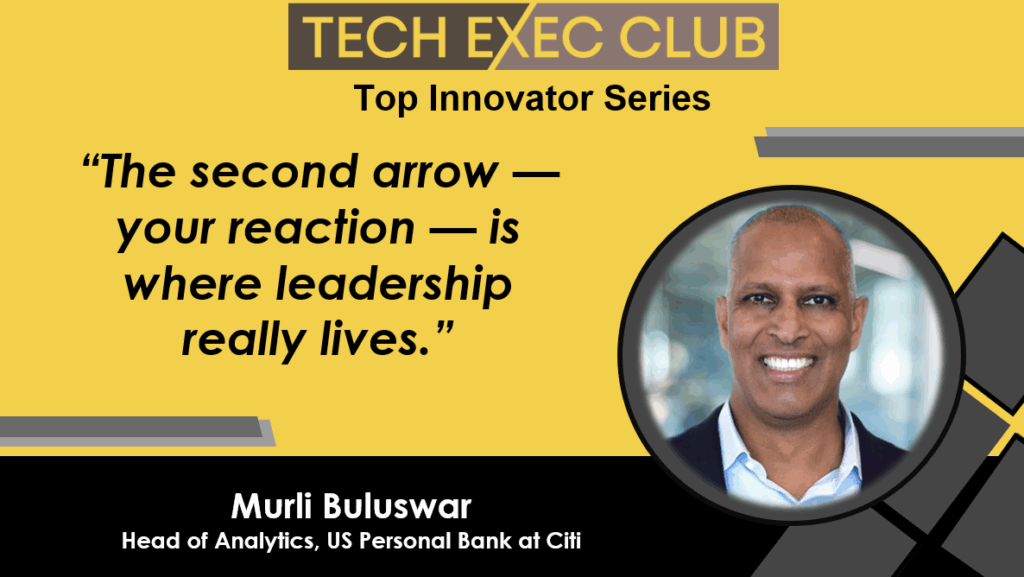
Murli Buluswar’s leadership toolkit includes data science, strategic thinking — and Buddhist philosophy. One of the most transformative ideas he draws from is the “second arrow” principle. The first arrow is what happens to us — an insult, a setback, a disruption. The second arrow is how we choose to respond. And that, Murli believes, is where authentic leadership begins.
You can’t always control the first arrow. Life — and leadership — will throw challenges your way. People will misunderstand you. Projects will derail. Situations will sting. But the second arrow? That’s yours. It’s your mindset. Your reaction. Your choice.
Murli utilizes this concept to develop emotional intelligence — not just in himself but also in his teams. He teaches people to pause, reflect, and observe rather than react. “Do we let the event guide our reaction?” he asks, “Or do we own that agency and respond with intention?” The difference, he says, isn’t just philosophical. It’s physiological. “If I’m reacting without thought, my pulse is probably spiking,” he jokes. “But if I’m centered, it’s steady — even in turbulence.”
This kind of composure is not about detachment. It’s about clarity. It’s about showing up for your team not as a volatile reactor but as a calm presence — one that can absorb complexity, reframe adversity, and model self-leadership. Murli imagines a future version of himself whose pulse rarely fluctuates — not because he doesn’t care, but because he cares deliberately.
In today’s volatile business landscape, emotional regulation is not a luxury. It’s a superpower. Murli’s commitment to mastering the second arrow is proof that the best leaders lead not just with vision — but with emotional discipline.
From Self-Doubt to Self-Belief: The Real Inner Work of a Leader
With his impressive resume — Chief Science Officer at AIG, VP of Innovation at Farmers Insurance, and now Head of Analytics at Citi — you’d think Murli Buluswar was always confident in his role. But he reveals something much more vulnerable — and much more real. “There was a lingering doubt in my mind as to whether I was worthy of that role,” he confesses, reflecting on the early days of his executive journey.
It’s a sentiment many leaders share, but few admit. Murli had the intellect, the strategy, the skill. However, self-belief — the inner conviction that he belonged in the room — didn’t always align with his outer accomplishments. “The best that somebody will see in you is the worst that you see in yourself,” he says. That insight became a turning point.
Instead of waiting for validation from others, Murli began cultivating it within. He started asking: What do I want to see in the mirror? Who do I want to become? This wasn’t about ego. It was about alignment. If others were going to trust him, he had to trust himself first.
Letting go of his need to be liked was part of this transformation. So was reframing self-doubt as a healthy signal — not something to suppress, but something to manage. “It’s healthy to have that self-doubt,” he says. “It’s how you handle it that shapes you.” Over time, that self-management turned into self-mastery.
Today, Murli stands as a testament to what leadership requires: not just vision but inner clarity. Not just skills, but self-work. Not just achievements but alignment between who you are and who you choose to be.
Whether you’re an executive, team leader, entrepreneur, or emerging professional, here’s how you can immediately begin to integrate Murli’s leadership wisdom into your path:
1. Reframe “Change” as “Evolution”: Stop viewing transformation as a black-and-white issue. Start asking: What’s the next small step in my growth? Create a 12–24 month vision for yourself or your team that’s aspirational yet grounded. Honor where you are today while deliberately stepping toward who you want to become.
2. Design Teams Around Autonomy, Mastery, and Purpose: Use this triad as a compass for hiring, providing feedback, fostering culture, and enhancing retention.
- Autonomy: Give people real decision-making power within their roles.
- Mastery: Invest in their development — training, mentoring, and stretch projects.
- Purpose: Articulate a mission that connects everyone’s work to something greater than themselves.
3. Trade Likeability for Authenticity: Recognize when your desire to be liked compromises your effectiveness. Prioritize clarity over comfort—challenge constructively, even when it’s hard. Differentiate between task conflict (productive) and interpersonal conflict (destructive). Lead with values and competence — and let likeability be the outcome, not the goal.
4. Master the Second Arrow: When something upsets you, pause. Don’t react out of habit. Ask: What’s the first arrow (external event)? What is my second arrow (reaction)? Choose your response deliberately, based on your values and long-term outcomes—practice calm, centered decision-making, especially under pressure.
5. Cultivate Inner Confidence — Daily: Identify your self-doubt triggers — and work with them, not against them. Use Murli’s mirror question: Do I see in myself the version I want others to experience? Build rituals that reinforce your self-belief, such as reflection, journaling, and intentional affirmations. Accept that self-doubt is natural — but let self-management be your differentiator.
6. Test Ideas Through Mountain, Monastery, and Metropolis: Use this model to navigate organizational innovation and drive culture-wide change
- Mountain: Reflect on your idea privately. Tear it apart. Be your harshest critic.
- Monastery: Share with a small group of trusted, candid advisors.
- Metropolis: Take it public — only once it’s resilient enough to handle resistance, criticism, and adaptation.
In an age where leadership is too often reduced to buzzwords and bravado, Murli Buluswar stands as a refreshing counterpoint — reflective, intentional, and quietly radical.
He doesn’t shout to be heard. He doesn’t posture to be seen. Instead, he embodies what authentic leadership looks like: the courage to evolve, the humility to question, and the wisdom to guide others through complexity with clarity and care.
Whether he’s leading data-driven innovation at Citi, shaping culture through his leadership philosophy, or mentoring future changemakers, Murli is not chasing titles — he’s cultivating transformation. Inside himself. Inside organizations. Inside people.
His message isn’t loud — but it’s unforgettable. You don’t need to be perfect to be a leader. You don’t need to be liked. You need to be honest, curious, and deeply committed to the journey — both yours and everyone else’s. Because, in the end, that’s what leadership is: not a destination but a deliberate, daily act of becoming.
Want to hear Murli Buluswar’s insights firsthand? Watch the full, live podcast interview [click here]